The Big Picture
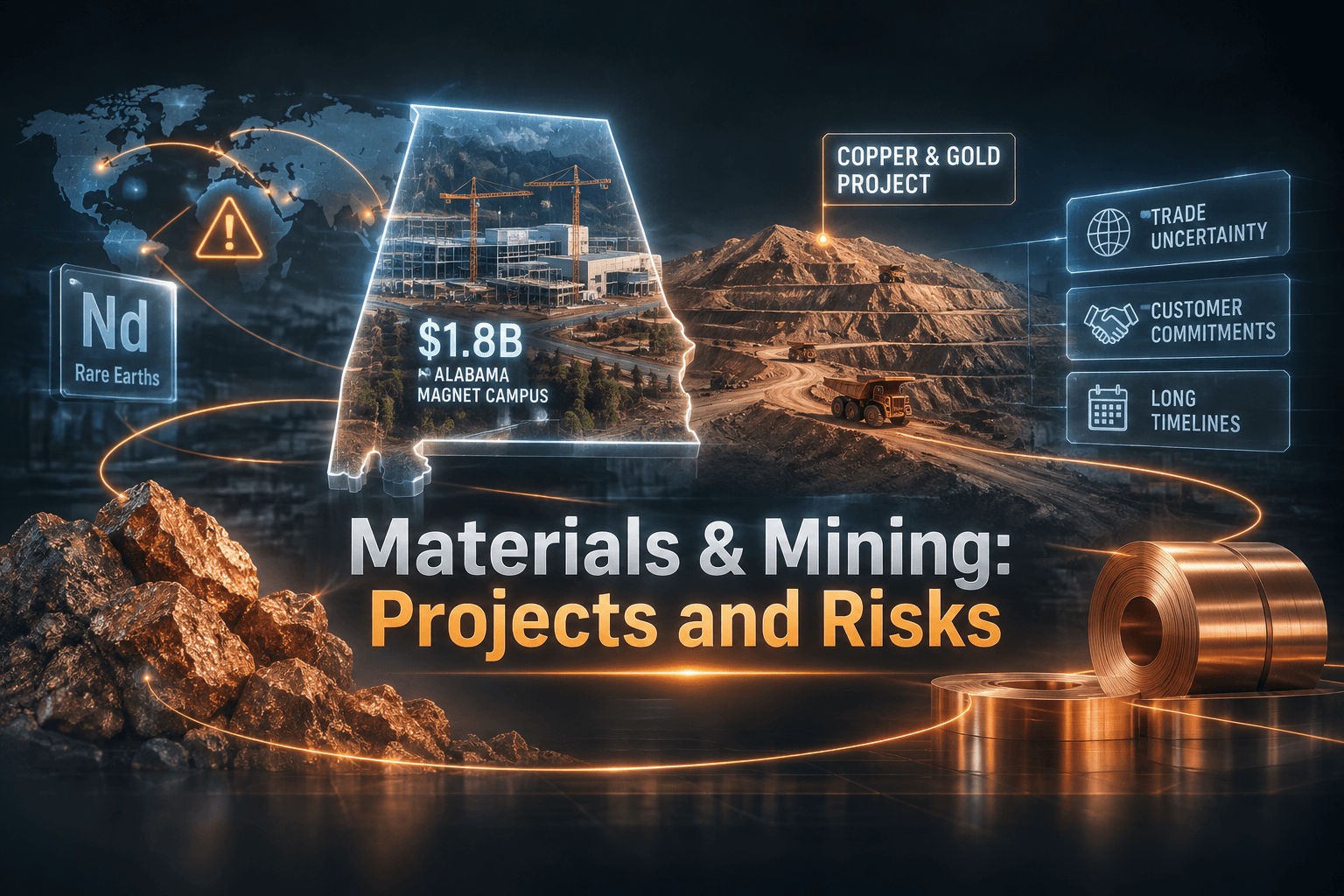
Materials and mining companies are advancing projects, but today’s headlines also ask a tougher question: can new capacity find customers and overcome supply-chain dependence? Niron Magnetics plans a $1.8 billion magnet manufacturing campus in Alabama, while Copper One and Newcore Gold reported steps tied to projects in Canada and Ghana.
Those developments come alongside renewed attention to rare-earth exports and the time required to build mines, processors and manufacturers. For you, the takeaway is a sector with potential capacity growth, but meaningful execution and demand questions remain. The stories provide no share-price changes or verified ticker symbols, so there is no reported pre-market move to cite.
Market Highlights
The day’s updates span upstream exploration and downstream manufacturing. They don’t include company earnings, production forecasts or financing terms, making it difficult to assess near-term revenue or valuation effects from the announcements alone.
- Niron Magnetics plans a $1.8 billion advanced magnet manufacturing campus in Dothan, Alabama.
- Copper One Resources signed an option agreement to acquire a 100% stake in the Quatum Copper Project in British Columbia.
- Newcore Gold submitted a mining lease application covering 53.37 square kilometres of its 248-square-kilometre Enchi project, about 21.5% of the total area.
- U.S.-China discussions have put rare-earth export licensing and the timing of material shipments back in focus.
No percentage moves or stock prices were included in the reports. That means today’s developments are best viewed as project and policy signals, not evidence of an immediate change in company performance.
Key Developments
Niron’s Alabama campus puts demand in the spotlight
Niron Magnetics is set to build an advanced magnet manufacturing campus in Dothan, southeast Alabama, with a reported investment of $1.8 billion. The project points to continuing efforts to expand U.S. manufacturing capacity for magnets, materials important to several industrial supply chains.
However, a large announced facility is not the same as proven sales or operating output. A separate InvestorNews commentary asks how much U.S. demand exists for magnets bought as finished products, which customers have committed to purchases, and what share of production has been qualified. Those details matter because capacity only translates into durable business if products meet specifications and can compete on delivered cost.
Rare-earth policy meets the realities of supply chains
A report on talks involving U.S. President Donald Trump and China’s President Xi Jinping says rare-earth export licences were part of a pointed exchange. U.S. Trade Representative Jamieson Greer described China as acknowledging the need to respond to American requests, while the report says Washington had not secured a further extension of the trade truce in Shenzhen. Any extension beyond January is described as depending in large part on the volume and speed of material shipments.
This leaves policy and actual deliveries as separate things to track. A dialogue or licensing response may affect supply expectations, but the reports don’t establish how much material will arrive or when. Melissa Sanderson of the Critical Minerals Institute also emphasized that building mines, processing facilities and magnet makers takes time, reinforcing that supply-chain independence cannot be achieved quickly.
Canadian copper and Ghanaian gold projects advance
Copper One Resources has signed an option agreement to acquire a 100% stake in the Quatum Copper Project northeast of Campbell River, British Columbia. The announcement is an acquisition step, not confirmation that the project has been acquired outright or will proceed to production; the report provides no terms, schedule or resource figures.
Newcore Gold has submitted a mining lease application for its Enchi Gold Project in Ghana. The application covers 53.37 square kilometres of the project’s 248-square-kilometre area. It marks a permitting milestone, but the report does not provide a decision date, development budget or production outlook. For both projects, you’ll want to distinguish progress through a process from approvals, construction and eventual output.
What to Watch
For Niron, the key questions are how construction will be funded and scheduled, what products the campus will make, and whether customers have signed purchase commitments. Watch for disclosed capacity, qualification progress, expected operating dates and cost comparisons. Without those figures, the $1.8 billion headline describes the scale of the plan, not its commercial returns.
On rare earths, monitor updates on export licences, shipments and the status of the trade arrangement ahead of January. The reports don’t quantify supply or confirm a resolution, so policy statements should be weighed against evidence of material actually reaching buyers.
For Copper One and Newcore Gold, look for further details on the option agreement and mining lease application, including terms, regulatory steps and project timelines. Broader market data, company filings and any available price movements may help investors assess how the news is being received during today’s trading session.
Bottom Line
- Materials and mining news is mixed: project advances and planned capacity sit alongside demand and supply-chain uncertainties.
- Niron’s $1.8 billion campus is a major manufacturing announcement, but customer commitments, qualification and costs remain central questions.
- Rare-earth licensing and shipment details may matter more than broad diplomatic signals for near-term supply visibility.
- Copper One’s option agreement and Newcore’s lease application are milestones, not confirmation of production.
- Use company disclosures and verified market data to assess developments; this summary is informational and not investment advice.
FAQ
Q: What is the largest investment announcement today? A: Niron Magnetics plans a $1.8 billion advanced magnet manufacturing campus in Alabama.
Q: Does Newcore’s lease application cover its full Enchi project? A: No. It covers 53.37 square kilometres of the project’s 248 square kilometres, approximately 21.5%.
Q: Has the rare-earth supply issue been resolved? A: The reports describe discussions and export-licensing concerns, but don’t confirm a resolution or quantify shipments.