The Big Picture
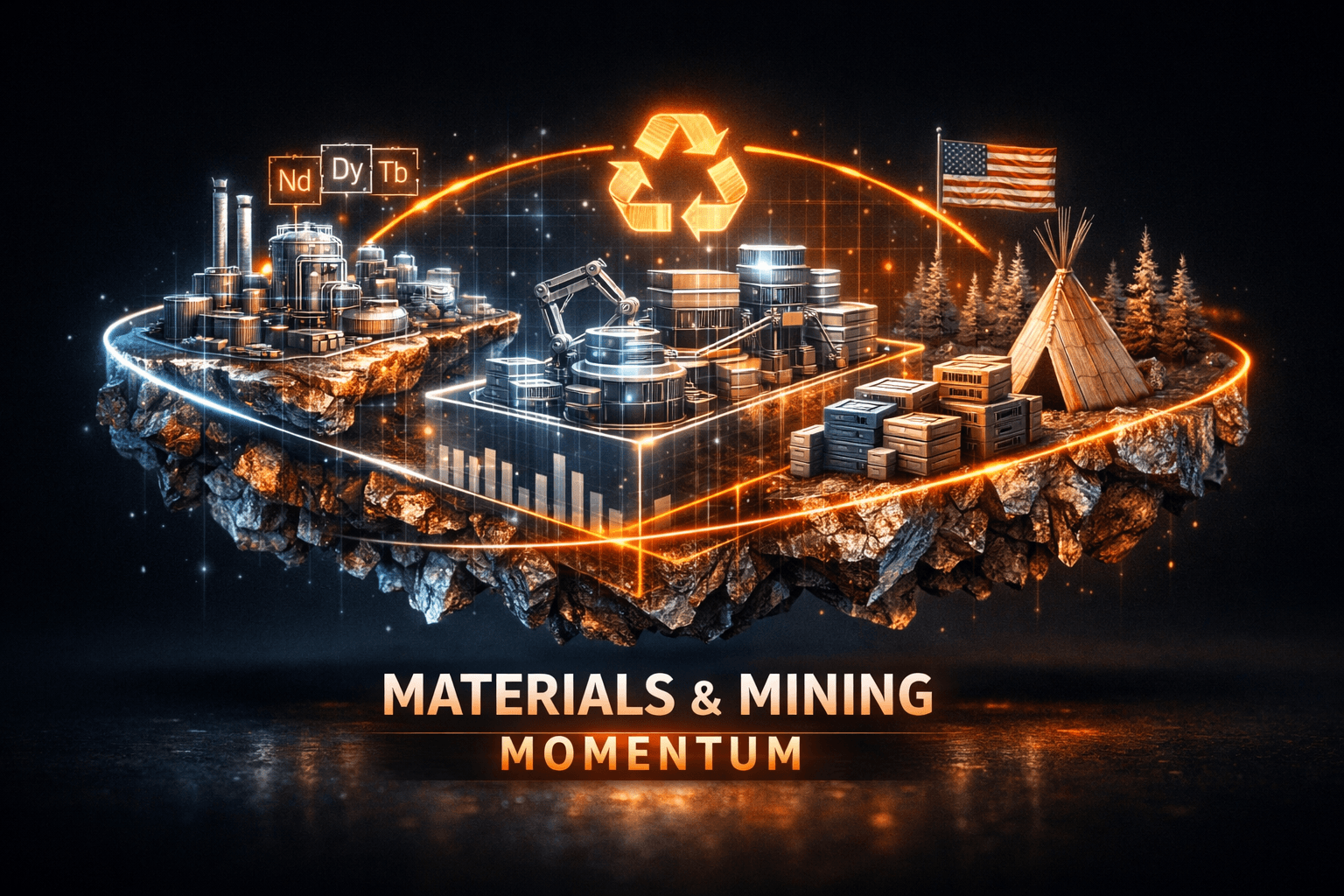
Energy Fuels’ start of construction at the White Mesa Mill expansion is the day’s most consequential development, signaling tangible progress in U.S. rare earth processing capacity. That move, together with fresh private funding for recycling technologies and federal grants to tribal recycling projects, underscores a clear theme: capital and policy are aligning to onshore critical material processing and improve waste-to-resource pathways.
This matters because you’re watching a market where supply-chain security and downstream processing capability are becoming as valuable as resource ownership. With Washington continuing to prioritize domestic capacity, the sector is shifting from exploration headlines to industrial-scale buildouts and commercialization.
Market Highlights
The day brought a mix of project milestones, capital raises and policy funding that investors should note.
- Energy Fuels, $UUUU, began construction to expand White Mesa Mill in Utah, aiming to add commercial-scale heavy rare earth oxide production.
- FAST Metals raised $4.3 million in pre-seed funding to advance red mud mineral recovery, highlighting investment into secondary feedstocks.
- EPA announced over $11.5 million in Solid Waste Infrastructure for Recycling grants to nine tribal entities in Alaska, Idaho and Washington.
- Republic Services, $RSG, released its 2025 sustainability report, noting $973 million in sustainability investments, reinforcing the sector’s CAPEX toward circularity.
- Investor commentary emphasized domestic downstream capabilities, citing $FCX for combining large-scale mining with U.S. processing as a growing competitive advantage.
Key Developments
Energy Fuels moves to commercialize heavy rare earths
Energy Fuels has started construction on the White Mesa Mill expansion to add commercial-scale heavy rare earth oxide production. The project moves a major U.S. rare-earth processor closer to delivering separated products and downstream materials needed for magnets and advanced components.
For you, that means a shift in how market participants value companies that can both mine and process complex feedstocks, because integrated capability reduces reliance on foreign processors and shortens supply chains.
Recycling and secondary feedstock innovation accelerates
FAST Metals secured $4.3 million to scale recovery of base and rare materials from red mud, a byproduct of alumina refining. At the same time, the EPA committed more than $11.5 million in recycling grants to tribal entities, and Republic Services highlighted nearly $1 billion in sustainability investments.
These items show both private and public capital flowing into circular economy solutions, which could ease raw-material pressures and create new domestic feedstocks. Who stands to benefit from improved feedstock economics?
Policy, analysis and M&A echoes
The Critical Minerals Institute announced an August masterclass titled Playing the American Trump Card, reflecting growing policy and investor interest in U.S. critical-mineral strategy. Opinion pieces also flagged companies that add value downstream, and a note on American copper producers highlighted $FCX’s integrated profile.
On the M&A front, Allied Gold and Zijin Gold ended their arrangement agreement, a reminder that cross-border deals remain fragile. That termination draws attention to geopolitical and regulatory risks in international consolidations.
What to Watch
Look ahead to catalysts that will shape momentum and risk into August. You’ll want to monitor project timelines, permitting updates, and commercialization milestones closely.
- White Mesa rollout: watch construction progress, permitting milestones and any production guidance from Energy Fuels, $UUUU, for signs of timeline adherence.
- Technology scale signals: FAST Metals’ pilot results, partnerships, or follow-on funding rounds will indicate whether red mud can become a competitive feedstock.
- Policy events: the CMI masterclass and related Washington activity could produce clearer signals on grants, tax treatment, or procurement that affect domestic processors.
- Recycling rollouts: track EPA grant recipients for early project metrics and Republic Services, $RSG, for operational deployment of funded programs.
- Commodity and macro risks: rare-earth prices, copper demand, and global trade policy remain primary variables that can move valuations quickly.
Got questions about timing or risk? Keep an eye on corporate releases and official permitting notices, because those will give you concrete dates rather than market noise.
Bottom Line
- Capital and policy are converging on U.S. processing and recycling capacity, shifting the sector from resource discovery to industrialization.
- Energy Fuels’ White Mesa expansion is a tangible step toward domestic heavy rare-earth production, reinforcing the value of downstream capability.
- Private funding for recovery tech and nearly $12 million in federal recycling grants show diversified sources of support for circular-economy projects.
- Deal failures, such as the Allied Gold/Zijin termination, remind you that geopolitical and regulatory risks still matter for cross-border consolidation.
- This coverage is informational only, analysts note that data suggests momentum, but you should monitor execution, policy updates and commodity trends before drawing conclusions.
FAQ Section
Q: What does the White Mesa expansion mean for the rare-earth supply chain? A: It signals increased domestic processing capacity for heavy rare earth oxides, which can reduce reliance on foreign separation facilities and shorten supply chains.
Q: How significant are funds like the EPA’s $11.5 million for tribal recycling projects? A: They’re meaningful for local infrastructure and can catalyze grassroots recycling programs, though national-scale supply impacts will depend on project execution and follow-on funding.
Q: Will new tech for red mud recovery change raw-material economics? A: If pilot and commercialization milestones are met, recovered materials could offer lower-cost, domestic feedstocks, but timing and scalability remain the key variables to watch.
This article is for informational purposes only and does not constitute investment advice or recommendations. Analysts note that momentum indicates growing focus on domestic capacity, but execution and policy details will determine winners and losers.