The Big Picture
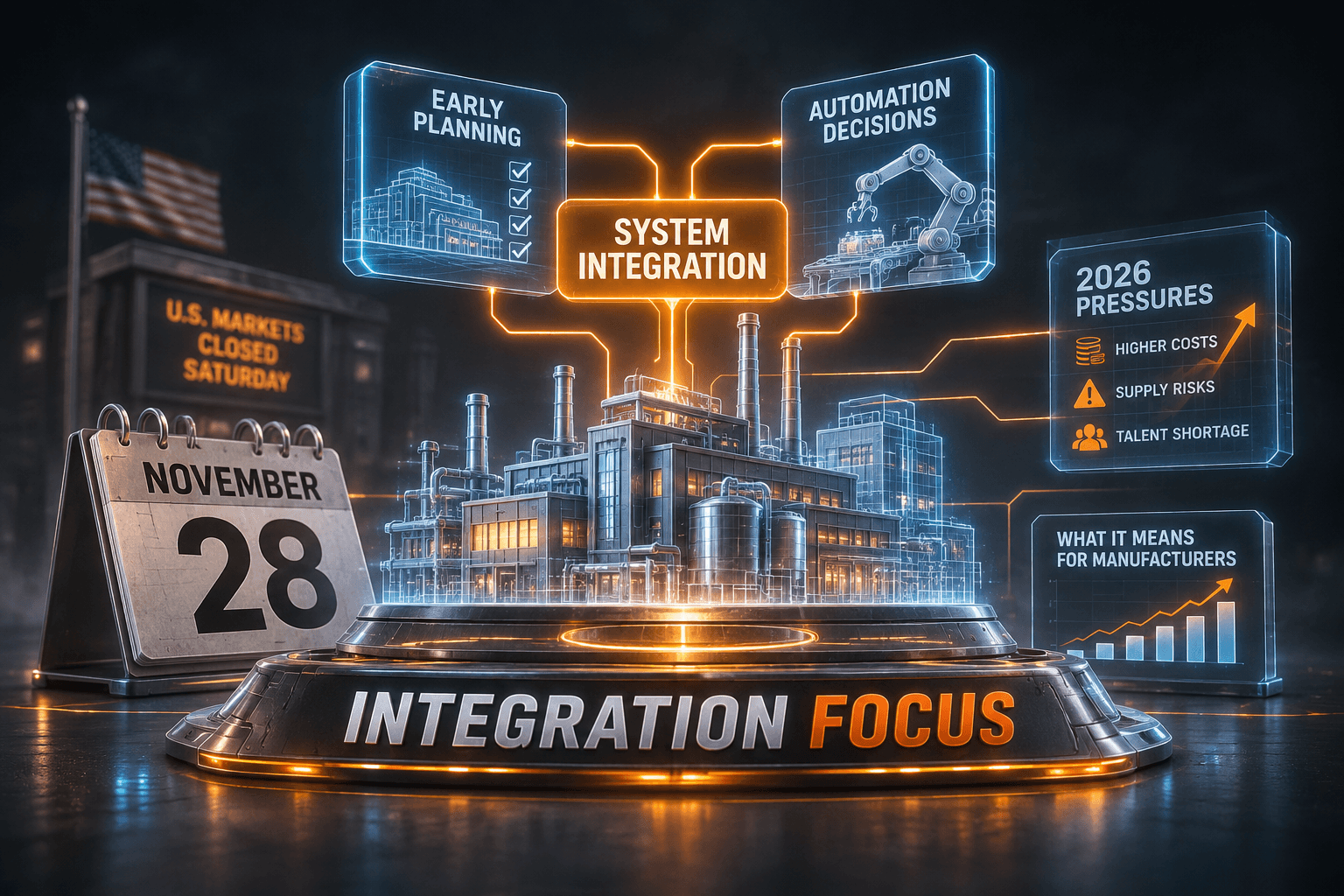
System integration is emerging as a practical priority for industrial operators, not just a technical project to consider after equipment decisions are made. A Plant Engineering article published Friday, November 27, argues that planning integration from the start can improve downstream choices across the automation life cycle.
A second report, published November 26, frames that work against tariffs, shifting trade policies, economic volatility, workforce shortages and AI. The stories offer no company earnings, share-price data or quantified savings, so the investor signal is strategic rather than a fresh financial read-through. U.S. markets are closed Saturday; the next regular session is Monday, November 30.
Market Highlights
The two reports point to a common question for industrial businesses: how can operators coordinate systems and automation while adapting to a changing operating environment? Better integration may help companies make more coherent decisions, but the articles don't quantify the costs, returns or timelines involved.
For investors, the coverage is industry context, not a report of a new contract, product launch or listed-company result. Neither story names a public company or ticker, and neither provides stock prices or percentage changes. You won't find a specific market catalyst in these reports, but the operating themes may be useful when evaluating future company disclosures.
- Plant Engineering's November 27 article presents a system-integration framework, two real-world examples and five implementation tips.
- Its November 26 report describes pressures on system integrators, including tariffs, trade-policy changes, economic volatility, labor shortages and AI.
- No company-specific financial figures, stock movements or measured returns were provided. U.S. equities were closed Saturday, November 28.
That lack of company-level data matters: operational themes can shape long-term investment questions, but they don't establish near-term revenue or margin outcomes. As you review the next round of industrial updates, look for evidence that companies are translating broad automation plans into measurable execution.
Key Developments
Integration planned early may influence the full automation life cycle
The November 27 article's central point is that integration planning works best when it begins early. According to the report, that timing can affect nearly every downstream decision. It offers two real-world examples and five implementation tips, although the supplied summary doesn't identify the companies, projects, methods or financial results behind them.
For investors, the implication is a framework for reading future disclosures rather than proof of a specific payoff. When manufacturers discuss automation investments, details about coordination across systems and the project life cycle may help explain execution plans. But without disclosed costs, savings or productivity measures, claims of improved performance should be treated as unquantified.
Integrators face a crowded mix of external pressures
The November 26 report describes system integrators entering 2026 amid familiar challenges: tariff pressures, changing trade policies, economic volatility and workforce shortages. It adds AI to that list, signaling that technology change is part of the planning environment. The article summary doesn't quantify how any one factor is affecting project demand, costs or delivery schedules.
These issues may interact in ways that make planning more complex, but the available reporting doesn't establish their impact on individual manufacturers. Investors can watch whether company commentary links policy shifts or labor constraints to project timing, capital spending, costs or customer demand. AI is a theme to follow, not a reported measure of sector-wide adoption or financial benefit in these stories.
One shared theme: execution under uncertainty
Taken together, the reports connect early integration planning with the need to navigate a changing business landscape. A framework for coordinating automation may be relevant to companies facing operational constraints, but these articles don't demonstrate that integration resolves tariffs, labor shortages or market volatility. That distinction keeps the investment takeaway measured.
What would make the story more actionable? Company-level evidence, such as disclosed project milestones, integration spending, operating metrics or quantified outcomes, could help investors assess whether a strategy is delivering results. No such figures are included in the two reports summarized here.
What to Watch
As the market reopens Monday, November 30, monitor scheduled company news and any new disclosures from industrial and automation businesses. The source material doesn't identify an upcoming earnings release, policy decision or sector event, so no specific catalyst can be confirmed from these stories. Check company calendars and filings for dated announcements rather than assuming a near-term event.
In future earnings reports and investor communications, look for specifics on automation plans, project execution, spending and measurable operating outcomes. You can also track whether management teams discuss tariffs, trade-policy changes, labor availability or AI as factors affecting costs and timing. The key is to separate reported results from broad strategic language.
Risks to monitor include continued policy and economic uncertainty, difficulty filling skilled roles and unclear returns on technology investment. The articles don't provide forecasts or quantify those risks, so their relative weight for any company remains unknown. A selective approach to interpreting disclosures can help distinguish a sector theme from evidence about an individual business.
Bottom Line
- Integration planning is the lead operational theme, with Plant Engineering emphasizing that starting early can shape downstream automation decisions.
- The November 27 report offers two examples and five tips, but the supplied summary provides no quantified costs, savings or returns.
- Tariffs, trade-policy shifts, economic volatility, workforce shortages and AI form a challenging backdrop for integrators, according to the November 26 report.
- No public companies, tickers, stock-price changes or percentage moves were cited. U.S. markets are closed Saturday and are next scheduled to trade Monday, November 30.
- Use future company disclosures to test whether integration plans are producing measurable outcomes. This summary is informational and isn't personalized investment advice.
FAQ
Q: What is the main industrial and manufacturing theme in these reports? A: Early system integration planning and the challenges facing integrators as they adapt to policy, labor, economic and technology changes.
Q: Do the stories report specific stock moves or financial results? A: No. The summaries name no public companies or tickers and provide no stock-price changes, earnings figures or quantified returns.
Q: When does the U.S. stock market reopen? A: U.S. markets are closed Saturday, November 28, and are next scheduled to trade Monday, November 30.