The Big Picture
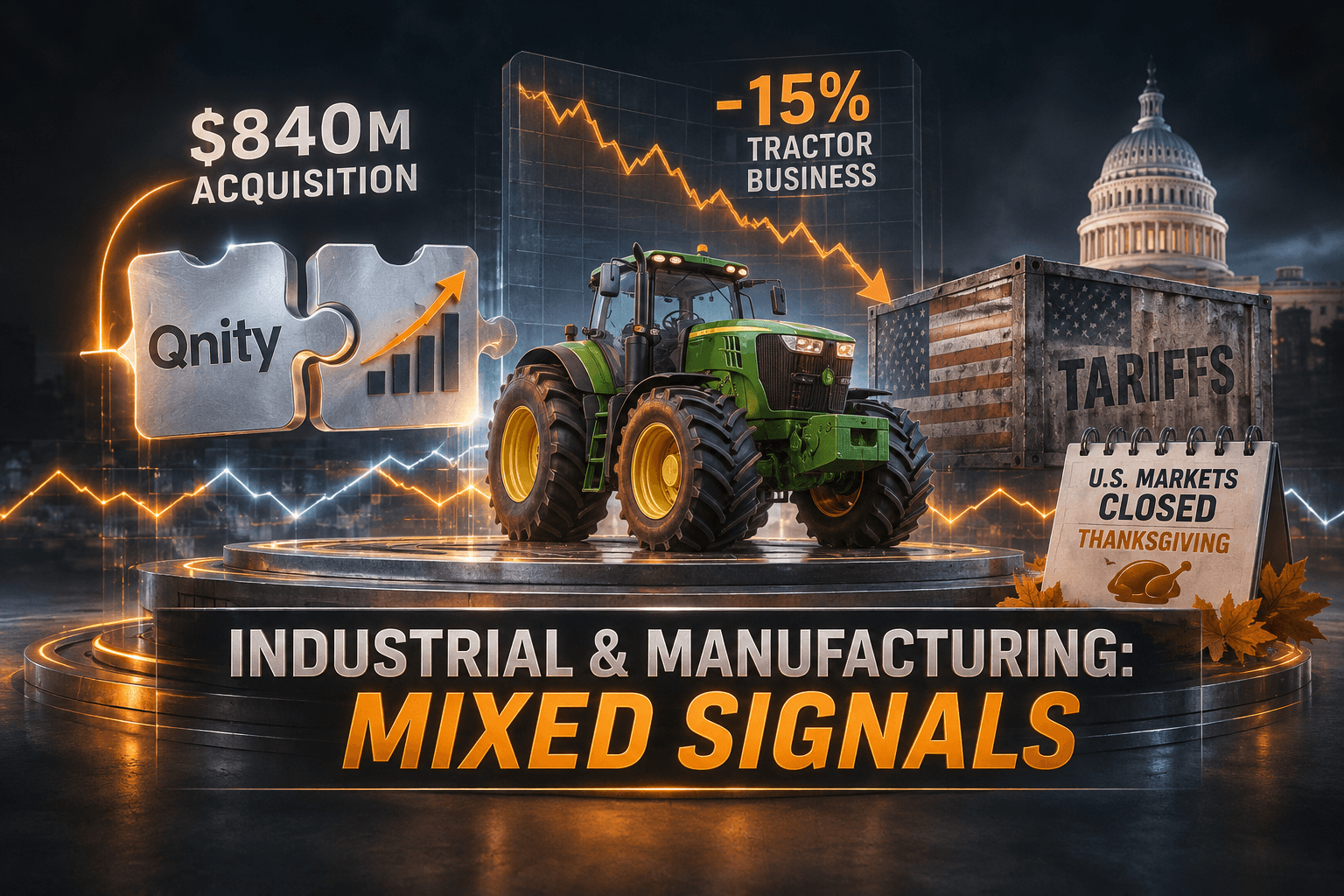
Industrial and manufacturing companies are heading into the Thanksgiving break with growth bets and fresh cost risks competing for attention. Qnity plans to pay $840 million for an electronics business, while Deere reported a 15% decline in its tractor business even as it offered an optimistic outlook for 2027.
For your sector read-through, the contrast matters: investment tied to electronics and data centers may support some businesses, but agricultural weakness and possible new tariffs could weigh on others. U.S. stock markets are closed Thursday, November 26, for Thanksgiving, so the next regular trading session is Friday, November 27. What should you watch when trading resumes? Company-specific demand, policy details and the ability to manage costs.
Market Highlights
Wednesday’s reports span acquisitions, equipment demand, logistics and supply-chain scrutiny. They don’t provide share-price changes or closing prices, so this briefing focuses on the business developments rather than suggesting that any stock moved. For price context, use Wednesday, November 25, as the last U.S. trading day.
- Qnity ($Q) agreed to pay $840 million for Meridian Adhesive Group’s electronics unit, targeting end markets including AI data centers, semiconductor equipment, aerospace and defense.
- Deere (Deere & (DE)) reported a 15% decline in its tractor business. Construction and small farm equipment sales provided a partial offset, with demand linked in part to data center projects and livestock markets.
- Proposed U.S. tariffs would range from 15% to 35% on goods from China, the European Union and 12 other trading partners, following a Section 301 probe.
- Molson Coors ($TAP) and Primo Brands ($PRMB) are using fuel hedging to manage logistics costs. Experts cited in the report cautioned that hedging can be costly and difficult to execute.
- PETA submitted a proposal on behalf of two PepsiCo (PEP) shareholders alleging animal-welfare risks in the company’s sugar sourcing practices. The allegation is a governance and supply-chain issue, not a reported finding of wrongdoing.
Those numbers describe transactions, operating performance and proposed policy, not market returns. Because the U.S. market is closed today, investors won’t get a fresh equity-session signal until Friday.
Key Developments
Qnity adds an electronics business with exposure to growth markets
Qnity’s planned $840 million purchase of Meridian Adhesive Group’s electronics segment would expand its position in markets that include AI data centers, semiconductor equipment, aerospace and defense. The stated goal is to bolster Qnity’s financial position in competitive end markets. The report does not specify the unit’s revenue, profitability or expected contribution after the acquisition.
For investors, the deal puts execution and valuation in focus. The purchase price is known, but assessing its financial impact will require more information about the acquired business and how Qnity plans to integrate it. You can also compare the company’s later disclosures with demand trends in the end markets it is targeting.
Deere’s tractor setback sits beside a more constructive outlook
Deere’s 15% tractor-business decline highlights pressure in an important part of its equipment portfolio. The report says an overall earnings dip was partly offset by positive construction and small farm equipment sales, with data center projects and livestock-market demand supporting those areas. Deere nevertheless offered an optimistic outlook for 2027.
That combination leaves a mixed operating picture rather than a uniform recovery signal. The outlook is a potential support, but the reported tractor contraction remains a point to monitor. In coming updates, pay attention to whether construction and small-farm demand can continue to offset weakness in tractors, and to the assumptions behind Deere’s 2027 view.
Costs, tariffs and supply-chain oversight remain watch items
Fuel hedging at Molson Coors and Primo Brands reflects an effort to bring more predictability to logistics expenses. But hedges aren’t cost-free or simple to manage, according to experts cited by Supply Chain Dive. The reports don’t disclose the companies’ hedge amounts or the savings they expect, so the effectiveness of the strategy will need to be assessed through future cost and margin disclosures.
Potential tariffs could add another layer of expense or sourcing complexity for manufacturers that rely on goods from the affected trading partners. The proposed 15% to 35% levies follow a Section 301 investigation, but the reports don’t establish their final scope, timing or implementation. Separately, the shareholder proposal concerning PepsiCo’s sugar sourcing puts supply-chain oversight and reputational exposure in view. The allegations remain allegations, and the proposal’s progress and company response are the relevant next signals.
What to Watch
Friday’s return to trading may bring investors’ first opportunity to respond to these developments, but the reports offer no specific share-price targets or scheduled company events. Rather than treating any single headline as a sector-wide signal, you can track the disclosures that clarify financial impact and policy exposure.
- Qnity’s next updates: Look for details on closing conditions, integration plans and the acquired unit’s financial contribution.
- Deere’s 2027 outlook: Monitor subsequent guidance and whether tractor demand improves or construction and small-farm sales continue to provide support.
- Tariff process: Watch for official decisions on product coverage, implementation timing and the countries or trading partners affected.
- Logistics costs: Future commentary from Molson Coors and Primo Brands may indicate whether fuel hedging is reducing volatility enough to justify its cost.
- PepsiCo shareholder proposal: Follow the company’s response and any governance developments, while distinguishing allegations from confirmed findings.
- System integration: Plant Engineering’s report emphasizes that automation and controls investments depend on connecting technology to business objectives. For manufacturers, the practical test is whether integration improves system performance and delivers measurable return on investment.
These signals may emerge at different times, so a selective approach can help separate long-term growth plans from near-term operating and policy risks. The Thanksgiving closure also means there is no U.S. equity trading session on Thursday to incorporate into price performance.
Bottom Line
- Qnity’s $840 million planned acquisition adds exposure to electronics-related markets, but the financial case depends on execution and details not yet provided in the report.
- Deere’s 15% tractor-business decline is a meaningful counterpoint to its optimistic 2027 outlook and stronger sales in select equipment categories.
- Proposed tariffs of 15% to 35% could create cost and sourcing uncertainty if implemented; their final terms remain unresolved.
- Fuel hedging may provide cost predictability for Molson Coors and Primo Brands, though experts warn that it can be expensive and difficult to execute.
- U.S. markets are closed for Thanksgiving on November 26. Wednesday, November 25, was the last trading day, and Friday, November 27, is the next scheduled session.
FAQ
Q: Why is Qnity spending $840 million on the electronics unit? A: The acquisition is intended to strengthen Qnity’s position in competitive markets such as AI data centers, semiconductor equipment, aerospace and defense.
Q: What does Deere’s 15% tractor-business decline mean for the outlook? A: It signals weakness in that business, while stronger construction and small farm equipment sales partly offset the earnings dip and Deere offered an optimistic 2027 outlook.
Q: Are U.S. markets open on November 26, 2026? A: No. U.S. stock markets are closed for Thanksgiving; the next scheduled trading day is Friday, November 27.