The Big Picture
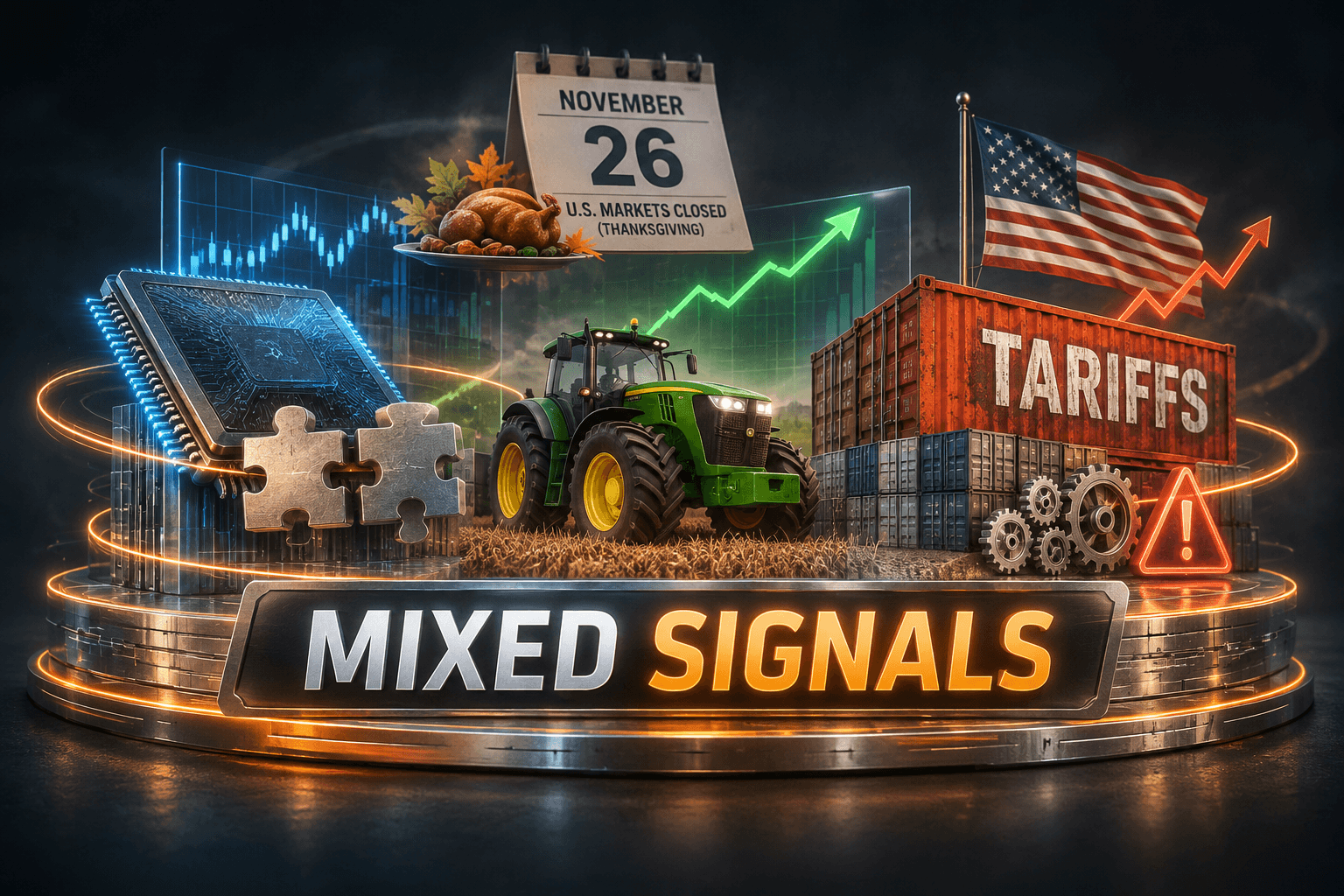
Industrial and manufacturing companies are balancing investment opportunities against rising policy and operating uncertainty. Qnity plans an $840 million acquisition to expand in electronics, while Deere reported a 15% decline in its tractor business even as it offered an optimistic outlook for 2027.
At the same time, proposed U.S. tariffs, fuel-cost management and new scrutiny of PepsiCo’s sugar sourcing highlight risks that can reach across supply chains. U.S. stock markets were closed Thursday for Thanksgiving, so these headlines had no Thursday equity trading session in which to register; the next session is Friday, November 27.
Market Highlights
The stories point to selective opportunities rather than a broad sector trend. Qnity’s planned purchase targets electronics applications including AI data centers and semiconductor equipment, while Deere cited construction and small farm equipment as areas of support. What should you take from that contrast? Demand appears uneven across end markets.
- Qnity plans to pay $840 million for Meridian Adhesive Group’s electronics segment, seeking to strengthen its position in competitive markets.
- Deere’s tractor business declined 15%. Its overall earnings also dipped, partly offset by positive construction and small farm equipment sales.
- Proposed U.S. tariffs would range from 15% to 35% on goods from China, the European Union and 12 other trade partners.
- Molson Coors and Primo Brands are using fuel hedging to manage logistics costs, though experts say hedging can be costly and difficult to execute.
Since markets were closed, there were no Thursday U.S. stock moves to report. The supplied stories also don’t include share-price changes from Wednesday, November 25, so the market reaction heading into the long weekend can’t be quantified here. For your review of Friday’s session, distinguish reported business developments from any later price response.
Key Developments
Qnity’s deal targets electronics growth markets
Qnity’s planned $840 million purchase of Meridian Adhesive Group’s electronics unit is aimed at bolstering its financial position in highly competitive markets. The unit serves areas including AI data centers, semiconductor equipment, aerospace and defense, where specialized materials can be important components of larger projects.
The deal gives Qnity a route to broaden its exposure to those markets, but the announcement alone doesn’t establish how much revenue or profit the business will contribute. You can monitor transaction completion and subsequent company disclosures for details on integration, financing and expected returns. No ticker was provided in the report, so the company is identified by name.
Deere pairs a weaker tractor business with a forward-looking outlook
Deere Deere & (DE) reported a 15% decline in its tractor business and an overall earnings dip. The company said positive construction and small farm equipment sales partly offset weakness, with demand in those areas supported by data center projects and livestock-market conditions.
That combination leaves investors weighing softness in a core equipment category against demand in other businesses and Deere’s optimistic outlook for 2027. The outlook is a forward-looking signal, not a guarantee that the tractor decline will reverse. Your assessment of the company’s trajectory can take account of whether upcoming updates show the offsetting categories continuing to provide support.
Tariffs and supply-chain choices add cost and reputational risks
U.S. officials are preparing proposed tariffs ranging from 15% to 35% on goods from China, the European Union and 12 other partners, following a Section 301 investigation. The measures are not described in the report as already in effect. If finalized, their implications would depend on which products are covered and how manufacturers and suppliers respond.
Separately, Molson Coors $TAP and Primo Brands $PRMB are using fuel hedging to seek greater predictability in logistics costs. Hedging can also be costly and difficult to execute, so it may reduce some exposure without eliminating transportation expense. PETA has also submitted a shareholder proposal on behalf of two PepsiCo PepsiCo (PEP) shareholders alleging that sugar-sourcing practices pose animal-welfare risks. These are allegations and a proposal, not a reported finding of wrongdoing; the development brings sourcing oversight and company response into focus.
What to Watch
Friday, November 27, is the next U.S. trading session. With no Thursday session to absorb the news, watch for market pricing after the holiday and for company or policy updates that clarify the business impact. The supplied reports don’t identify a specific upcoming earnings date or decision deadline for these developments.
For tariff exposure, look for details on product coverage, timing and any response from affected trade partners. For Deere, future updates on tractor demand and the contribution of construction and small farm equipment can help clarify the balance behind its 2027 outlook. Qnity’s transaction progress and disclosures about the electronics unit’s performance are also relevant milestones.
On logistics, fuel prices and the costs and effectiveness of hedging will matter to companies that depend on transportation. For PepsiCo, watch how the company addresses the shareholder proposal and whether it provides more information about sourcing practices. These separate stories have different drivers, so a selective approach to interpreting sector-wide implications is warranted.
Bottom Line
- The sector’s signals are mixed, with an electronics acquisition and Deere’s outlook counterbalanced by operating and policy risks.
- Qnity’s $840 million deal targets AI data centers, semiconductor equipment, aerospace and defense, but integration and financial details remain important.
- Deere’s 15% tractor-business decline underscores uneven demand, despite strength in construction and small farm equipment.
- Proposed tariffs and fuel hedging could affect costs; the tariff plan is not reported as implemented, and hedging has trade-offs.
- U.S. markets were closed Thursday. Friday’s reopening may provide the first session for investors to assess the headlines, but the reports provide no Wednesday share-price changes.
FAQ
Q: Were U.S. stocks open on November 26, 2026? A: No. U.S. stock markets were closed for Thanksgiving, and Friday, November 27, is the next trading session.
Q: What is the main detail in Qnity’s acquisition announcement? A: Qnity plans to pay $840 million for Meridian Adhesive Group’s electronics segment, which serves several competitive end markets.
Q: Are the proposed U.S. tariffs already in effect? A: The report describes tariffs of 15% to 35% as proposed, following a Section 301 probe, not as levies already implemented.