The Big Picture
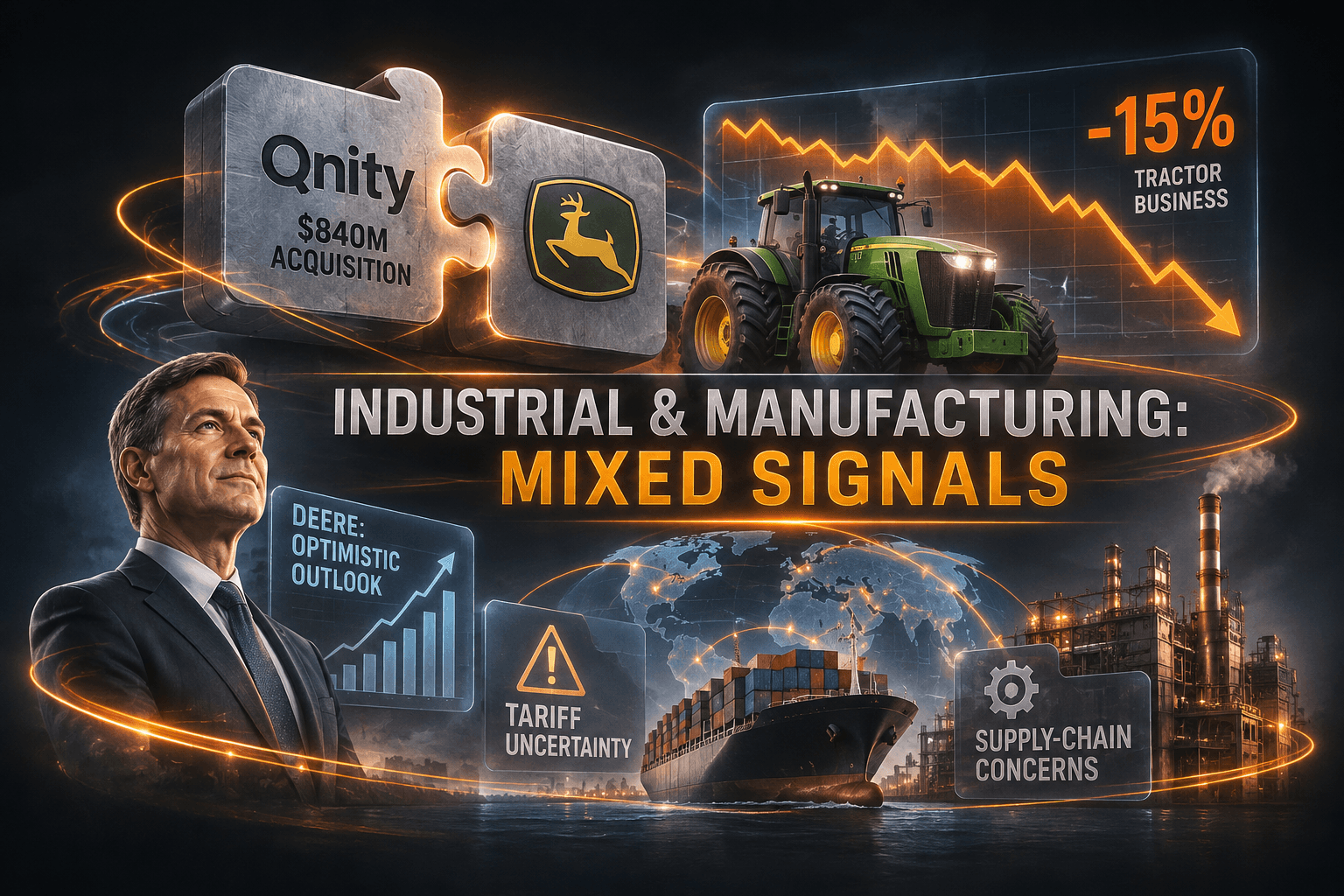
Industrial companies closed Wednesday with a mix of growth moves and fresh cost and policy risks, leaving the sector without a clear directional signal. Qnity agreed to pay $840 million for an electronics business, while Deere reported a 15% decline in its tractor business alongside an optimistic outlook.
Potential U.S. tariffs of 15% to 35% could complicate planning for manufacturers, and companies including Molson Coors and Primo Brands are using fuel hedges to manage logistics costs. What matters to you is how those pressures meet investment in higher-demand markets, from AI data centers to construction equipment. The reports provided no same-day share-price or percentage stock moves, so market reaction cannot be quantified here.
Market Highlights
Today’s stories point to sharply different forces shaping industrial and manufacturing businesses. Acquisition activity and targeted demand are supporting some outlooks, while input costs, trade policy and scrutiny of supply chains remain important risks.
- Qnity plans to pay $840 million for Meridian Adhesive Group’s electronics unit, targeting markets that include AI data centers, semiconductor equipment, aerospace and defense.
- Deere reported a 15% decline in its tractor business. Positive construction and small-farm equipment sales partly offset an overall earnings dip, with demand linked to data center projects and livestock markets.
- Proposed U.S. levies of 15% to 35% could apply to goods from China, the European Union and 12 other trading partners.
- Molson Coors and Primo Brands are using fuel hedging to bring more predictability to logistics costs, though experts cautioned that hedging can be costly and difficult to execute.
These are reported operating and policy developments, not evidence of a specific stock reaction. If you’re following individual companies, distinguish the reported business trends from any share-price move that would need separate market data.
Key Developments
Qnity buys into electronics end markets
Qnity’s planned $840 million purchase of Meridian Adhesive Group’s electronics segment is intended to strengthen the Dupont spinoff’s position in competitive end markets. The named applications include AI data centers, semiconductor equipment, aerospace and defense, areas where specialized materials can be part of broader industrial supply chains.
The deal gives Qnity a route to add capabilities and exposure in those markets, but the announcement alone doesn’t establish how much revenue or profit the acquired unit will contribute. For your assessment, the key details to watch are the transaction’s completion, integration progress and any future disclosure about its financial contribution. The purchase price is substantial, so execution and the effect on Qnity’s financial position matter alongside the growth rationale.
Deere’s tractor decline contrasts with its outlook
Deere reported a 15% decline in its tractor business, a clear sign of pressure in a core equipment category. The company’s overall earnings dip was partially offset by positive sales in construction and small-farm equipment, supported by data center projects and livestock-market demand. Deere also offered an optimistic outlook, though the supplied report doesn’t include detailed forecast figures.
That combination makes the company’s update a mixed signal rather than a simple rebound story. Construction demand tied to data center projects may be a support, but it doesn’t erase the tractor decline. You’ll want to compare subsequent results with the outlook and see whether strength in those other equipment categories continues.
Trade, fuel and supply-chain concerns persist
The U.S. is preparing proposed tariffs ranging from 15% to 35% on goods from China, the European Union and 12 other partners after a Section 301 probe. The report describes proposed levies, not tariffs already in force. If implemented, they could affect sourcing costs and production decisions, but the specific impact would depend on which goods are covered and how companies respond.
Fuel hedging offers another example of companies trying to manage uncertain costs. Molson Coors and Primo Brands are seeking more predictable logistics expenses, but experts noted that hedging itself can be costly and challenging to execute. Separately, PETA submitted a proposal on behalf of two PepsiCo shareholders alleging risks to animal welfare in the company’s sugar sourcing. These are allegations and a shareholder proposal, not a finding of wrongdoing. Together, the stories put cost controls and supply-chain oversight in focus.
A Plant Engineering article added a broader operational theme: system integrators can connect automation, controls and instrumentation investments to business objectives through industrial expertise and established practices. It offers a framework, not a reported company-specific performance result, but it underscores why technology spending needs a clear link to operational value.
What to Watch
For the next session, monitor any additional detail on the proposed tariffs, including the goods covered, timing and potential response from affected trading partners. Until policy specifics emerge, the scale of exposure for individual manufacturers remains uncertain. Companies with international sourcing may face different risks from those serving customers primarily through domestic production.
On the company front, watch for Qnity’s transaction timeline and disclosures about integration and financing, as well as Deere’s next updates on tractor demand and its optimistic outlook. Fuel prices and the cost of hedging are also relevant for businesses with substantial transport needs. You can also track whether the PepsiCo shareholder proposal leads to further disclosure or a formal company response; the allegation itself does not establish an operational or financial impact.
Across the sector, the practical question is whether targeted demand and productivity investments can offset cost and policy uncertainty. No new earnings dates or policy decision deadlines were specified in the reports, so investors should check company and government announcements for confirmed catalysts rather than assume a timetable.
Bottom Line
- Sector news was mixed, with no verified share-price reactions included in the reports.
- Qnity’s $840 million acquisition adds exposure to electronics end markets, but integration and financial contribution remain to be assessed.
- Deere’s 15% tractor-business decline is tempered, but not erased, by strength in construction and small-farm equipment and an optimistic outlook.
- Proposed tariffs and fuel-cost management highlight ongoing uncertainty for production and logistics planning.
- PepsiCo supply-chain claims remain allegations raised through a shareholder proposal, not established findings.
FAQ
Q: What was the biggest acquisition announced today? A: Qnity agreed to pay $840 million for Meridian Adhesive Group’s electronics segment.
Q: Why is Deere’s update a mixed signal? A: Its tractor business declined 15%, while construction and small-farm equipment sales helped offset an overall earnings dip and the company offered an optimistic outlook.
Q: Are the proposed U.S. tariffs already in effect? A: The report says the U.S. is preparing proposed levies of 15% to 35%; it does not say they are already in force.