The Big Picture
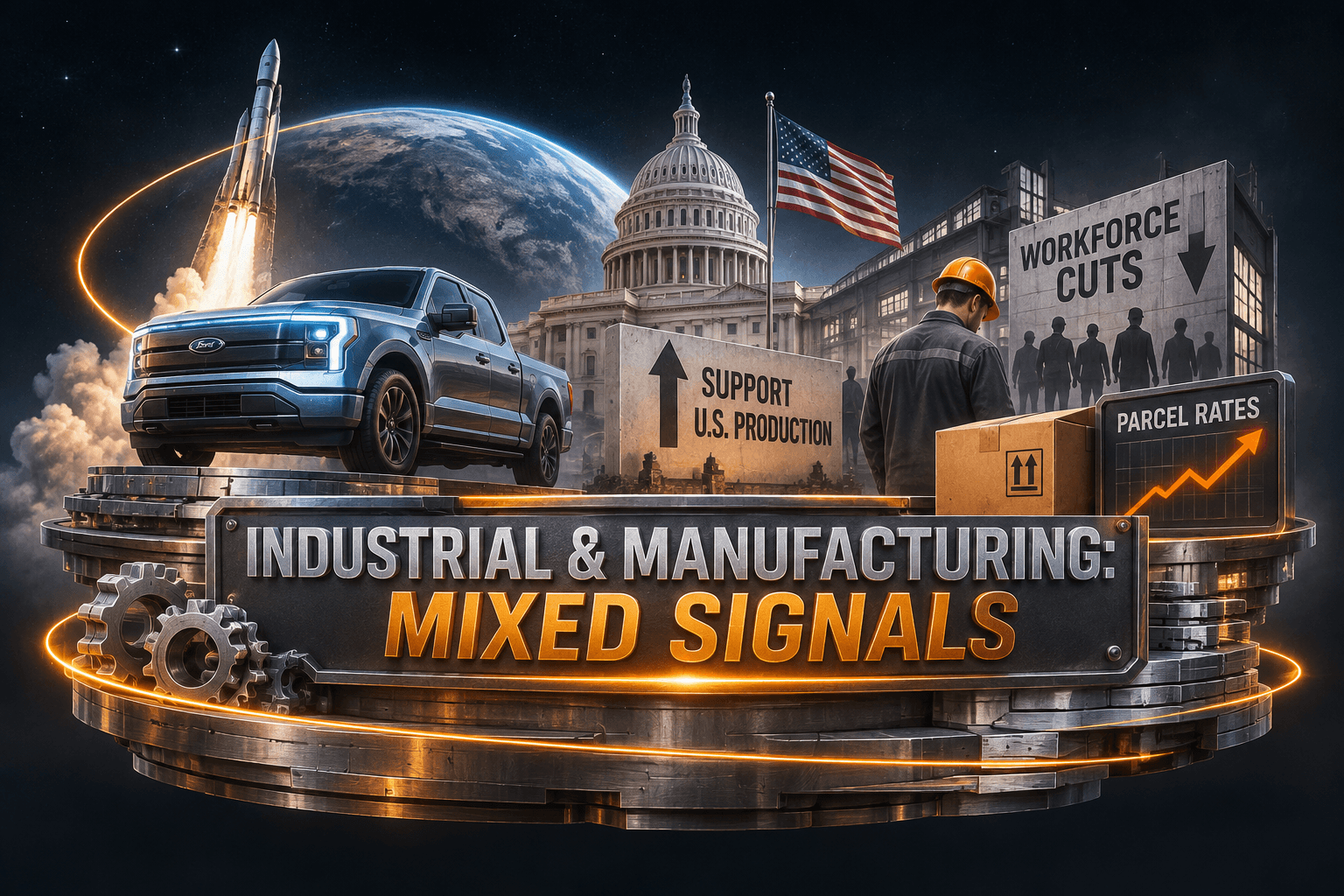
Industrial companies are balancing investment in new capabilities against pressure to simplify operations and control costs. Ford’s investment in satellite maker Revolution Space points to a potential manufacturing expansion beyond autos, while Procter & Gamble’s plan to cut as much as 30% of its product-supply workforce by 2030 shows how automation can reshape established operations.
Policy, product assortment and shipping costs add to the mixed picture. For you, the key question is whether investment in technology and domestic production can deliver efficiencies that outweigh restructuring and logistics expenses.
Market Highlights
Today’s reports span aerospace, consumer goods, apparel, logistics and industrial automation. Several include measurable targets, but the available coverage does not report closing share prices or percentage moves for the publicly traded companies, so specific stock reactions cannot be confirmed.
- Ford, through subsidiary Industrial Platform, made an undisclosed investment for a minority stake in Revolution Space. The companies plan to work together to scale spacecraft and component production.
- Procter & Gamble expects to eliminate as much as 30% of its product-supply headcount by 2030 as automation expands.
- Under Armour, which said it had already exceeded a 25% assortment-reduction goal, now aims to cut its assortment in half.
- FedEx and UPS are preparing average price increases of 5.9%, with experts warning that changes to rate structures could add to shipper costs.
These figures point in different directions: manufacturers are pursuing new markets and operational efficiency, but employees and customers may bear some of the adjustment. You’ll want to distinguish long-term productivity goals from the near-term costs of implementing them.
Key Developments
Ford’s satellite investment opens a new manufacturing lane
Ford’s minority investment in Revolution Space was made through Industrial Platform, a subsidiary, and the financial terms weren’t disclosed. The planned collaboration focuses on scaling production of spacecraft and related components, placing the announcement at the intersection of advanced manufacturing and the space economy.
The report describes a production partnership, not a disclosed revenue forecast or a change to Ford’s core auto business. For investors, the potential significance is strategic: scaling production could create a foothold in a different manufacturing market, but the size, timing and financial contribution of the investment remain unknown.
Policy advocates seek support as automation reshapes work
At a House select committee hearing held Friday, manufacturing leaders called for expanded tax credits, stronger trade policy and a national strategy to reinforce U.S. manufacturing and respond to competition from China. Those recommendations could matter to companies weighing domestic investment, but the report describes industry proposals rather than enacted policy.
The workforce story at P&G illustrates another side of the sector’s transformation. The company expects to reduce product-supply headcount by as much as 30% by 2030 as automation expands. That may reflect a push to improve operating efficiency, while also raising questions about execution, workforce transitions and whether productivity gains will offset implementation costs.
Streamlining and digital tools meet higher logistics bills
Under Armour’s next target is to halve its product assortment after clearing an earlier goal to reduce it by 25%. A smaller range can simplify decisions and focus investment on stronger products, according to the report. The outcome will depend on how well the company maintains customer demand while narrowing its offering.
Meanwhile, FedEx and UPS plan average rate increases of 5.9%, and experts say underlying changes could squeeze shipper budgets further. That makes transportation costs a relevant watchpoint for companies moving goods, including manufacturers and retailers. On the technology side, Rockwell Automation previewed a digital orchestration platform at its Boston automation fair last week and has expanded digital-twin, computing and robotics capabilities. An industry overview from Plant Engineering also emphasizes the role of system integrators in connecting automation projects to business objectives. Could these tools help companies manage cost pressure? The reports describe capabilities and approaches, not quantified savings.
What to Watch
For the next session and beyond, watch for company disclosures that turn these plans into measurable financial or operational outcomes. Ford has not disclosed the investment amount or a production timetable for its Revolution Space collaboration. Details on milestones, capacity and commercial demand would help clarify the project’s scale.
Policy proposals deserve attention, but investors will need to see whether lawmakers advance specific tax credits or trade measures. For P&G, monitor updates on the timing and implementation of the workforce reduction, as well as any reported efficiency gains. You can also track how Under Armour’s assortment changes affect product availability and sales, and whether FedEx and UPS customers face additional costs beyond the headline average increase.
Finally, Rockwell’s digital platform and system-integration themes reflect continued interest in industrial automation. Future disclosures on customer adoption, project returns or productivity would provide more evidence of business impact. The current reports do not establish a near-term earnings effect for any of these developments.
Bottom Line
- Ford’s Revolution Space investment offers a strategic manufacturing angle, but its undisclosed terms limit assessment of financial scale.
- Manufacturing leaders are seeking policy support, though the proposals have not been reported as enacted measures.
- P&G’s planned workforce reductions and Under Armour’s assortment target put operational restructuring in focus.
- FedEx and UPS rate increases could add pressure for shippers, while the reported average does not capture every customer’s final bill.
- Automation and digital tools remain important themes, but reported savings and returns will need to be verified in future disclosures.
FAQ
Q: Why is Ford investing in Revolution Space? A: Ford’s subsidiary Industrial Platform made an undisclosed minority investment, and the companies plan to collaborate on scaling spacecraft and component production.
Q: What workforce change is P&G planning? A: The company expects to eliminate as much as 30% of its product-supply headcount by 2030 as automation expands.
Q: How much are FedEx and UPS raising rates? A: The carriers are deploying another 5.9% average price increase, while experts say other changes could further affect shipper costs.