The Big Picture
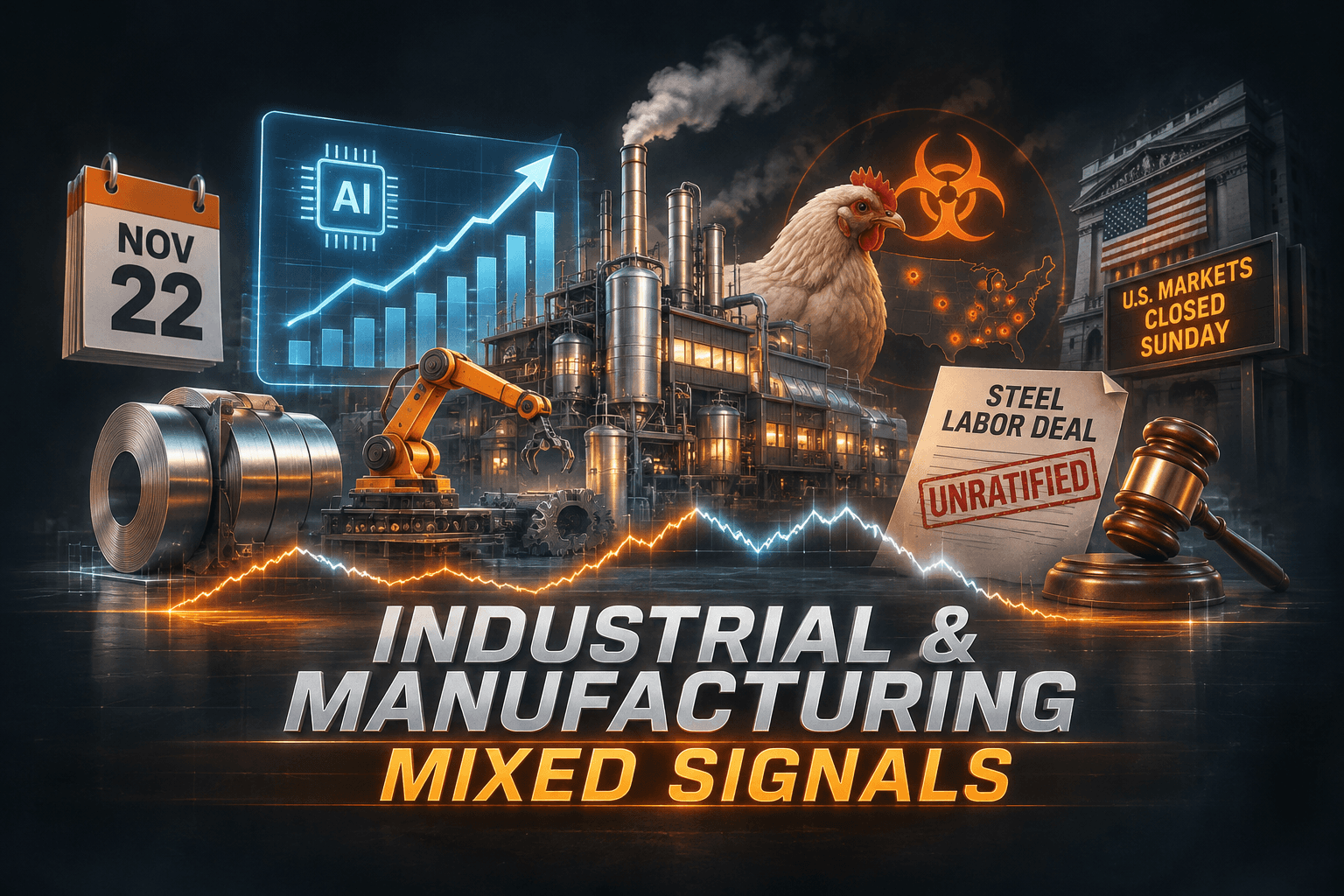
Industrial and manufacturing headlines heading into the long weekend point in several directions at once: companies are adding capacity and reshaping portfolios, while a poultry producer has paused production at a Florida plant after a bird flu outbreak. For investors, the contrast matters because expansion plans can support future output, but execution, labor, and supply disruptions remain important variables.
The reports arrived mostly on Friday, November 20, with a boiler-efficiency update published Saturday. U.S. markets are closed Sunday, so there are no Sunday stock moves to interpret; the next regular session is Monday, November 23. What deserves your attention first? The key is to separate proposals and pending decisions from completed operating changes.
Market Highlights
Several developments involve investment or throughput, but the available reports don’t provide associated share-price changes. Avoid reading a percentage move into these headlines: market prices should be checked against Friday’s close and any company disclosures when trading resumes.
- Tesla (TSLA) proposed a $3.1 billion polysilicon refinery in Texas. The proposal is an investment plan, not confirmation that construction or production has begun.
- Nvidia (NVDA) disclosed new supplier agreements intended to add capacity for AI demand, following other partner deals announced about a month earlier.
- Textron ($TXT) found a private equity buyer for its industrial business at $1.2 billion, as it moves toward an aerospace-and-defense-focused profile.
- U.S. Steel ($X) and the United Steelworkers reached a proposed four-year agreement covering 11,200 employees. The deal still needs a union vote.
- Cal-Maine Foods ($CALM) halted egg production at a Florida plant after a bird flu outbreak, against a backdrop of industry oversupply and falling consumer prices.
Walmart (WMT) also reported a surge in delivery volume completed in under 30 minutes during the third quarter. The company’s U.S. president and CEO, David Guggina, said faster in-store picking could shorten delivery times further. Separately, Plant Engineering described how boiler tuning and control upgrades can improve energy efficiency and production consistency while reducing costs, emissions, and equipment wear.
Key Developments
Capacity plans meet execution questions
Tesla’s proposed Texas refinery would represent a major manufacturing investment, while Nvidia’s supplier agreements target capacity to meet AI-related demand. Together, the stories highlight efforts to strengthen domestic production and supply availability. But the reports don’t specify the refinery’s timeline, permitting status, or expected output, and they don’t quantify the capacity Nvidia’s partners will add.
That distinction matters for your assessment of industrial growth: announcements can signal strategic intent, but production, customer demand, and project execution determine the eventual operating impact. This week’s other U.S. investment announcements from Limik Capital, Silex Microsystems, and HDI America add to the activity, though the supplied reports provide no investment amounts or detailed timelines for those projects.
Labor and portfolio changes remain in progress
The proposed U.S. Steel agreement includes annual wage increases and healthcare improvements after extended negotiations. Its terms may offer greater clarity for the company and workers if approved, but the vote is a near-term milestone, not a completed resolution. The deal follows a Cleveland-Cliffs ($CLF) agreement with the union two weeks earlier, putting labor relations across the steel sector in focus.
Textron’s $1.2 billion sale to an affiliate of Kingswood Capital Management would transfer an industrial segment that includes an auto supplier and specialty vehicles. The planned divestiture fits Textron’s stated shift toward becoming a pure-play aerospace and defense company. Investors can watch for further details on the transaction and how the company describes its portfolio after the sale; the report doesn’t provide a closing date.
Operations show both efficiency gains and disruption
Cal-Maine’s Florida production halt adds a supply-side complication to an egg market already dealing with oversupply and lower consumer prices. The report gives no estimate of the plant’s lost output or how long the pause may last, so the effect on company results and broader supply remains uncertain. Bird flu developments and any further production changes are worth monitoring.
On the other side of the operating picture, Walmart’s sub-30-minute delivery growth underscores the role of store-level picking speed in supply chains. Boiler tuning offers a more broadly applicable efficiency lever for manufacturers: better control can help stabilize production and limit energy use and equipment wear. These are useful operational signals, but neither report supplies quantified savings or margins.
What to Watch
Monday, November 23, is the next U.S. trading session. Watch for any new company filings or updates that clarify Tesla’s project scope, Nvidia’s supplier capacity, and the expected timing of Textron’s transaction. Those details will help distinguish long-term plans from nearer-term changes to production or financial results.
The U.S. Steel union vote is a direct catalyst: approval would settle the proposed terms, while the outcome and any next steps remain unknown. You can also track Cal-Maine’s updates on the Florida plant and the broader egg supply picture, especially given the existing oversupply and price weakness described in the report. For Walmart, the next useful indicators would be delivery growth, store picking speed, and any reported operating benefits. No specific earnings dates or policy decisions were included in these stories.
For industrial operators, efficiency projects may support cost control, but the boiler report doesn’t quantify returns. Keep the distinction between announced plans, pending votes, and realized performance in view; not all the headlines point in the same direction.
Bottom Line
- Sector news is mixed, with capacity plans and efficiency themes balanced by production and labor uncertainty.
- Tesla’s $3.1 billion Texas refinery remains a proposal; project timing and output details weren’t provided.
- Nvidia’s supplier agreements target AI demand, but the reported capacity increase isn’t quantified.
- The U.S. Steel labor deal awaits a vote, and Cal-Maine has halted production at one Florida plant after bird flu.
- Markets are closed Sunday. Review confirmed company updates and Friday closing prices before drawing conclusions when trading resumes Monday.
FAQ
Q: Are U.S. stock markets open on Sunday, November 22? A: No. U.S. markets are closed Sunday, and the next regular trading session is Monday, November 23.
Q: Has U.S. Steel’s labor agreement been approved? A: No. The four-year proposal, covering 11,200 employees, is still subject to a union vote.
Q: What is the status of Tesla’s Texas refinery plan? A: Tesla has proposed a $3.1 billion polysilicon refinery. The report does not provide a construction timeline or confirm that the project has begun.