The Big Picture
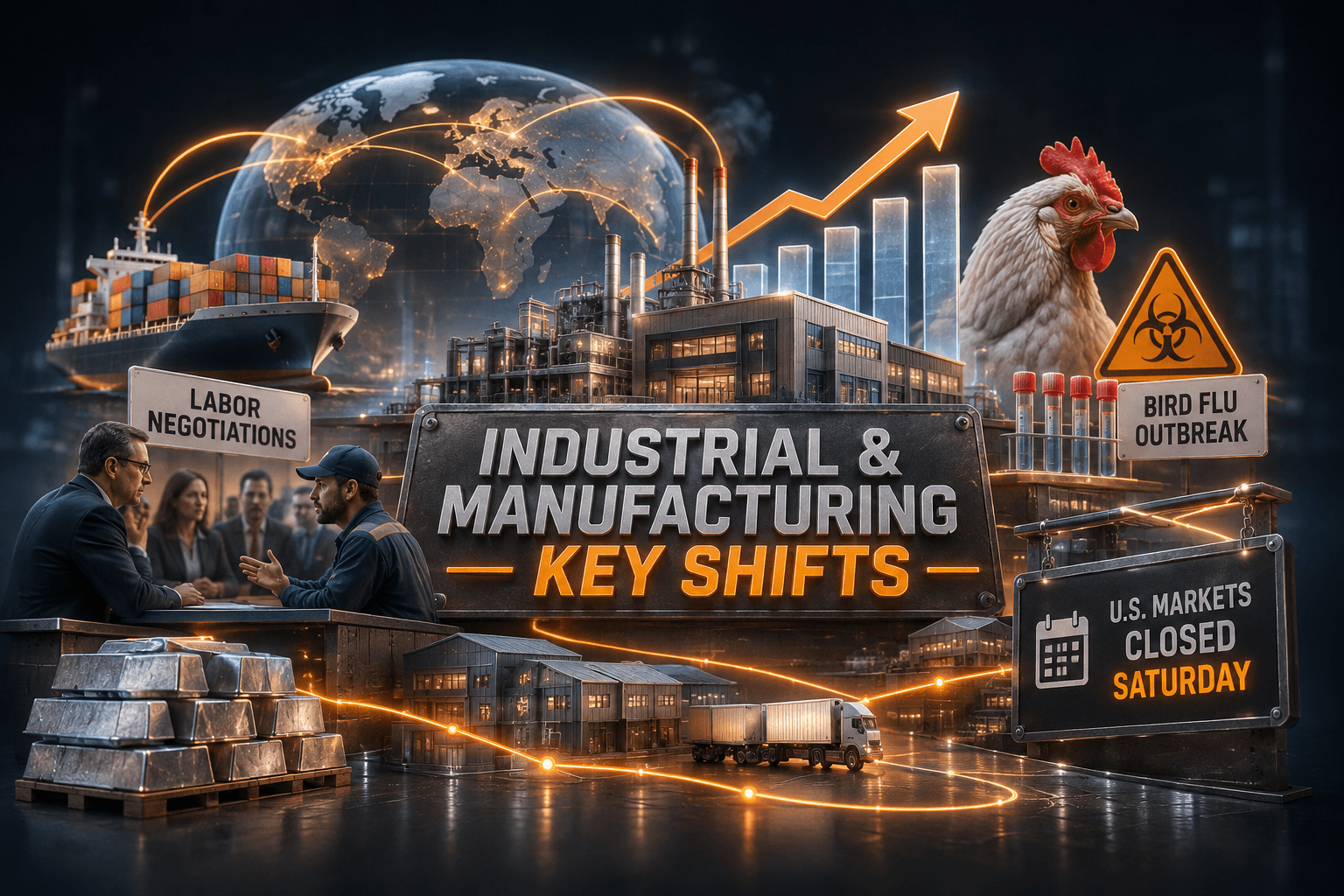
Industrial and manufacturing news heading into the long weekend points to a sector balancing expansion with execution risks. Walmart reported a surge in deliveries completed in under 30 minutes, Nvidia secured more supplier capacity for AI demand, and Tesla proposed a $3.1 billion Texas polysilicon refinery.
At the same time, a proposed labor agreement at U.S. Steel still needs a vote, while Cal-Maine Foods paused production at a Florida plant after a bird flu outbreak. US stock markets are closed Saturday, November 21; the next session is Monday, November 23. What should you take from a busy Friday news cycle? The announcements signal activity, but several outcomes remain unresolved.
Market Highlights
These headlines span consumer logistics, industrial investment, labor costs and food production. The reports don’t provide stock-price moves or percentage changes, so the figures below describe announced activity rather than Friday share performance.
- Walmart said its sub-30-minute delivery volume surged in Q3. CEO David Guggina said faster in-store picking could help speed deliveries further. Walmart trades as Walmart (WMT).
- Tesla proposed a $3.1 billion polysilicon refinery in Texas. The report also cited U.S. investment announcements by Limik Capital, Silex Microsystems and HDI America. Tesla trades as Tesla (TSLA).
- Nvidia announced additional supplier capacity to address AI demand, following other partner agreements disclosed a month earlier. Nvidia trades as Nvidia (NVDA).
- U.S. Steel and the United Steelworkers proposed a four-year deal covering 11,200 employees. It includes annual wage increases and healthcare improvements and is up for a union vote.
- Cal-Maine halted egg production at a Florida facility after an avian influenza outbreak. The disruption comes as the industry faces egg oversupply and falling consumer prices. Cal-Maine trades as $CALM.
- Textron found a private-equity buyer for its industrial business at a reported $1.2 billion. The company trades as $TXT.
Because the market was closed Saturday, none of these headlines represents a move in US equities today. You can use the weekend to distinguish confirmed operating changes from proposals, pending votes and longer-term plans.
Key Developments
Delivery growth and AI capacity test supply chains
Walmart’s rise in deliveries completed in less than 30 minutes points to continued investment in speed and fulfillment. Guggina’s comments suggest store picking times remain one area the retailer could improve. For investors, the relevant question is whether faster service can be sustained while managing the labor and operating demands of fulfilling orders quickly. The report did not provide a specific growth rate or disclose the cost of the initiative.
Nvidia’s new supplier agreements address another part of the logistics equation: access to production capacity. More capacity may help the chipmaker and its partners respond to AI-related demand, but agreements alone don’t establish how quickly production will ramp or how much additional output will reach customers. Together, the Walmart and Nvidia stories show why supply-chain execution matters as much as demand. You’ll want to watch for follow-up details on throughput, delivery speed and production volumes.
Labor and food-production risks remain in view
The proposed U.S. Steel agreement would bring annual wage increases and healthcare improvements for 11,200 workers, subject to a vote. Extended negotiations preceded the proposal, which arrived two weeks after Cleveland-Cliffs reached its own deal with the union. A successful vote could reduce uncertainty around labor relations, while the terms may also matter to future labor costs. The available report doesn’t specify the size of the wage increases.
Cal-Maine’s production halt presents a different operational challenge. The outbreak comes amid an egg oversupply and a decline in consumer prices, so the impact on the company and the broader market will depend on the duration and scope of the interruption. Avian influenza can disrupt production, but the report doesn’t quantify the affected capacity or give a restart date. That leaves both the supply impact and any financial effect unclear.
Portfolio shifts and operational execution
Textron’s planned sale of its industrial business to an affiliate of Kingswood Capital Management, at a reported $1.2 billion, fits the company’s stated shift toward becoming a pure-play aerospace and defense company. The industrial segment includes an auto supplier and specialty vehicles. For shareholders, the transaction’s significance will depend in part on completion and how the company deploys the proceeds; the report does not provide closing details.
Two Plant Engineering articles focused on less visible sources of manufacturing performance: maintenance, repair and operations management, and turning operational data into sustained savings. Their central point is that visibility or recommendations alone don’t guarantee returns. Coordinating automation, operations and asset expertise, and managing MRO needs, can affect reliability and costs. These are industry insights rather than announcements of financial results by a named public company, but they frame the execution challenge behind broader productivity goals.
What to Watch
Monday’s session is the next opportunity for US markets to respond to the Friday headlines. No specific earnings dates or policy events were included in the supplied reports, so near-term attention is likely to center on company updates and whether pending decisions advance.
- Watch for a result from the U.S. Steel union vote and further information about the agreement’s cost and implementation.
- Track any details on Tesla’s refinery proposal, including permitting, timing and investment milestones. A proposal is not the same as an approved or operating facility.
- Look for evidence that Nvidia’s added supplier capacity translates into production, and monitor Walmart’s comments on picking speed and rapid-delivery economics.
- Follow updates on the Cal-Maine facility, including the length of the shutdown and any information about affected production.
- Monitor Textron’s transaction timeline and disclosures about the planned separation of its industrial business.
For you, the main risk is treating announced plans as completed results. Labor approval, permitting, production recovery and deal completion could all affect how these stories develop.
Bottom Line
- Sector sentiment is mixed: supply-chain expansion and investment announcements are balanced by labor, disease and execution risks.
- Walmart’s rapid-delivery growth and Nvidia’s added supplier capacity are constructive operating signals, but the reports provide limited detail on costs and realized output.
- The U.S. Steel agreement remains subject to a vote, while Tesla’s refinery is a proposal and Textron’s sale is a transaction in progress.
- Cal-Maine’s Florida production pause adds uncertainty in an egg market already dealing with oversupply and lower consumer prices.
- US markets are closed Saturday, with the next session on Monday, November 23. This analysis is for informational purposes only, not a recommendation to buy, sell or hold any security.
FAQ
Q: Are US stock markets open on Saturday, November 21? A: No. US stock markets are closed Saturday, and the next trading session is Monday, November 23.
Q: What is the most immediate operational risk in these headlines? A: Cal-Maine’s Florida production halt after a bird flu outbreak is an immediate disruption, though the report does not quantify its scale or duration.
Q: Which major announcements are still pending? A: The U.S. Steel labor proposal awaits a union vote, Tesla’s refinery is a proposal, and Textron’s industrial-business sale is not described as completed.