The Big Picture
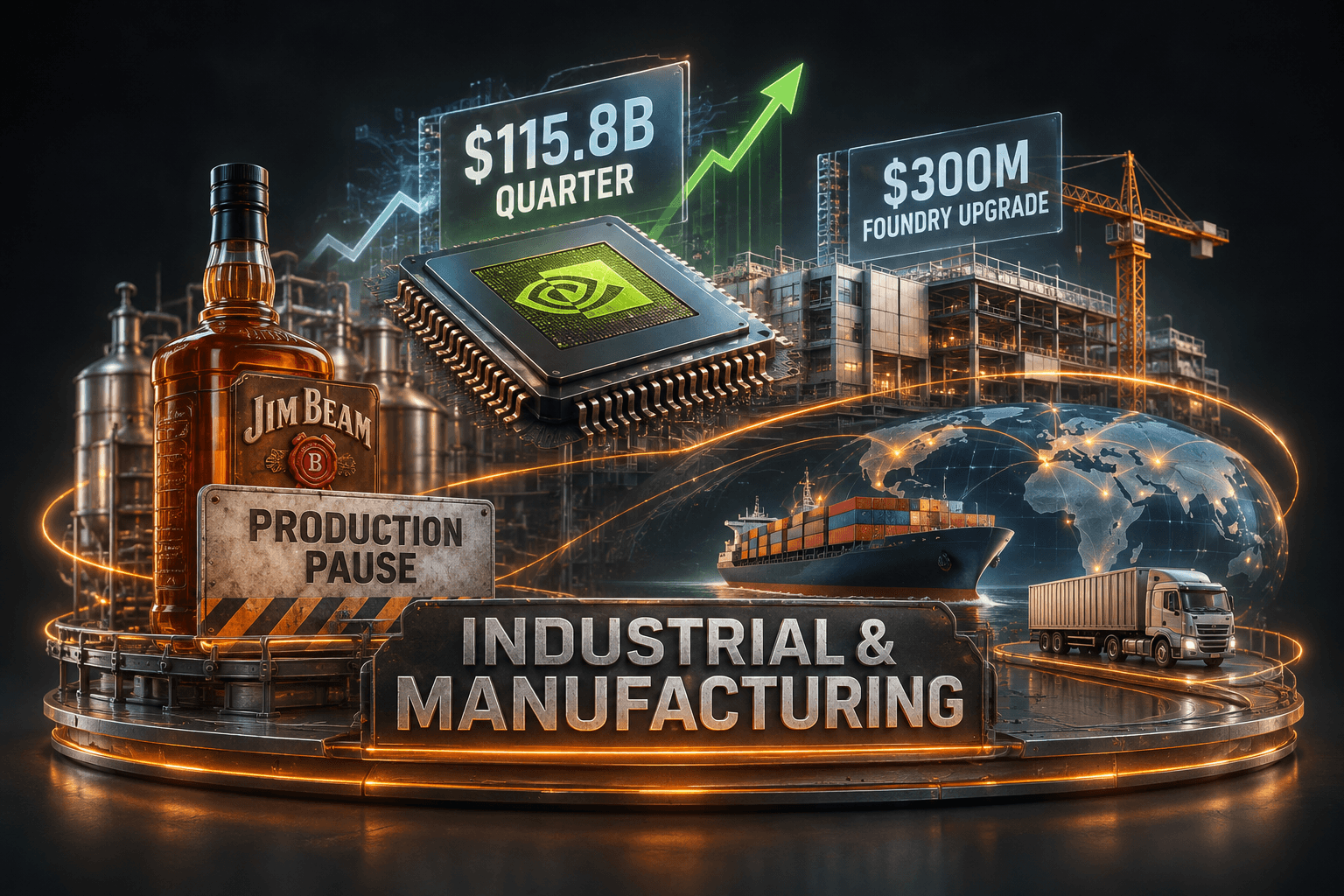
Industrial and manufacturing news points to opportunity in technology and capacity investment, alongside a reminder that demand isn’t strong everywhere. Nvidia reported $115.8 billion in Q3 revenue, more than double year over year, while defense-focused manufacturer Hadrian plans a $300 million upgrade and expansion at a Pennsylvania foundry.
Meanwhile, Amazon is adding delivery capacity in Puerto Rico, Starbucks says inventory availability is at an all-time high, and Jim Beam won’t resume production at its flagship distillery next year. What connects these updates? Each shows how companies are adjusting technology, logistics or production to meet changing needs, but results remain uneven across end markets.
Market Highlights
Technology demand and investment are prominent in the latest updates. Nvidia’s results point to continued demand tied to AI and data centers, while Hadrian’s planned investment is aimed at supporting the U.S. Navy’s submarine program. Neither story includes a reported share-price move in the information provided, so you’ll need live market data to assess how trading responds today.
- Nvidia reported Q3 revenue of $115.8 billion, more than double the year-earlier level, and announced new supply partnerships.
- Hadrian acquired Kutztown Foundry & Machine and plans a $300 million facility upgrade and expansion in Pennsylvania.
- Amazon’s new 100,000-square-foot Puerto Rico delivery station is expected to reduce delivery times in the San Juan metro area from about two weeks to about two days.
- Starbucks’ CEO described inventory availability as at an “all-time high,” following work on daily deliveries and a 24-hour operating model.
- Jim Beam will move production to another Kentucky facility and keep its flagship distillery idle next year, as value spirits brands continue to struggle.
The updates don’t include stock percentage changes or specific prices for Nvidia (NVDA), Amazon.com (AMZN) or Starbucks (SBUX). Treat company operating news and market reaction as separate signals: the first describes business developments, while the second depends on today’s trading and investor expectations.
Key Developments
AI demand and manufacturing data take center stage
Nvidia’s $115.8 billion in quarterly revenue, more than double year over year, gives investors a significant data point on demand tied to AI and data centers. The company also announced new supply partnerships on its earnings call. The supplied report doesn’t detail the partners or quantify their expected contribution, so investors will need further disclosures to judge how much they change Nvidia’s supply outlook.
Two manufacturing data stories point to a broader operational challenge: turning industrial information into useful, timely decisions. A Manufacturing Dive podcast examines how manufacturers can scale data systems while managing performance, speed and cost. A separate Plant Engineering article argues that an operational technology data fabric can connect and contextualize data across systems, supporting AI and wider digital transformation. These are industry perspectives, not announcements of specific contracts or financial results, so look for named deployments and measurable outcomes before drawing company-level conclusions.
Capacity investment meets supply-chain execution
Hadrian’s acquisition of Kutztown Foundry & Machine and planned $300 million upgrade target production capacity for the U.S. Navy’s submarine program. The Pennsylvania project gives the private defense startup a route to expand at an existing industrial site. The report doesn’t provide a completion timeline, output targets or customer contract value, leaving those as key details to watch.
Amazon’s first Puerto Rico delivery station offers a concrete logistics improvement for the San Juan metro area. The 100,000-square-foot facility is expected to bring delivery times down to about two days from roughly two weeks. For $AMZN, this is a reported service and infrastructure development; the story doesn’t quantify operating costs, delivery volumes or the effect on revenue.
Starbucks’ daily deliveries and 24-hour operating-model test are also focused on execution. The CEO says inventory availability is at an all-time high, but the report doesn’t give a financial measure of savings, sales impact or rollout plans. For you, the useful follow-up is whether better availability is sustained and translates into measurable operating results at $SBUX.
Jim Beam pause highlights uneven consumer demand
Jim Beam, owned by Suntory, won’t resume production at its flagship distillery next year and is shifting production to another Kentucky facility. The report links the decision to continued struggles among value spirits brands, contrasting with the growth-oriented technology and defense stories elsewhere in the sector.
The available details don’t specify the production volume affected, staffing consequences or how long the pause will last. Investors tracking beverage and consumer-goods supply chains can watch for further information on demand, inventory and the cost of moving production. The story is a caution against assuming that all manufacturers are benefiting equally from current investment and technology trends.
What to Watch
Today, monitor market responses to Nvidia’s reported results and supply partnerships, but don’t infer a trend from a single session. The information provided contains no current share prices or percentage moves. Compare any trading reaction with the company’s reported revenue growth and watch for further detail on demand, supply availability and partnership scope.
For manufacturing and industrial businesses, look for concrete milestones from Hadrian’s $300 million project, including upgrade timing and production capacity. Amazon and Starbucks provide operating indicators to follow: delivery speed in Puerto Rico, and whether Starbucks can maintain improved inventory availability beyond its test model. Do companies turn better infrastructure and data into measurable performance? That’s the key question for upcoming disclosures.
Finally, keep an eye on consumer demand and production decisions in spirits. Jim Beam’s pause may reflect pressure in a specific part of the market, but the story doesn’t establish how widespread the weakness is. More information on volumes, inventory and production plans would help clarify the risk.
Bottom Line
- Nvidia’s $115.8 billion Q3 revenue, more than double year over year, underscores strong reported AI and data-center demand.
- Hadrian’s planned $300 million Pennsylvania upgrade is a notable capacity project tied to the Navy submarine program, though timing and output details remain unknown.
- Amazon’s Puerto Rico station and Starbucks’ inventory initiatives show companies working to improve service and supply-chain execution.
- Jim Beam’s production pause is a counterpoint to growth stories and highlights continuing pressure among value spirits brands.
- Use a selective approach: distinguish announced plans and operational claims from realized financial results, and check live prices for market reaction.
FAQ
Q: What is the main industrial and manufacturing trend today? A: The stories show strong AI-related demand and investment in manufacturing capacity, alongside supply-chain improvements and weakness in some consumer categories.
Q: How much did Nvidia report in Q3 revenue? A: Nvidia reported $115.8 billion, more than double its revenue a year earlier.
Q: Why is Jim Beam’s flagship distillery pausing production? A: The report says production won’t resume there next year and will move to another Kentucky facility, amid struggles among value spirits brands.