The Big Picture
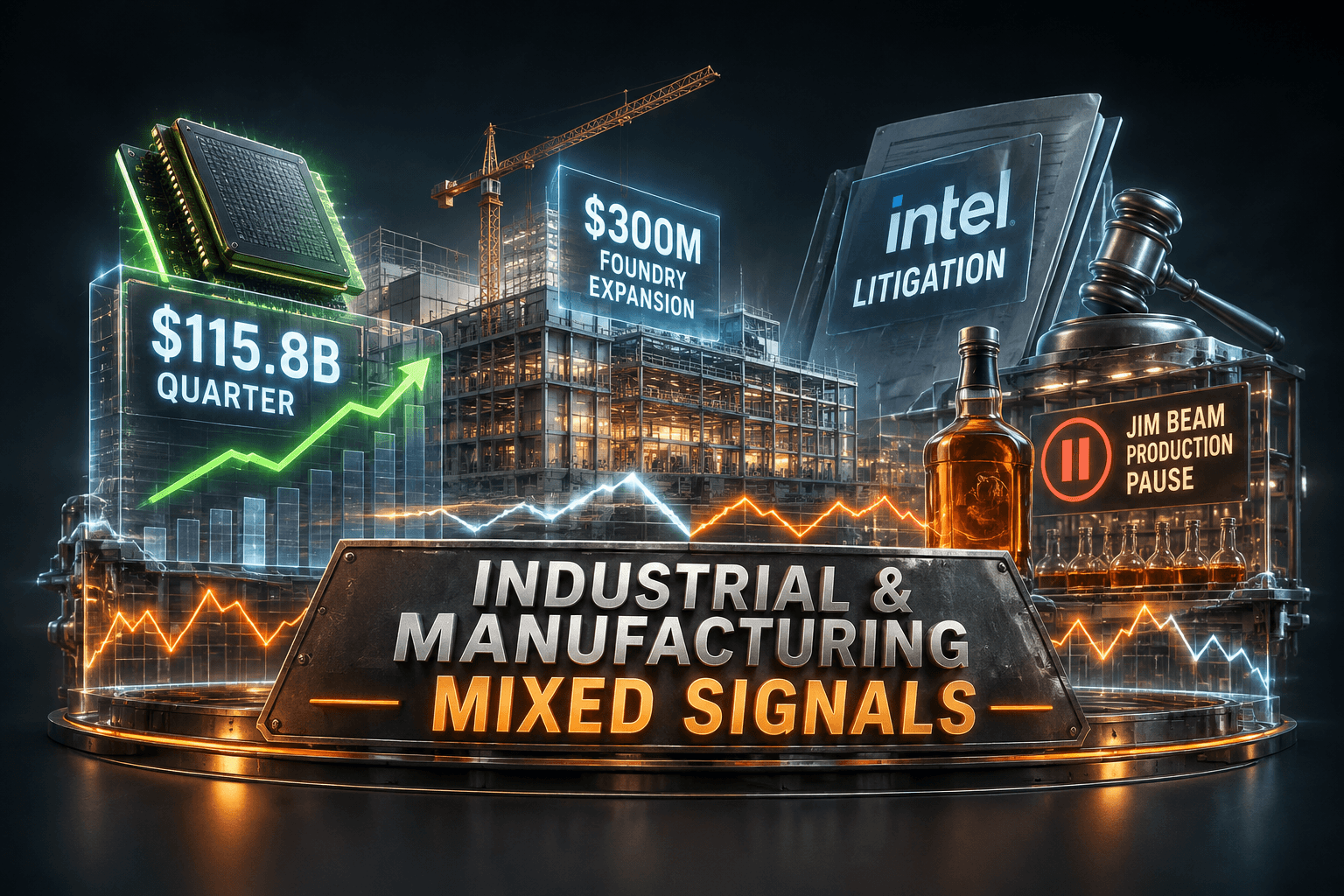
Manufacturing's growth story looked strong in some corners Wednesday, but the day's headlines also showed why a broad sector view can obscure company-level risks. Nvidia reported $115.8 billion in third-quarter revenue, while defense manufacturer Hadrian announced plans for a $300 million foundry upgrade and expansion. At the same time, Intel faces a shareholder lawsuit over disclosures about PC demand, and Jim Beam won't restart production at its flagship distillery next year.
Supply-chain execution was another theme. Amazon's new Puerto Rico delivery station is expected to cut delivery times in the San Juan metro area from about two weeks to about two days, while Starbucks says daily deliveries have helped push inventory availability to an all-time high. For you as an investor, the takeaway is mixed: demand, investment and operational improvements are visible, but they're not lifting every business equally.
Market Highlights
The reports point to concrete changes in revenue, capacity and delivery operations, but the supplied stories don't include closing prices or percentage stock moves. That means today's company news can be assessed on its operating implications, not on a verified market-price reaction.
- Nvidia (NVDA) reported $115.8 billion in Q3 revenue, more than double the year-earlier level, and announced new supply partnerships.
- Hadrian plans a $300 million upgrade and expansion at Kutztown Foundry & Machine's Pennsylvania site after acquiring the steel caster.
- Amazon (Amazon.com (AMZN)) opened its first Puerto Rico delivery station, a 100,000-square-foot facility designed to shorten delivery times in the San Juan metro area.
- Starbucks (SBUX) says inventory availability is at an all-time high as it tests daily deliveries and a 24-hour operating model.
- Intel (INTC) shareholders have sued its CEO and CFO, alleging they didn't properly disclose the effects of weaker PC demand on revenue and profitability.
These developments aren't direct comparisons: Nvidia's results reflect large-scale AI and data-center demand, while the delivery and inventory stories focus on logistics execution. Still, each highlights how supply reliability and capacity decisions are becoming central to industrial and consumer-facing businesses.
Key Developments
AI demand and defense production drive investment
Nvidia's $115.8 billion in Q3 revenue, more than double year over year, is the day's clearest signal of the scale of AI and data-center demand. The company also announced new supply partnerships on its earnings call. For manufacturers and suppliers, that combination points to continuing pressure to secure components and production capacity. The reported revenue figure is significant, but it doesn't by itself show how demand or margins will develop in future quarters.
In a different part of the industrial landscape, Hadrian's planned $300 million investment is intended to expand and modernize the Kutztown Foundry & Machine site in Pennsylvania. The work is aimed at supporting the U.S. Navy's submarine program. The acquisition and upgrade bring together a specific end market and a substantial capacity plan, though execution, timing and the facility's eventual output will matter in assessing the investment's impact.
Logistics improvements aim to bring service closer
Amazon's 100,000-square-foot Puerto Rico delivery station is expected to reduce delivery times for San Juan metro customers to about two days, compared with roughly two weeks. A shorter delivery window can improve customer experience, but the report doesn't provide financial estimates for the facility or detail its operating costs. For you, the distinction matters: a faster service target is an operational milestone, not a disclosed measure of added profit.
Starbucks' report of all-time-high inventory availability offers another example of supply-chain changes reaching the customer-facing end of a business. The company has been testing daily deliveries and a 24-hour operating model to improve reliability. If the approach proves sustainable, it could help stores keep products available, but the story doesn't quantify the financial effect. Together, the two updates underline that better logistics can be a competitive advantage, while the cost and consistency of execution remain worth watching.
Demand pressures and data infrastructure remain watch points
Jim Beam, owned by Suntory, won't resume production at its flagship distillery next year, with production moving to another Kentucky facility. The report links the decision to continued struggles among value spirits brands. It signals adjustment to demand conditions rather than a broad measure of the spirits market, and the story doesn't specify how much output will move or what the change means for costs.
Intel's CEO Lip-Bu Tan and CFO David Zinsner are defendants in a shareholder lawsuit. Shareholders allege the executives failed to properly disclose how waning PC demand affected revenue and profitability. Those are allegations, not a court finding. The suit adds legal and disclosure scrutiny as the company contends with demand pressure in its PC business.
A Plant Engineering article also argues that an operational technology data fabric can connect and contextualize manufacturing data, supporting AI and digital transformation. It is an industry perspective rather than a company earnings announcement. Its relevance is practical: manufacturers pursuing automation still need systems that make operational data usable across facilities and processes.
What to Watch
Tomorrow, monitor company updates for evidence of whether today's plans translate into measurable results. For Nvidia, attention will remain on supply partnerships, AI and data-center demand, and the company's ability to support that demand. Hadrian's announced expansion makes project timing, investment execution and progress toward Navy program requirements important longer-term markers.
For Amazon and Starbucks, watch for further details on service performance, inventory availability and the resources required to sustain more frequent deliveries. These stories describe operational gains, but don't quantify the cost-benefit balance. In spirits, the Jim Beam production shift puts consumer demand and facility utilization in focus. For Intel, the lawsuit's progress and any company response may draw attention, while the underlying PC demand picture remains central. What would turn these mixed signals into a clearer sector trend? More evidence on sustained demand, margins and execution will be needed.
Investors can also follow manufacturing companies' commentary on data integration and AI adoption. The broader opportunity is improved coordination and performance, but implementation costs and measurable productivity gains are key factors to assess. No single story provides a complete read on industrial-sector conditions.
Bottom Line
- Nvidia's reported Q3 revenue underscores strong AI and data-center demand, alongside the importance of supply partnerships.
- Hadrian's $300 million planned foundry investment supports U.S. submarine manufacturing, with delivery and execution milestones still ahead.
- Amazon and Starbucks reported operational improvements, but neither story disclosed a quantified profit impact.
- Intel's lawsuit and Jim Beam's production pause highlight legal and demand-related risks in distinct businesses.
- The day's news is informational, not a recommendation to buy, sell or hold any security; company outcomes remain uneven.
FAQ
Q: What was the biggest manufacturing result announced today? A: Nvidia reported $115.8 billion in Q3 revenue, more than double year over year, and announced new supply partnerships.
Q: Why is Hadrian expanding the Pennsylvania foundry? A: The company says the planned $300 million upgrade and expansion will support the U.S. Navy's submarine program.
Q: Did the reports include stock-price changes? A: No. The supplied stories didn't provide percentage moves or closing prices, so no specific market reaction can be confirmed.