The Big Picture
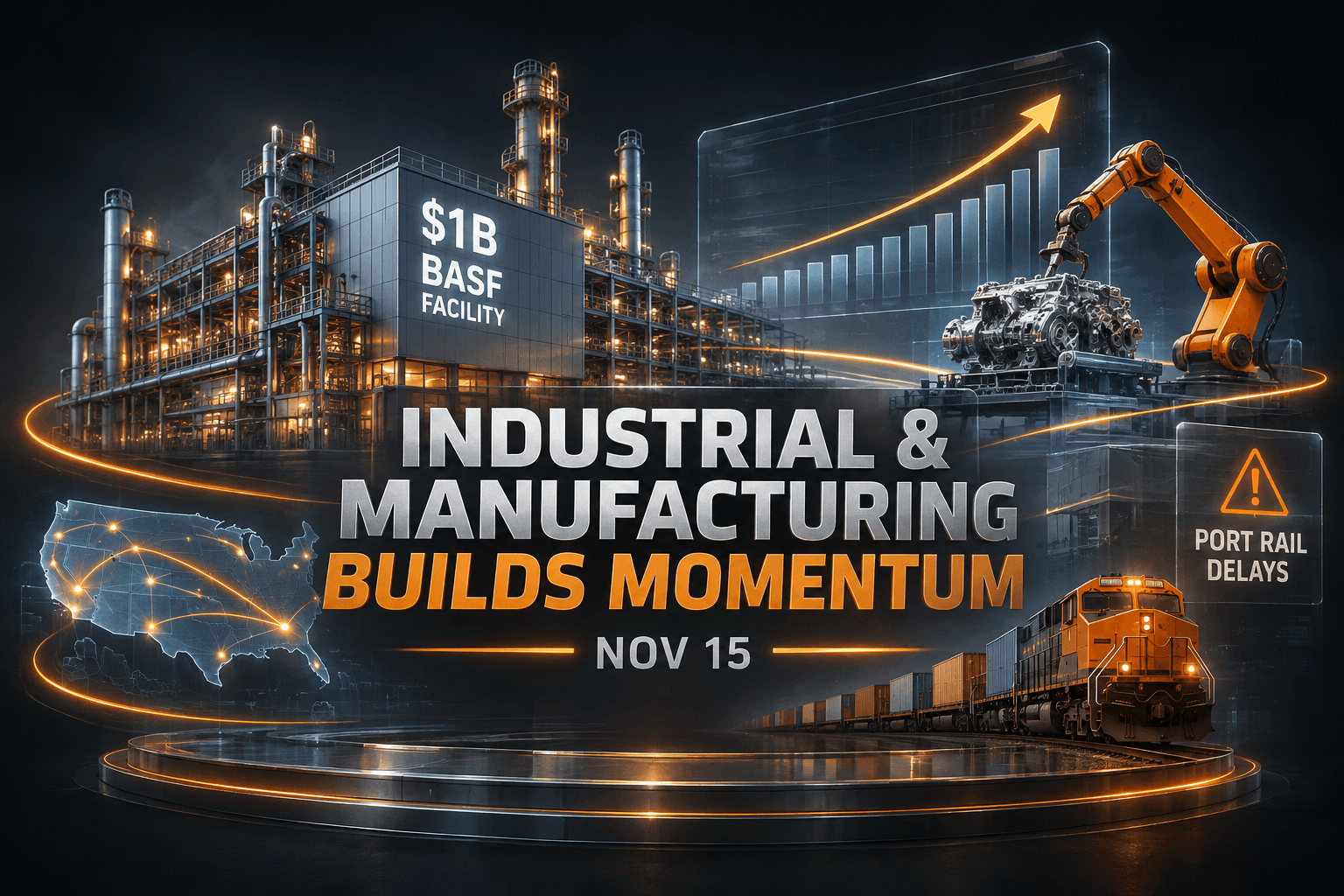
Industrial investment and technology adoption are offering a constructive read on the sector, with manufacturing technology orders reaching $1 billion in September and BASF opening a major Louisiana production facility. The developments suggest companies are still committing capital to capacity and operational improvements, even as supply-chain bottlenecks remain visible.
Because it is Sunday, U.S. stock markets are closed; the last trading session was Friday, November 13, and the next is Monday, November 16. What matters for the week ahead is whether expansion plans and efficiency projects translate into measurable output, while manufacturers manage delays such as the more than nine-day rail dwell time reported at the Port of Los Angeles.
Market Highlights
The week's headlines combine sizable manufacturing investment with efforts to improve productivity and customer fulfillment. The supplied reports did not include share-price changes or percentage moves, so there is no reported stock-performance data to cite for Friday. For investors, the focus is on the scale of the projects and the operational indicators companies have disclosed.
- Manufacturing technology orders reached $1 billion in September, according to the Manufacturing Dive report.
- BASF opened a $1 billion MDI production facility in Geismar, Louisiana, its largest single U.S. investment to date and its most significant MDI production site in North America.
- Idle containers waiting for rail transport at the Port of Los Angeles were taking more than nine days, according to Executive Director Gene Seroka.
- JD Sports cited 98% on-shelf availability as it partners with Zebra Technologies for real-time inventory visibility.
- Walmart more than doubled its planned drone delivery sites through an expanded partnership with Zipline, with broader customer availability expected over several years.
Other expansion announcements this week involved GE Vernova, Honda, Kopin and ATP Adhesive, though the supplied summaries did not provide project costs, capacity figures or timelines. That makes the news positive for the activity backdrop, but not enough on its own to quantify the potential revenue contribution for each company.
Key Developments
BASF adds major MDI capacity in Louisiana
BASF's new Geismar facility is a significant capacity and capital commitment. The $1 billion project makes the site the Germany-based company's largest single investment in the United States and its most significant MDI producer in North America. MDI is used in polyurethane products, linking the facility to a range of industrial and consumer applications.
For investors tracking BASF SE, whose U.S. ADR trades as $BASFY, the opening is a concrete milestone rather than a preliminary announcement. A new facility can strengthen regional production capability, but returns depend on utilization, customer demand, input costs and the time needed to ramp operations. You can track those factors in future company updates rather than treating the headline investment figure as a direct forecast of earnings.
Orders and factory technology point to efficiency gains
Manufacturing technology orders reached $1 billion in September, a notable measure of demand for tools and systems used by manufacturers. The report also pointed to expansions or openings at GE Vernova ($GEV), Honda ($HMC), Kopin ($KOPN) and ATP Adhesive. The available details do not specify the order growth rate or the individual financial impact of those projects, so the total is best read as a sector activity signal.
At a virtual State of Automotive Manufacturing event, experts said artificial intelligence can help connect factory-floor operations and optimize supply chains. That potential links with the broader push to reduce waste, control costs and make production more flexible. The opportunity is operational, but execution matters: manufacturers need to show that technology deployments improve productivity enough to offset implementation costs.
Fulfillment gains meet a logistics bottleneck
JD Sports is working with Zebra Technologies (ZBRA) to improve real-time inventory visibility across its omnichannel operations, citing 98% on-shelf availability. Better inventory information can support faster replenishment and reduce gaps between digital and store channels. The announcement describes an operating initiative, not a reported financial result, so its value will be clearer through subsequent service and performance measures.
Walmart (WMT) is also expanding technology-enabled fulfillment, more than doubling planned drone delivery sites with Zipline. The company says the expansion is intended to make rapid air delivery available to customers nationwide over the next several years. Yet the Port of Los Angeles report underscores that supply-chain capacity can remain uneven: rail-bound containers waited more than nine days, creating a potential source of delay for businesses reliant on imported goods. It's a reminder that faster last-mile delivery doesn't remove upstream constraints.
What to Watch
On Monday, November 16, markets reopen after the weekend. With no company-specific stock moves provided in these reports, you may want to watch how industrial names respond to the investment and logistics headlines, while separating general sector sentiment from company-level fundamentals.
For BASF, monitor updates on the Geismar site's ramp-up, production levels and demand for MDI. For GE Vernova and the other firms cited in expansion news, more detail on project scale, timing and expected capacity would help investors assess whether announcements are likely to have a material financial effect. The $1 billion manufacturing technology order figure also merits context from subsequent releases, including how it compares with earlier periods.
Supply-chain conditions are another near-term variable. Watch for changes in rail dwell times at Los Angeles and whether port congestion affects delivery schedules or costs. For manufacturers adopting AI and connected factory systems, look for evidence of realized savings and productivity improvements, not only stated goals. Walmart's drone plans and JD Sports' inventory initiative are longer-running execution stories, with rollout pace and service outcomes worth following.
Bottom Line
- The sector's news flow is tilted toward investment, with BASF's $1 billion Geismar facility now open.
- Manufacturing technology orders reached $1 billion in September, but the report supplied no growth rate or company-level breakdown.
- Factory AI and inventory tools could support efficiency, though realized benefits will depend on execution and measurable results.
- Port of Los Angeles rail dwell times above nine days highlight continuing logistics risk for manufacturers and retailers.
- U.S. markets are closed Sunday; the next regular trading session is Monday, November 16. These developments are informational and are not a recommendation on any security.
FAQ
Q: What is the biggest industrial investment in these headlines? A: BASF opened a $1 billion MDI production facility in Geismar, Louisiana, its largest single U.S. investment to date.
Q: What supply-chain risk should investors monitor? A: Rail-bound containers at the Port of Los Angeles were waiting more than nine days, a potential warning sign for freight delays.
Q: Are U.S. markets open on Sunday, November 15? A: No. Markets are closed Sunday; the last session was Friday, November 13, and the next is Monday, November 16.