The Big Picture
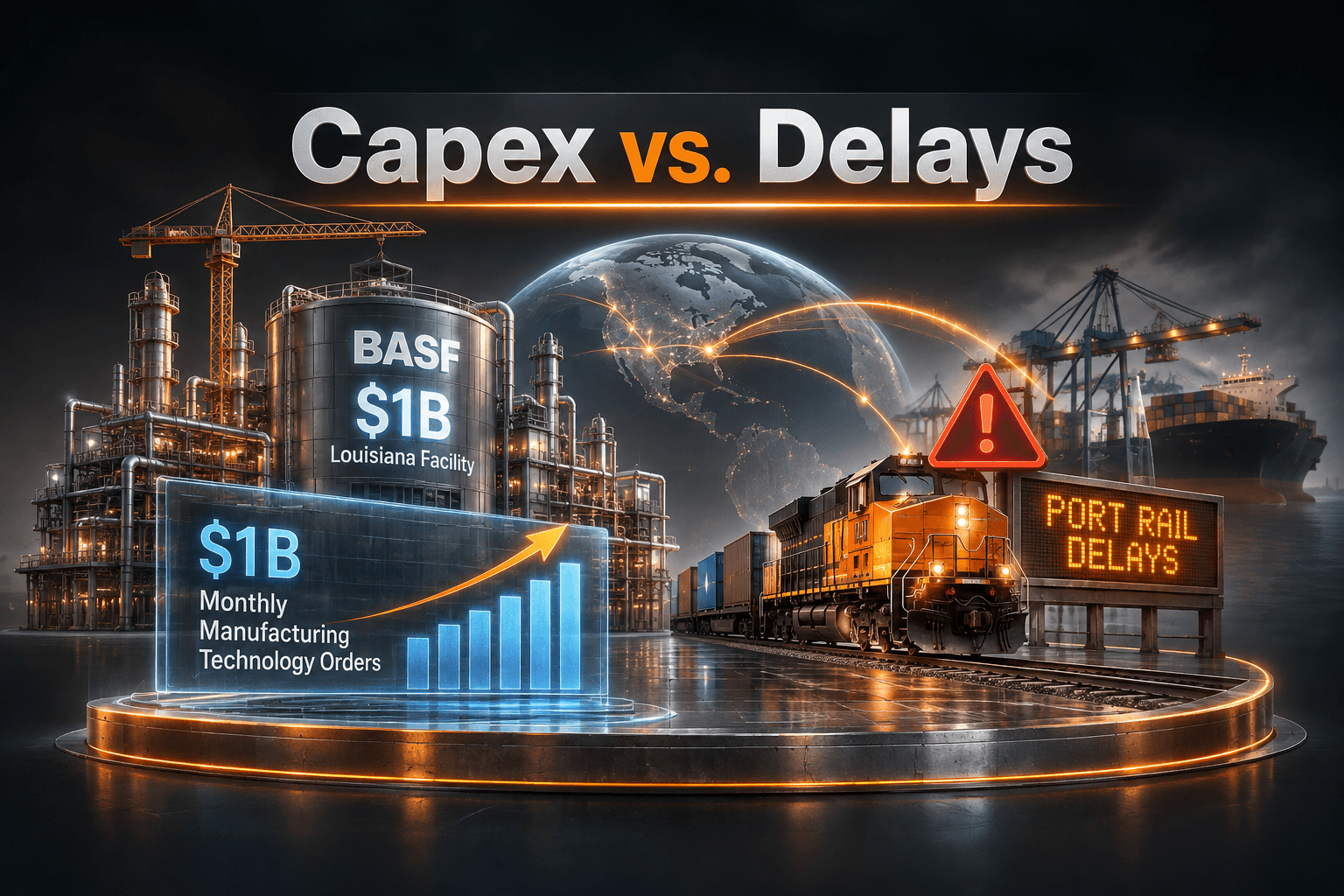
Industrial companies are investing in new capacity and technology, but a nine-day-plus wait for some rail-bound containers at the Port of Los Angeles shows that supply chain constraints remain a real counterweight. BASF’s $1 billion Louisiana facility and September manufacturing technology orders reaching $1 billion point to continued spending across the sector, even as logistics friction could slow the movement of goods.
U.S. stock markets were closed Saturday, November 14, so there was no trading today and the reports provide no verified share-price reactions. For your next session, Monday, November 16, the key question is whether these announcements translate into durable operating gains, rather than simply higher investment and technology spending. The available stories don’t establish that outcome yet.
Market Highlights
The week’s headlines offered a mixed picture: fresh investment and efficiency initiatives on one side, and a concrete transportation bottleneck on the other. The stories do not include Friday closing prices or percentage share moves, so there are no supported stock-performance figures to report for $GEV, BASF, or other companies mentioned.
- Manufacturing technology orders reached $1 billion in September, according to the Manufacturing Dive report.
- BASF opened a $1 billion MDI production facility in Geismar, Louisiana, its largest single U.S. investment to date and its most significant MDI producer in North America.
- Rail-bound containers at the Port of Los Angeles faced wait times of more than nine days, according to Executive Director Gene Seroka.
- JD Sports cited 98% on-shelf availability as it works with Zebra on real-time inventory visibility. Walmart more than doubled its planned drone delivery sites with Zipline.
Other expansion and opening announcements this week involved GE Vernova, Honda, Kopin, and ATP Adhesive. The reports supplied here don’t give project costs, timelines, or expected output for those plans, so their scale is difficult to compare with BASF’s investment. Still, the broader pattern points to companies pursuing capacity, automation, and faster replenishment through different routes.
Key Developments
Investment strengthens the industrial growth story
BASF’s new MDI facility in Geismar is the clearest single commitment in the day’s news. The company described it as its largest U.S. investment to date and its most significant MDI production site in North America. That scale makes the opening relevant to investors tracking industrial capacity and chemical production, although the report doesn’t quantify expected sales, utilization, or earnings contribution.
Separately, monthly manufacturing technology orders reached $1 billion in September. That figure suggests demand for factory technology is meaningful, but one monthly total doesn’t show whether orders are accelerating or how much will convert into revenue. GE Vernova, Honda, Kopin, and ATP Adhesive also announced openings or expansion projects this week, adding to the investment picture without enough detail to assess each project’s financial impact.
Factory AI and inventory tools target efficiency
At a virtual event on automotive manufacturing, experts said AI can help connect factory-floor operations and optimize supply chains. The proposed benefits include less waste, lower costs, and greater flexibility. For manufacturers, these are important goals, but the report describes potential applications, not measured savings or confirmed returns at specific companies.
JD Sports’ partnership with Zebra focuses on real-time inventory visibility across its omnichannel operations, with the retailer citing 98% on-shelf availability. This highlights how data tools can support replenishment as well as factory operations. If you’re assessing the significance, distinguish a reported operating metric from proof that a new system has improved margins or revenue; no such financial result was provided in the story.
Logistics delays test the benefits of better technology
Port of Los Angeles rail dwell times are a reminder that digital tools can’t eliminate every physical constraint. Containers waiting more than nine days for rail transport may face delayed movement through the supply chain. The report doesn’t quantify the effect on any specific manufacturer, but longer waits can complicate planning for companies that depend on timely deliveries.
Walmart’s expanded plan with drone operator Zipline points in the opposite direction: the retailer is extending a delivery model intended to reach customers nationwide over the next several years. The expansion more than doubles planned sites, but it is a forward-looking rollout, not an immediate nationwide service. Together, the port and drone stories show that supply chains are being reshaped by both infrastructure bottlenecks and new delivery technology.
What to Watch
As markets reopen Monday, November 16, keep the focus on follow-through. For BASF, relevant questions include how the Geismar facility ramps production and whether the company reports evidence of commercial contribution. For manufacturing technology suppliers, order trends in subsequent months may help clarify whether September’s $1 billion total reflects sustained demand or a single-period data point.
Watch for further details on the announced expansion projects and for evidence that automotive AI and inventory systems are delivering measurable efficiency gains. On logistics, updates on Port of Los Angeles rail dwell times could indicate whether the more-than-nine-day waits are easing or persisting. Walmart’s multi-year drone rollout also warrants attention for implementation milestones and customer reach, rather than treating the planned expansion as an already realized result.
Risks include delays in new capacity or technology deployment, uncertain returns on investment, and transportation disruptions. Which signal matters most? For now, the contrast between investment momentum and operational bottlenecks makes a selective, evidence-led reading more useful than treating every expansion headline as a near-term earnings catalyst.
Bottom Line
- Industrial investment is active: BASF opened a $1 billion MDI facility, while manufacturing technology orders reached $1 billion in September.
- AI and inventory visibility are being positioned as tools to reduce waste, improve flexibility, and support replenishment, but reported financial benefits remain unquantified.
- Port of Los Angeles rail waits exceeding nine days present a tangible supply chain concern that could affect delivery timing.
- Walmart’s expanded Zipline plan is a multi-year delivery initiative, while JD Sports cited 98% on-shelf availability in its inventory technology efforts.
- Markets were closed Saturday. The next U.S. trading session is Monday, November 16; these reports did not provide Friday share-price moves.
FAQ
Q: What was the biggest industrial investment announced? A: BASF opened a $1 billion MDI production facility in Geismar, Louisiana, its largest single U.S. investment to date.
Q: What supply chain risk stood out? A: Port of Los Angeles rail-bound containers were waiting more than nine days, according to the port’s executive director.
Q: Were U.S. stocks trading on November 14? A: No. Saturday markets were closed; the next trading session is Monday, November 16.