The Big Picture
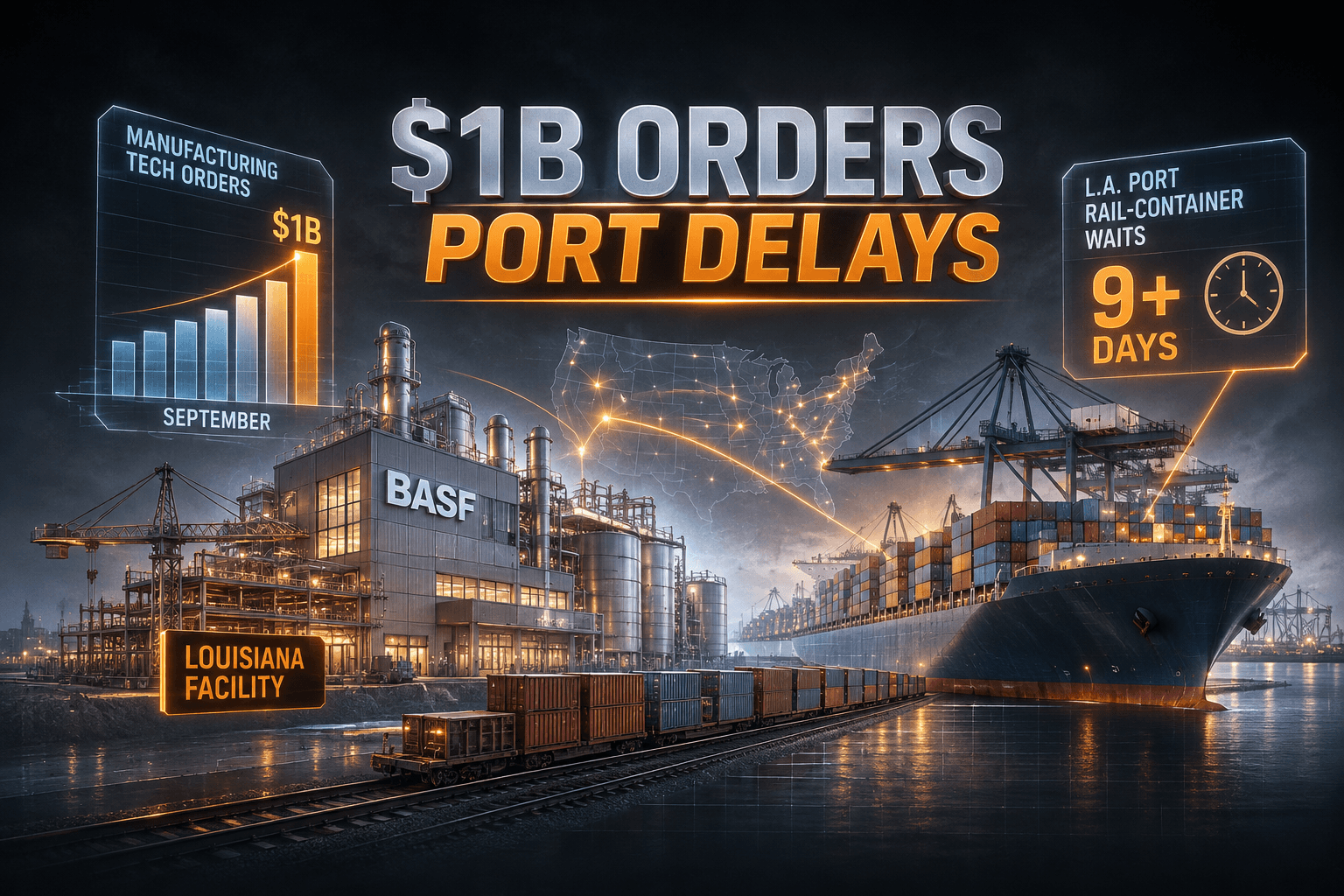
Industrial investment is building, but supply-chain friction remains in view: BASF opened a $1 billion Louisiana production facility as rail-bound containers at the Port of Los Angeles waited more than nine days. The mix captures the sector’s central tension: companies are adding capacity and deploying technology, while logistics delays can complicate the movement of goods.
Manufacturing technology orders reached $1 billion in September, and several companies announced openings or expansion projects this week. US stock markets are closed Saturday, November 14, so there’s no trading session to assess; the next session is Monday, November 16. For you, the key question is whether investment and efficiency efforts can translate into durable operating gains despite supply-chain bottlenecks.
Market Highlights
The week’s updates span industrial production, factory technology and retail logistics. The figures are operational announcements, not a set of reported stock moves, and the supplied stories don’t include share-price changes. With markets closed, investors can use the weekend to consider what the developments may mean for companies’ capacity and execution.
- Manufacturing technology orders totaled $1 billion in September. The report also highlighted expansion or opening plans involving GE Vernova, Honda, Kopin and ATP Adhesive.
- BASF opened a $1 billion MDI facility in Geismar, Louisiana. The company described it as its largest single US investment and its most significant MDI production site in North America.
- Rail-bound container dwell times at the Port of Los Angeles exceeded nine days, according to Executive Director Gene Seroka.
- JD Sports is working with Zebra on real-time inventory visibility and cited 98% on-shelf availability. Walmart more than doubled its planned drone-delivery sites through an expanded partnership with Zipline.
For publicly traded names mentioned in these reports, GE Vernova trades as $GEV, Honda as $HMC, Kopin as $KOPN, BASF’s US OTC ADR as $BASFY, and Walmart as Walmart (WMT). These announcements alone don’t establish how the companies’ shares will perform. No percentage share-price changes were provided in the source reports.
Key Developments
Capacity additions point to continued investment
BASF’s Geismar opening is the clearest single capital-investment headline. The facility produces MDI, a chemical used in making polyurethane materials, and BASF says the site makes it a more significant producer of MDI in North America. The $1 billion commitment demonstrates a substantial addition to the company’s regional production footprint, though the report doesn’t provide production volumes, utilization targets or financial guidance tied to the opening.
Other expansion and opening announcements this week included GE Vernova, Honda, Kopin and ATP Adhesive. Taken together with September’s $1 billion in manufacturing technology orders, these stories show spending and project activity across several parts of the industrial ecosystem. For investors, the useful distinction is between announced investment and measurable results: watch for later disclosures on capacity, customer demand, operating costs and project ramp-up.
Factory technology aims to reduce waste and costs
At a virtual State of Automotive Manufacturing event, experts discussed using artificial intelligence to improve factory-floor connectivity and optimize supply chains. The stated goals include less waste, lower costs and more flexibility. Those are potential benefits, not reported outcomes from the event, so it’s too early to infer that AI adoption has already lifted margins across automakers.
Retail supply chains offer a related example of technology being applied to day-to-day operations. JD Sports is partnering with Zebra to improve real-time inventory visibility across its omnichannel business, citing 98% on-shelf availability. That metric offers a snapshot of availability, but the report doesn’t quantify the partnership’s financial impact or say how the figure may change. This is where the rubber meets the road: whether better information produces faster replenishment and fewer missed sales.
Logistics delays contrast with delivery innovation
At the Port of Los Angeles, rail-bound containers faced dwell times of more than nine days. Extended waits can make shipment timing harder to manage for businesses moving goods through the port, although the report doesn’t specify which manufacturers or customers are most affected. The elevated dwell time is a concrete risk to monitor alongside investment announcements.
Walmart, meanwhile, more than doubled its planned drone-delivery sites in an expanded partnership with Zipline. The plan is to make rapid air delivery available to customers nationwide over the next several years, not immediately. The announcement signals an ambition to broaden delivery options, but the report doesn’t give a site count, rollout timetable by market or expected financial contribution.
What to Watch
On Monday, November 16, the next US trading session begins after the weekend. Investors can watch whether companies provide follow-up details on the announced expansions and whether any new company disclosures connect capacity investment to demand, costs or production targets. The supplied stories don’t identify upcoming earnings dates or policy events, so avoid treating these operational headlines as a near-term earnings forecast.
For industrial supply chains, the Port of Los Angeles’ rail dwell time is an important operational indicator. Look for updates on whether waits ease or remain elevated, and consider what a prolonged delay could mean for delivery schedules. You should also distinguish a broad technology-order total from orders for any one company; the reported $1 billion figure doesn’t identify individual beneficiaries or establish future revenue.
For factory AI and delivery automation, the next useful evidence will be implementation and performance data. Watch for companies to report measurable changes in waste, costs, inventory availability or delivery coverage. Until then, the announcements establish plans and objectives, not proven returns.
Bottom Line
- The sector’s news flow is mixed: capacity investment and technology adoption sit alongside logistics delays.
- BASF’s $1 billion Geismar facility is a major production addition, but financial effects and ramp-up details weren’t provided.
- September manufacturing technology orders reached $1 billion, though the report doesn’t break out company-level totals.
- More than nine days of rail-container dwell time at the Port of Los Angeles is a supply-chain risk worth tracking.
- Factory AI, inventory tools and drone delivery remain developments to assess through future operating data, not announcements alone.
FAQ
Q: Are US markets open on Saturday, November 14? A: No. US stock markets are closed Saturday, and the next trading session is Monday, November 16.
Q: What was the biggest investment announcement? A: BASF opened a $1 billion MDI production facility in Geismar, Louisiana, its largest single US investment to date.
Q: What is the main supply-chain concern in these reports? A: Rail-bound containers at the Port of Los Angeles faced more than nine days of dwell time, according to the port’s executive director.