The Big Picture
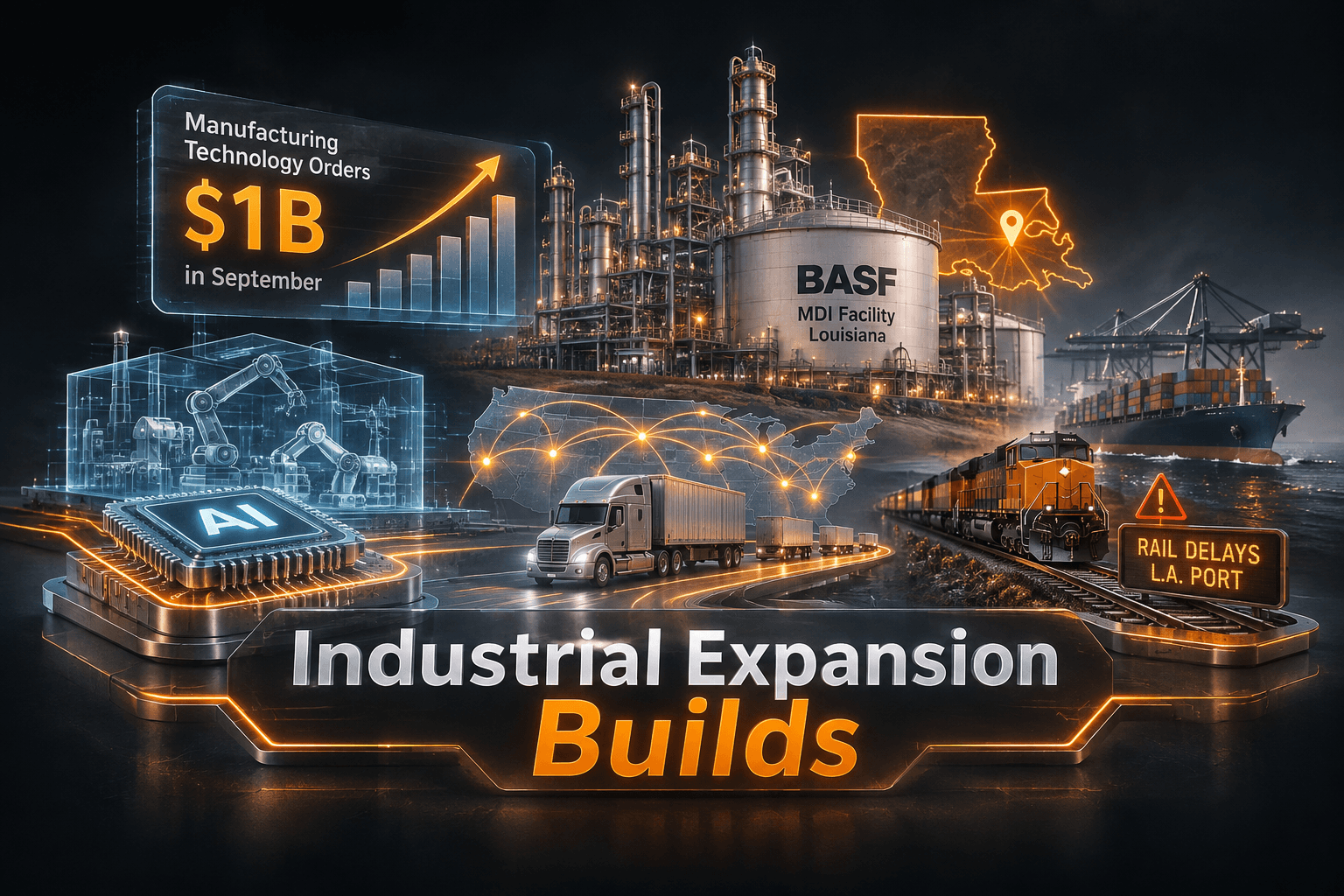
A $1 billion manufacturing technology order total and BASF's opening of a $1 billion Louisiana plant put industrial investment in focus Friday. Together with expansion announcements and factory efficiency initiatives, the news suggests companies continue to direct capital toward production capacity and more flexible operations.
The picture isn't uniformly positive: containers waiting for rail transport at the Port of Los Angeles are facing dwell times of more than nine days. For you, the key takeaway is a sector with active investment plans but persistent logistics friction that could complicate the movement of goods.
Market Highlights
- Manufacturing technology orders reached $1 billion in September, according to Manufacturing Dive.
- BASF opened a $1 billion MDI production facility in Geismar, Louisiana, its largest single US investment to date.
- Port of Los Angeles rail-bound containers faced waits of more than nine days, according to Executive Director Gene Seroka.
- JD Sports cited 98% on-shelf availability as it partners with Zebra for real-time inventory visibility.
- Walmart more than doubled its planned drone delivery sites through an expansion with Zipline.
Among publicly traded companies mentioned, GE Vernova trades as $GEV, BASF as $BASFY, Honda as $HMC, Walmart as Walmart (WMT), and Kopin as $KOPN. The reports provided no daily price or percentage changes for these companies, so the operational developments should be kept separate from any claim about how their shares performed.
Key Developments
Manufacturing investment broadens across sectors
The September tally of $1 billion in manufacturing technology orders offers a signal of equipment demand, though the report doesn't provide a year-over-year comparison or a breakdown of order categories. The broader roundup also noted openings or expansion projects from GE Vernova, Honda, Kopin, and ATP Adhesive, showing that investment activity spans multiple manufacturers and technologies.
For investors, the reported spending is an indicator to track, not proof that revenues or profits will rise immediately. Orders, construction, and facility openings can take time to translate into operating results. You'll want to look for company disclosures on project timelines, capacity utilization, and expected costs before drawing conclusions about the financial impact.
BASF adds major MDI capacity in Louisiana
BASF has opened its Geismar MDI production facility, a $1 billion investment and the company's largest single investment in the United States. The site makes BASF its most significant MDI producer in North America, expanding its production footprint for a material used in polyurethane products.
The scale of the project underscores a long-term commitment to regional manufacturing capacity. Its eventual contribution to results will depend on factors not detailed in the report, including demand, operating rates, and production costs. Still, the opening is a concrete milestone, unlike an expansion announcement that has yet to reach operation.
Technology targets efficiency, but logistics remain a test
At a State of Automotive Manufacturing virtual event, experts said artificial intelligence can improve factory-floor connectivity and help optimize supply chains. The focus on reducing waste, cutting costs, and increasing flexibility reflects manufacturers' effort to get more from existing operations as well as invest in new capacity.
Elsewhere in the supply chain, JD Sports is working with Zebra to improve real-time inventory visibility and faster replenishment, citing 98% on-shelf availability. Walmart's expanded Zipline plans aim to make rapid drone delivery available to customers nationwide over several years. These examples show technology moving from factory operations into inventory management and last-mile delivery, while the Port of Los Angeles' rail dwell times highlight the physical bottlenecks that software alone can't solve.
What to Watch
Tomorrow and in the coming weeks, monitor updates from companies on the timing and execution of announced expansions, as well as details on manufacturing technology demand. BASF's new facility is now open, so future operating updates may offer more insight into ramp-up and production levels. The reports don't identify a specific upcoming earnings date or policy event tied to these developments.
Logistics is the clearest near-term risk in today's roundup. Rail dwell times exceeding nine days could signal delays in moving containers onward from the port, but the report doesn't quantify the effect on manufacturers or retailers. Watch for updates on whether waits ease, and compare them with company commentary on inventory, delivery timing, and costs. As you assess the efficiency stories, distinguish announced capabilities from demonstrated savings.
Bottom Line
- Manufacturing technology orders reached $1 billion in September, a constructive demand datapoint without a reported comparison period.
- BASF's new $1 billion Geismar facility marks a significant addition to North American MDI production capacity.
- AI, inventory visibility, and drone delivery feature in efforts to improve efficiency across manufacturing and distribution.
- Port of Los Angeles rail delays above nine days are a counterweight and merit follow-up.
- Company execution and operating updates will matter more than announcement headlines when gauging financial impact.
FAQ
Q: What was the biggest industrial investment announced today? A: BASF opened its $1 billion MDI production facility in Geismar, Louisiana, its largest single US investment to date.
Q: What is the main supply-chain concern? A: Rail-bound containers at the Port of Los Angeles faced dwell times of more than nine days.
Q: How are manufacturers using AI? A: Experts said AI can connect factory-floor operations and optimize supply chains, supporting efforts to reduce waste and improve flexibility.
This article is for informational purposes only and is not personalized investment advice.