The Big Picture
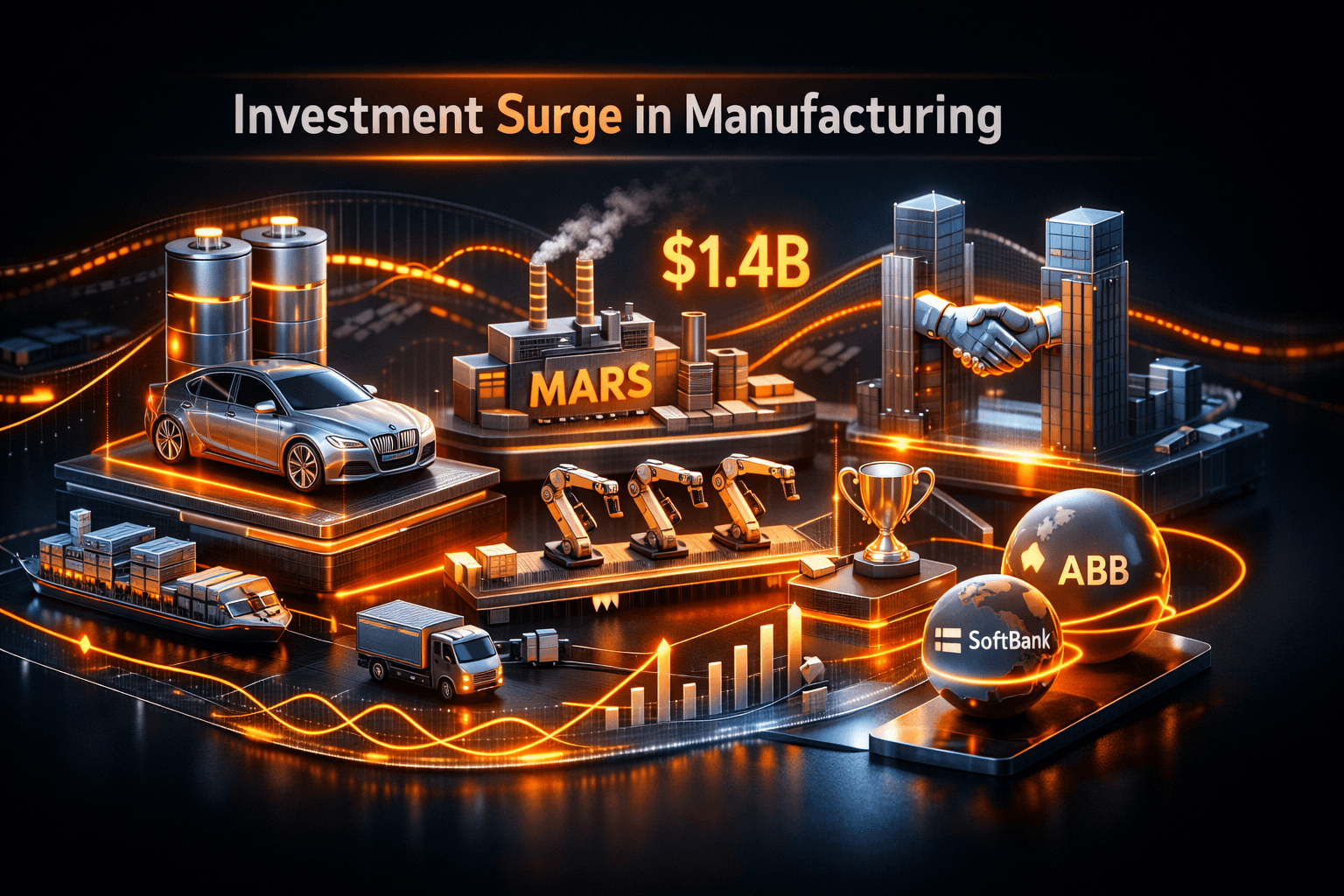
Major capital commitments and supply- chain localization are driving momentum in the Industrial & Manufacturing sector this morning. BMW's new battery supply agreements and Mars' $1.4 billion U.S. manufacturing plan signal that automakers and consumer goods firms are pushing to secure regional production and inputs.
Those moves come alongside industry recognition for system integrators focused on software-defined automation, suggesting technological investment is stepping up even as freight volumes and logistics show softer seasonal demand. What does this mean for you as an investor watching industrials today? It points to selective strength in manufacturers and suppliers tied to electrification and reshoring, even while transportation remains a headwind.
Market Highlights
Quick takeaways you can scan before the open or as markets trade today:
- BMW announced new battery cell supply deals with Samsung SDI and LG Energy Solution to localize EV battery sourcing for the U.S. and Europe, a strategic step for its EV rollout, noted across industry coverage this week, ticker cited in reporting: $BMW.
- Mars said it will invest $1.4 billion in U.S. manufacturing and operations in 2027, the largest single-year spend the company has disclosed, aimed at integrating its Kellanova acquisition and expanding snack production.
- System integrator awards from Plant Engineering recognized George T. Hall (under $10M), GreyLogix ($10M–$40M), and GrayMatter (over $40M) for complex control-system and software-defined automation work, reinforcing demand for advanced integration services.
- Logistics signals were mixed: Xeneta data showed air cargo failed to produce an expected year-end surge, while transpacific ocean rates eased slightly as peak season cooled.
- Deal uncertainty resurfaced as SoftBank reentered talks around its planned robotics acquisition from $ABB after China blocked the original deal, leaving potential carve-outs or a change of buyer on the table, ticker: $ABB.
Key Developments
BMW localizes battery supply for U.S. and Europe
BMW's contracts with Samsung SDI and LG Energy Solution underline a broader push to regionalize EV battery supply chains and reduce exposure to long global logistics tails. For suppliers and battery materials firms, that trend suggests higher near-term order visibility and more stable demand in North America and Europe.
How will your exposure change if supply localization accelerates? Suppliers with capacity or partnerships near BMW plants could see stronger demand, while firms reliant on distant, long-haul logistics may face margin pressure.
Mars commits $1.4 billion to U.S. manufacturing
Mars' announcement, tied to its integration of Kellanova assets, is a major capital allocation aimed at scaling snack production and reshoring operations. That kind of spending often trickles down to equipment makers, packaging suppliers, and contract manufacturers.
Data suggests such investments typically boost orders for industrial equipment and automation, a potential tailwind for engineering and parts suppliers in 2027. Will that translate into revenue growth this quarter, or is it a longer-term lift? Expect a phased benefit as projects ramp.
Freight and deal friction create mixed signals
Freight markets showed a cooling of the late-season surge many had hoped for, with air cargo volumes disappointing and transpacific rates easing but remaining elevated year over year. That eases immediate cost pressures for some shippers, yet persistent rate gaps still affect margins for import-reliant manufacturers.
Meanwhile, the return of talks between SoftBank and $ABB after China blocked an acquisition highlights geopolitical and regulatory risk in cross-border robotics deals. Corporate restructurings, carve-outs, or alternative buyers could create near-term volatility for suppliers and integrators tied to automation robotics.
What to Watch
Here are the catalysts and risks that will shape sector moves in the near term, and what you should monitor.
- Supply-chain signals: Watch October and November freight, port throughput, and air cargo reports for confirmation of a softer year-end. Slower volumes can relieve short-term cost pressure, but they also signal weaker demand for export-focused manufacturers.
- Deal and policy updates: Keep an eye on any resolution to the SoftBank-$ABB talks and on U.S. trade policy chatter, including manufacturing groups pushing for tariff enforcement after midterm elections. Policy shifts could reshape sourcing strategies.
- Capital spending cadence: Look for more details from Mars on project timelines and for supplier commentary during upcoming earnings. Also watch capital orders and backlog comments from automation and equipment makers for early signs of spending trends.
- Earnings and guidance: Upcoming quarterly reports from major industrials and equipment suppliers will clarify whether localized battery deals and reshoring are already showing up in order books.
- Input costs: Monitor metal, chemical, and battery material prices. If raw material inflation slows, margins could improve for manufacturers with heavy raw input exposure.
Bottom Line
- Capital and supply-chain localization are providing a bullish signal for manufacturers tied to EVs and consumer goods, with BMW and Mars leading headlines today.
- Automation and system integrators are getting recognition for software-defined projects, indicating steady demand for advanced manufacturing upgrades.
- Logistics showed mixed, softer seasonal demand, so you should watch freight and port metrics for signs of stabilization or renewed strain.
- Regulatory and deal uncertainty, highlighted by SoftBank and $ABB, could prompt volatility in robotics and automation supply chains.
- Stay selective, and keep an eye on order books, earnings guidance, and raw material trends to see whether momentum broadens across the sector.
FAQ Section
Q: How will BMW's battery deals affect suppliers? A: The deals point to greater regional demand for battery cells and components, benefiting suppliers near BMW plants and companies with scalable cell or pack production capabilities.
Q: Does Mars' $1.4B investment mean immediate revenue growth for equipment makers? A: Not immediately, projects typically roll out over quarters, but equipment, packaging, and automation suppliers often see rising order flow as projects move from planning to execution.
Q: Should I be worried about freight weakness? A: Freight softness can relieve short-term cost pressure, but it may also signal weaker end-market demand, so monitor volume trends and supplier backlog comments for clarity.