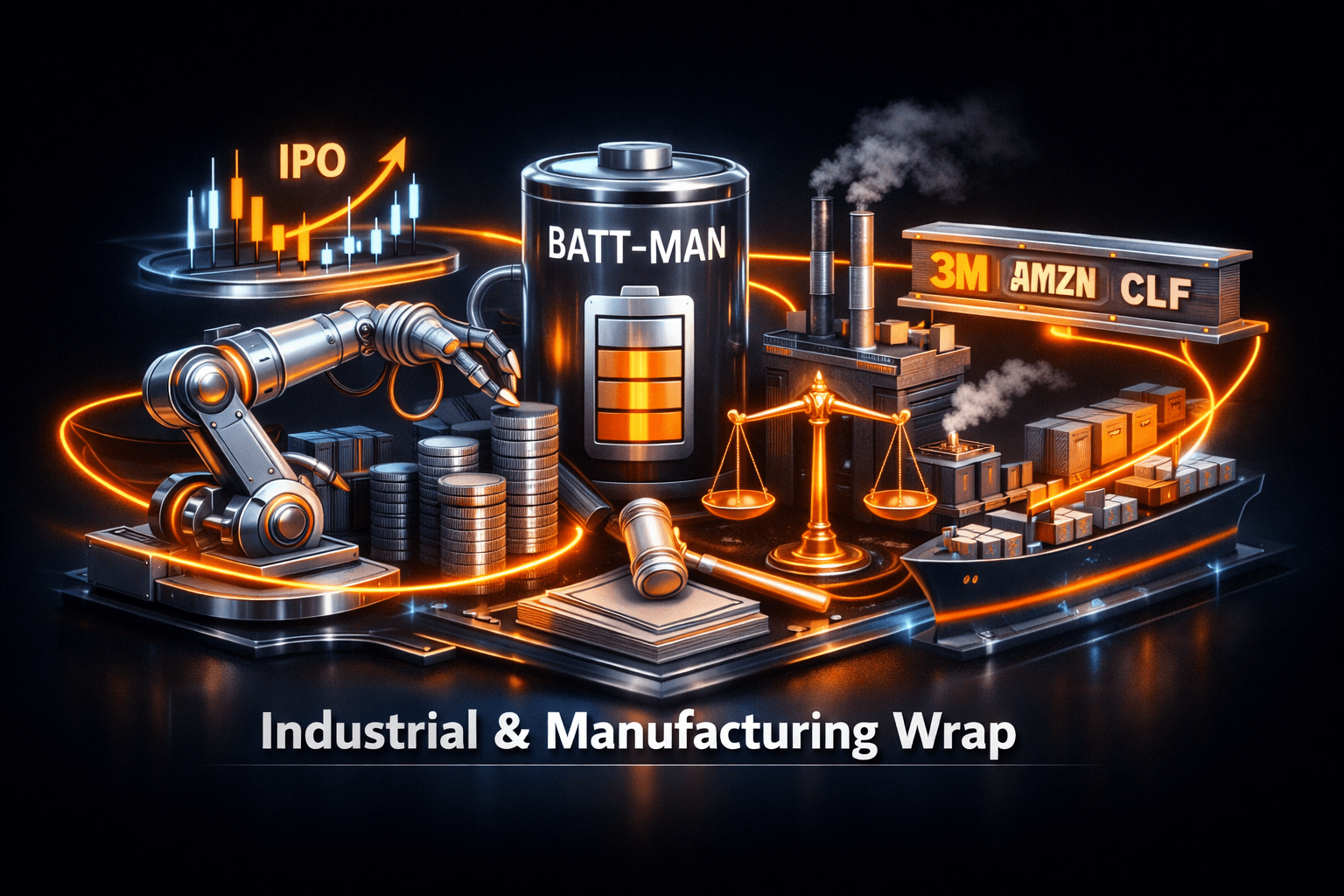
The Big Picture
Today the Industrial & Manufacturing sector saw mixed but meaningful developments that will matter to your portfolio and to the broader U.S. supply chain. Federal and industry actions aimed at securing batteries and logistics capacity collided with corporate moves that resolve long‑running liabilities and push automation into daily operations.
Those shifts mean clarity in some corners and fresh pressure in others. You should pay attention to policy signals and technology adoption, because they can change cost curves and competitive positioning over the next year.
Market Highlights
Here are the key facts you need from today's headlines. Read these bullets to catch up fast on company actions, policy signals, and funding events.
- $MMM: 3M proposed a $7.4 billion deal to resolve roughly 99% of personal injury PFAS claims tied to AFFF litigation, aiming to reduce legal uncertainty for the company and its investors.
- $CLF: Cleveland‑Cliffs confirmed it will meet with Canada’s Minister of Industry to discuss a path to resume full employment for laid‑off Stelco workers in Hamilton, Ontario.
- Amazon.com (AMZN): Amazon rolled out thousands of smart glasses to delivery drivers to boost navigation and drop‑off efficiency, expanding its automation footprint in logistics.
- $CCXI / Agility Robotics: Agility cleared a shareholder vote and raised $465 million ahead of a planned public listing via a merger valued at about $2.5 billion, with trading set to start this Thursday.
- BattMan: The Energy Department’s Battery Manufacturing Accelerator aims to shore up domestic material and component supplies as U.S. battery demand is expected to quadruple in the coming years.
- Trade costs: The World Shipping Council and the National Retail Federation urged USTR to permanently suspend China‑linked ship fees, warning of another cost layer for an already strained transportation system.
Key Developments
3M’s $7.4B PFAS settlement, legal risk turns toward resolution
3M said it has proposed a $7.4 billion settlement to resolve the bulk of PFAS personal injury claims connected to AFFF litigation, potentially addressing about 99% of current claims. For you that means legal uncertainty may start to clear, but balance sheets and cash flow will face pressure while the deal is implemented and approved by courts.
Automation and robotics scale up in logistics and manufacturing
Amazon's deployment of thousands of smart glasses to delivery drivers signals a push to embed augmented workflows at the front line, improving routing and drop accuracy. At the same time, Agility Robotics cleared its shareholder vote and looks set to list after raising $465 million, which could accelerate commercial adoption of humanoid robotics in warehouses and lines.
These moves show automation is moving from pilot projects to scaled deployments. If you follow industrial automation, ask whether your exposure captures productivity gains or risks of capital intensity.
Policy and supply chain: BattMan and shipping fees in focus
The Energy Department’s Battery Manufacturing Accelerator, nicknamed BattMan, is designed to close gaps in U.S. material and component supplies as domestic battery demand may quadruple. That is good news for companies building capacity, but it raises questions about timelines and the near‑term supply constraints you should monitor.
Meanwhile, industry groups urged the USTR to permanently suspend China‑linked ship fees, saying added charges would increase costs across transport networks. That plea highlights the fragility of freight economics and why logistics costs remain a watch item for manufacturers and retailers.
What to Watch
Expect a busy calendar that could move stocks and supplier chains in the short term. You should monitor policy actions, Q4 guidance, and execution on automation rollouts.
- Regulatory approvals: Court decisions on the $7.4 billion 3M settlement are a key near‑term catalyst that could remove litigation overhang or force adjustments to the proposal.
- Battery policy rollout: Watch for funding details and award announcements from BattMan, and track which battery material and component suppliers win contracts.
- Labor and operations: Follow Cleveland‑Cliffs meetings with Canadian officials to see whether layoffs are reversed and what timelines are proposed for rehiring at Hamilton works.
- Automation scale: Look for Agility Robotics' first trading day and early commercial win announcements, plus performance metrics from Amazon’s smart‑glasses pilot as it scales.
- Logistics costs: Keep an eye on USTR action on China‑linked shipping fees and any carrier pass‑throughs that could affect input costs for manufacturers.
Which of these will move the needle for you? The answer depends on exposure and time horizon.
Bottom Line
- Today’s news is balanced: policy and automation provide upside for industrial productivity while litigation and potential shipping fees keep costs elevated.
- 3M’s settlement proposal may clear legal uncertainty but will use substantial capital, so expect lingering conversations about cash allocation and liability management.
- Automation is accelerating, with $AMZN deploying smart glasses and Agility preparing to list, indicating increased adoption of robotics and wearable tech across logistics.
- BattMan signals stronger federal support for domestic battery supply chains, but procurement and buildout timelines will determine near‑term impact.
- Monitor regulatory and labor developments closely, because they can create abrupt shifts in costs and capacity that affect margins and order flows.
FAQ Section
Q: What does 3M’s $7.4 billion proposal mean for shareholders? A: Analysts note the proposal aims to resolve most PFAS claims, which could reduce litigation uncertainty, but it also represents a large cash commitment that may affect capital allocation and near‑term balance sheet metrics.
Q: Will BattMan fix battery supply shortages quickly? A: The program should strengthen domestic supply over time, but data suggests buildout and sourcing will take several years, so near‑term shortages may persist while capacity scales.
Q: How important is Amazon’s smart‑glasses rollout? A: It shows a practical move from pilots to wider deployment in last‑mile logistics, which could boost efficiency and set a standard other carriers may follow.