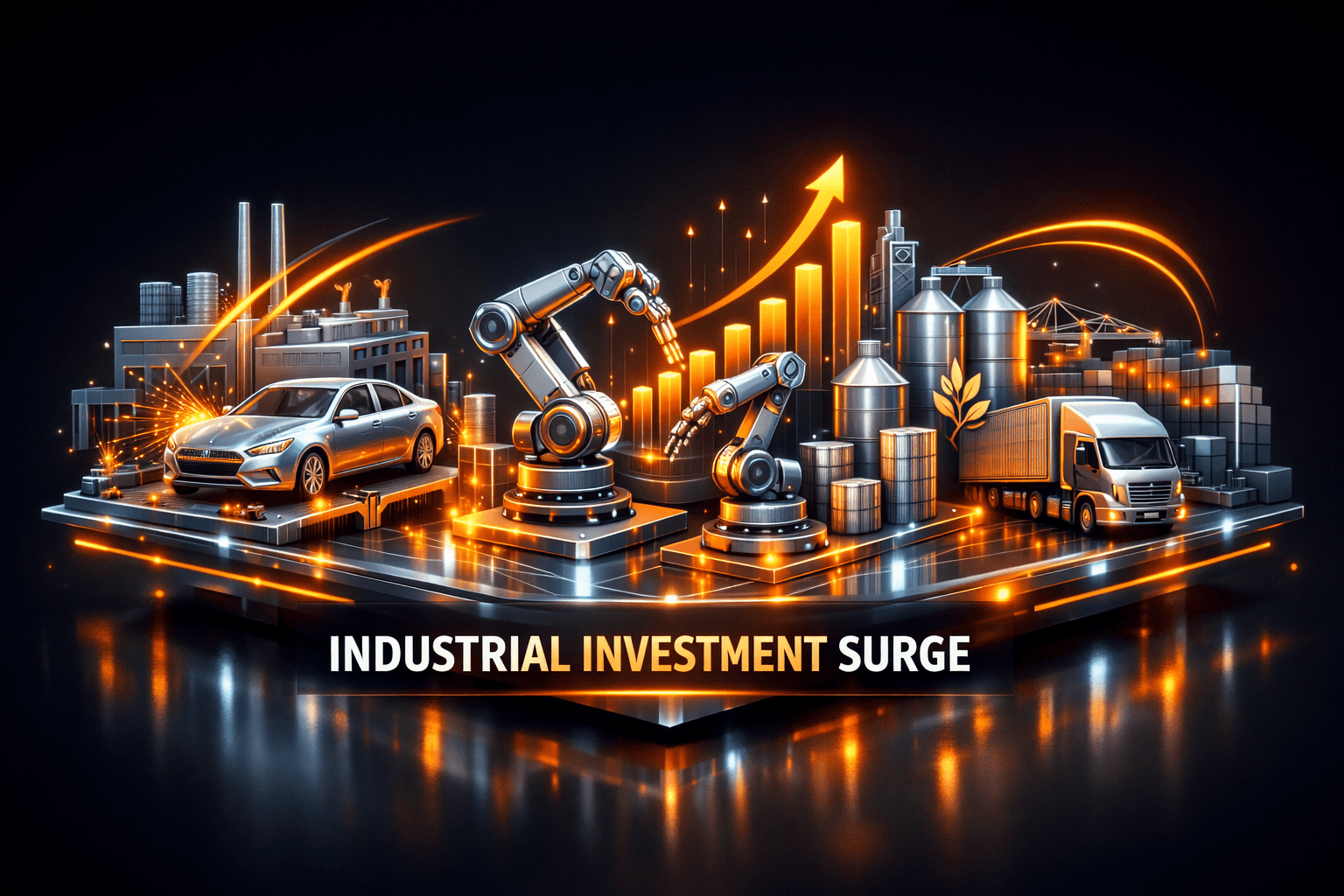
The Big Picture
Capital and demand signals moved to the foreground today, and that matters for your view of industrial stocks. General Motors confirmed Lansing Delta Township will produce hybrid vehicles as a $500 million grant is restructured with Department of Energy support, while automation demand accelerated with North American robot orders rising nearly 25% in Q3.
At the same time the USDA announced more than $1.3 billion for fertilizer projects, and major logistics players including United Parcel Service (UPS) and Walmart (WMT) announced expansions in visibility and distribution capacity. Together these developments point to rising investment in production, supply resilience, and automation, which could support margins over time.
Market Highlights
Several concrete metrics stood out that you can use to size today's flow of capital and demand.
- General Motors General Motors (GM) confirmed Lansing Delta Township will build hybrid vehicles as a previously awarded $500 million grant is restructured with the Department of Energy.
- Association for Advancing Automation reported North American robot orders grew nearly 25% in Q3, the strongest quarter of 2026 so far, led by semiconductor, biopharma and automotive demand.
- USDA said it will fund eight fertilizer manufacturing projects totaling more than $1.3 billion, aimed at boosting domestic nutrient production and reducing import reliance.
- $UPS plans to scale RFID-labeled package volume, with the company targeting visibility for about 6 million packages per day in 2027.
- $WMT announced a $400 million, 744,000-square-foot distribution center in Cibolo, Texas, with groundbreaking expected in February.
Key Developments
Autos and electrification
GM's confirmation that the Lansing Delta Township plant will produce hybrid vehicles arrives as the company and the Department of Energy restructure a previously awarded $500 million grant. For you that means federal support is being preserved while plans shift to reflect market demand for hybrids as an intermediate step in electrification.
The hybrid build decision signals automakers are balancing full electrification timelines with consumer and supply realities, and it could influence parts suppliers and materials demand in the near term.
Robotics and factory automation
Robot orders in North America rose nearly 25% in Q3, the Association for Advancing Automation reported, driven by surging demand from semiconductor, biopharma and automotive industries. That is the strongest quarter of 2026 so far, and it suggests manufacturers are still investing to boost throughput and precision.
What does this mean for you as an investor? Increased automation can lift capital spending in the short run and improve unit economics over time, but it also raises questions about the timing of productivity gains and the winners among equipment makers and systems integrators.
Logistics, capacity and supply resilience
The USDA's financing of eight fertilizer projects totaling more than $1.3 billion aims to add production capacity and reduce import reliance. Increased domestic fertilizer production could relieve input cost pressure for farmers and food processors down the line.
On the logistics side $UPS is expanding RFID adoption to target 6 million packages a day by 2027, while $WMT is committing $400 million to a new Texas distribution center. Those moves add visibility and capacity to supply chains and could cut friction for retailers and shippers, a silver lining for margins if execution follows through.
What to Watch
Several catalysts and risk points will matter for industrials and manufacturing in the coming weeks and months, and you'll want to track them closely.
- Earnings and guidance from major OEMs and industrial equipment makers, which will show whether capex for automation and electrification is translating to orders and margin improvement.
- Follow-through on the USDA projects, including permitting and construction timelines, since delays would push out any price relief from higher domestic fertilizer supply.
- Adoption rates for RFID at $UPS and other carriers, and whether standardized tagging reduces loss and improves fulfillment economics as promised.
- Labor and hiring developments, including programs to recruit workers with disabilities, which could widen the available labor pool but will require capital and training to implement effectively.
- Policy signals from the Department of Energy and other agencies about grant restructuring and future incentives for electrification and domestic manufacturing.
Can manufacturers convert these investments into sustained productivity gains? Execution risk is real, so monitor order books and unit economics rather than headlines alone.
Bottom Line
- Federal and private investment accelerated across autos, automation, fertilizer production and logistics today, pointing to a constructive demand backdrop for industrial capital spending.
- $GM's hybrid production plan keeps federal grant support intact while aligning capacity with current consumer and supply conditions.
- Robot orders up nearly 25% in Q3 indicate continued automation spending in semiconductor, biopharma and auto supply chains.
- USDA funding and big retail and carrier logistics projects should improve domestic supply resilience, but watch execution timelines and permitting.
- For your portfolio perspective, analysts note the moves boost investment themes in automation and supply-chain modernization, yet risk remains around project rollouts and macro demand cycles.
FAQ Section
Q: How will GM's Lansing decision affect suppliers? A: Suppliers tied to hybrid powertrain components may see steadier demand than if the plant converted immediately to full electrics, and analysts will watch supplier order cadence for confirmation.
Q: Does the 25% rise in robot orders mean automation adoption is accelerating? A: Data suggests strong near-term investment, especially in semiconductor, biopharma and automotive, but you'll want to see recurring order flow to confirm a long-term trend.
Q: Will USDA funding cut fertilizer prices quickly? A: The projects aim to add capacity and reduce import reliance, but material price relief depends on project timelines, ramp speeds and global market conditions.