The Big Picture
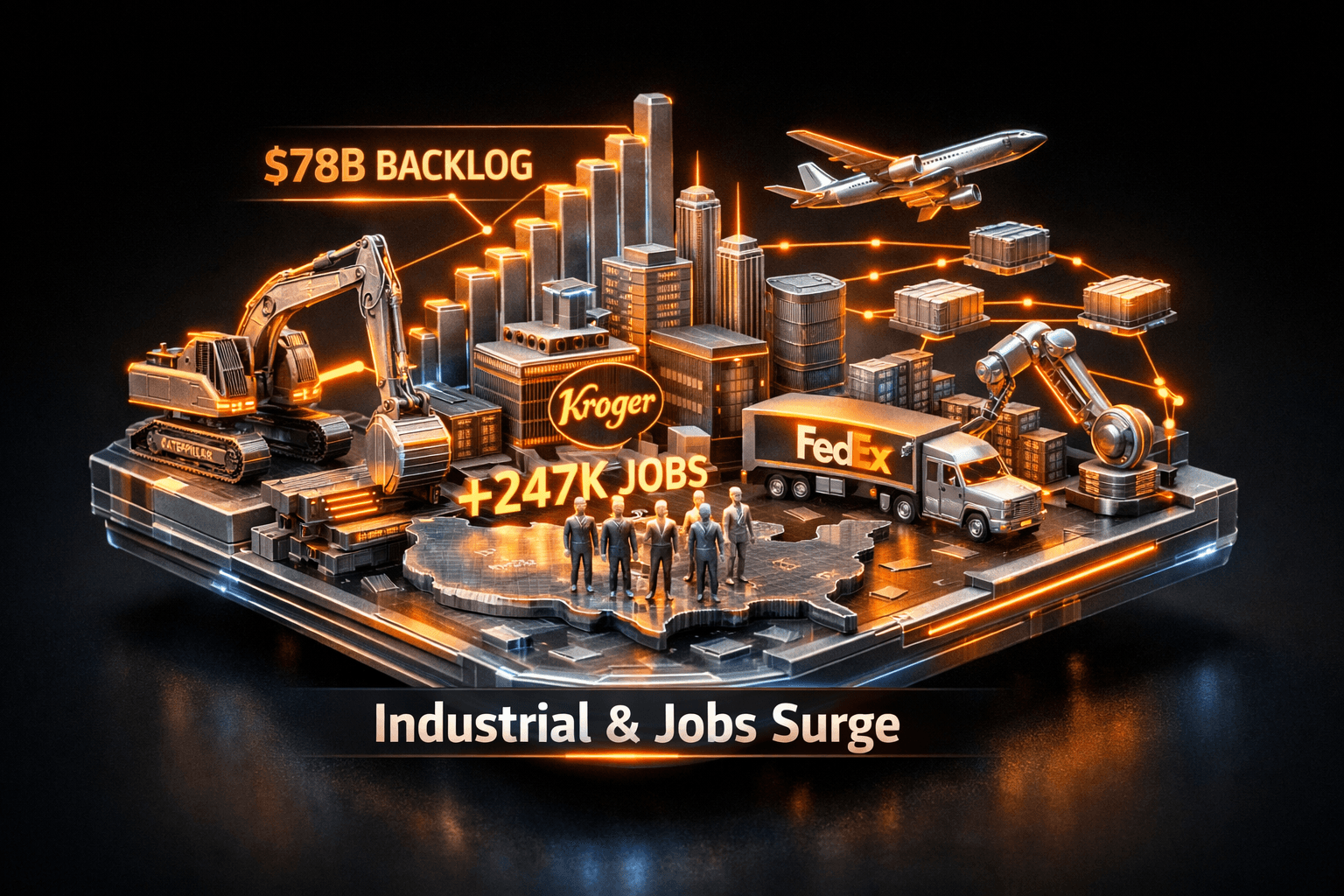
Caterpillar posted its highest sales quarter ever and saw its order backlog surge to $78 billion, almost double the year-ago level, and that headline dominated today for industrials and manufacturing. You should note that the combination of stronger data-center demand, reshoring flows, and retailers taking direct control of sourcing is reinforcing demand across equipment, logistics, and supply-chain services.
These developments matter because they point to revenue momentum and operational shifts that can reshape margins and capital spending plans. What does it mean for you as an investor watching the sector? Expect selective strength where exposure to infrastructure, power, logistics, and nearshoring is highest.
Market Highlights
Today’s activity reinforced a growth narrative in parts of the sector while leaving policy uncertainty lower after a trade decision that favored talks over tariffs.
- Caterpillar Caterpillar (CAT): Reported its highest sales quarter and an order backlog of $78 billion, roughly double year-ago backlog.
- Reshoring/FDI: The Reshoring Initiative says reshoring and foreign direct investment added 247,000 jobs in 2025 and expects about 25% growth in 2026.
- Kroger The Kroger (KR): Accelerating direct sourcing efforts to push first-party procurement volumes above 10%, working toward a fully owned import and distribution model.
- FedEx FedEx (FDX): Seeing rising demand from parcel-focused shippers for air freight as customers seek faster service for high-value AI and data-center shipments.
- Wella owner (The Wella Company): Appointed Javier Huerta as chief supply chain officer effective Dec. 1 to oversee sourcing, manufacturing, and logistics.
Key Developments
Caterpillar's record quarter and a massive backlog
Caterpillar said it posted the highest sales quarter in its history, and its backlog climbed to $78 billion, almost double what it was a year ago. That backlog indicates sustained demand for heavy machinery and power equipment, particularly from data centers and infrastructure projects, which supports longer-term revenue visibility for suppliers and rental fleets.
For you, that means companies exposed to power systems, diesel and electric equipment, and aftermarket parts could see steadier order books. Analysts note higher backlog tends to lower near-term cyclicality and gives firms more pricing leverage when supply tightness persists.
Reshoring and FDI sustain manufacturing jobs
The Reshoring Initiative reported 247,000 jobs added in 2025 through reshoring and foreign direct investment, a result similar to 2024 with expectations of roughly 25% growth in 2026. Transportation industries led reshoring activity, underscoring demand for local logistics and fleet equipment.
Can reshoring become a multi-year tailwind? If the 2026 growth materializes, you could see stronger investment in U.S. manufacturing capacity and a longer runway for suppliers and industrial automation vendors.
Supply-chain moves and trade policy lower near-term risk
Kroger is accelerating direct sourcing to boost first-party procurement to more than 10% and is moving toward a fully owned import and distribution model to gain cost control and visibility. That shift highlights a trend where large buyers reduce intermediaries, which can pressure third-party intermediaries but benefit logistics and private-label suppliers who win direct deals.
On trade policy, the administration chose negotiations over immediate tariffs for robotics and industrial machinery flagged by a Section 232 probe. That decision removes an immediate tariff shock for many manufacturers and keeps trade disruption risk lower for now, which is a positive for capital goods demand and global supply chains.
What to Watch
Look for earnings and order trends from capital goods makers and logistics firms over the next few weeks. Caterpillar will be the bellwether to watch for signs of whether backlog converts into sustained revenue and margin gains.
Upcoming catalysts you should track include quarterly reports from major industrial suppliers, manufacturing PMI and ISM data, and any developments from the Section 232 negotiations on robotics and machinery. Will the talks produce binding agreements or just temporary pauses? The answer will guide supply-chain planning.
Risks to monitor include a slowdown in data-center spending, weakening global manufacturing demand, or a reversal in policy that reintroduces tariffs. Also watch for margin pressure if direct sourcing by large retailers accelerates faster than suppliers can adapt.
Bottom Line
- Caterpillar's record quarter and $78 billion backlog point to durable, equipment-led demand, especially for data-center and infrastructure projects.
- Reshoring and FDI added 247,000 jobs in 2025 and may accelerate in 2026, supporting onshore manufacturing, logistics, and industrial automation markets.
- Kroger's push to increase first-party sourcing to over 10% signals more direct procurement, which changes supplier relationships and distribution economics.
- Trade talks instead of tariffs reduce immediate policy risk for robotics and industrial machinery imports, offering a calmer near-term outlook for capital goods flows.
- Actionable takeaway: monitor order conversion at equipment makers, air freight demand tied to AI and data centers, and reshoring announcements to assess where you see longer-term exposure, while remembering this is informational and not personalized advice.
FAQ
Q: How does Caterpillar's backlog affect suppliers and service providers? A: A larger backlog typically means steadier future demand for parts, attachments, and field service, which can support revenue visibility for suppliers.
Q: Will reshoring produce immediate profit gains for manufacturers? A: Reshoring can raise near-term costs as capacity is built, but analysts note benefits over time in reduced logistics risk, faster turnaround, and better control of quality.
Q: Does the decision to negotiate on robotics tariffs remove trade risk entirely? A: No, negotiations lower the immediate threat of tariffs but do not guarantee a final outcome; you should watch negotiation progress for policy risk changes.
Investment disclaimer: This article provides market analysis and reported facts for informational purposes only. It does not recommend buying, selling, or holding any security, and it is not personalized investment advice. Analysts note that momentum indicates sector strength, but you should consider your own situation and consult a professional before making investment decisions.