The Big Picture
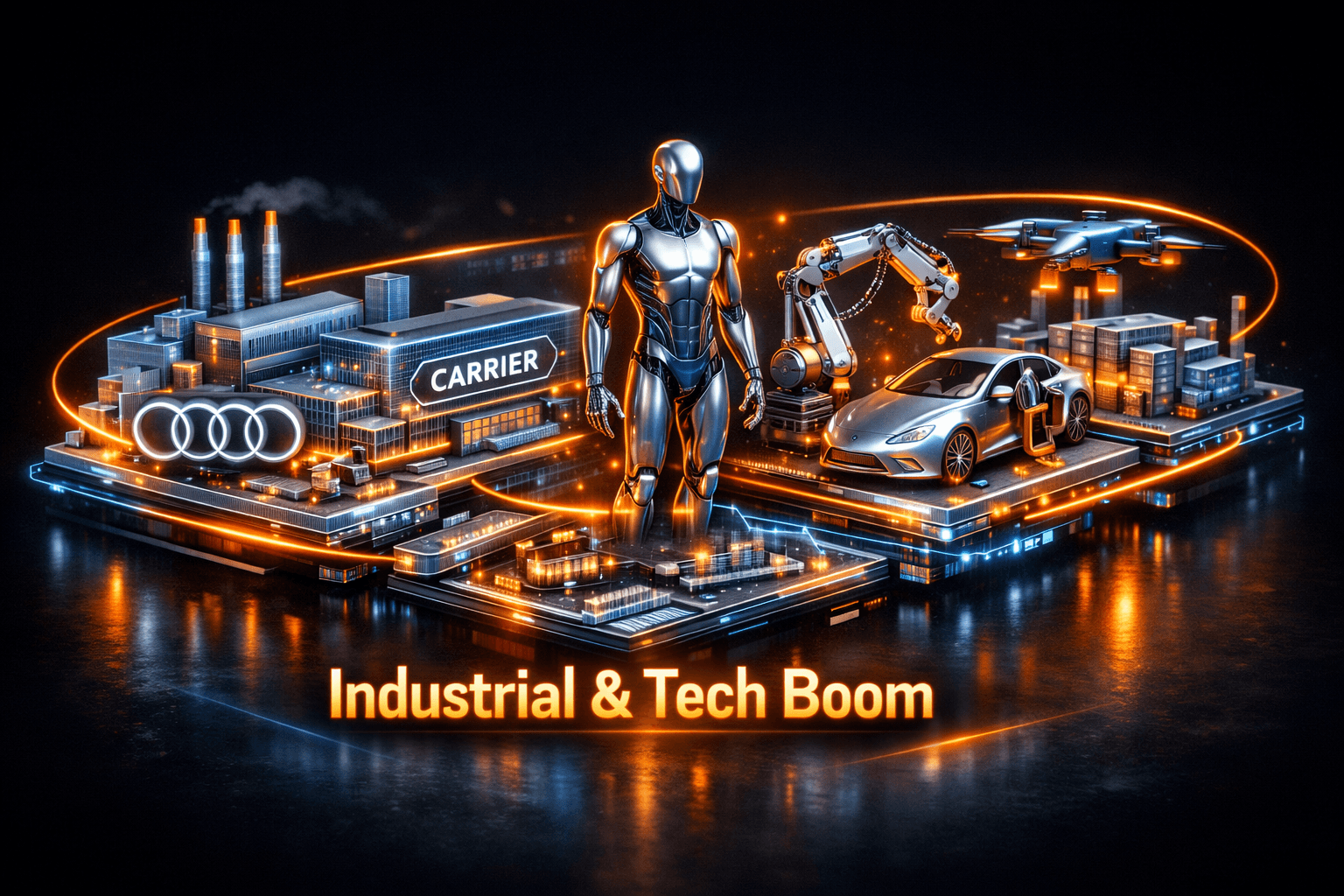
Capital spending and technology adoption are setting the tone in industrial and manufacturing this morning, and investors are seeing concrete moves rather than just plans. Large-scale projects from Audi and Carrier, combined with production milestones at Tesla (TSLA) and digital supply chain deployments at The Kroger (KR), suggest the sector is leaning into capacity expansion and efficiency gains.
That momentum matters because it signals potential revenue expansion, stronger supply-chain resilience and new product lines that could reshape end markets over the next several years. What does this mean for you and your portfolio exposure to the sector? It points to selective opportunities, but also to time horizons that vary by project.
Market Highlights
Here are the quick facts to know before the opening bell and during today’s session.
- Kroger $KR is piloting RFID at 1,500 store bakeries and sharing machine learning inventory insights with suppliers to improve on-shelf availability.
- UPS United Parcel Service (UPS) says U.S. parcel volumes will dip year over year in Q4, but expects other customer segments to boost revenue during peak season.
- Carrier Global Carrier Global (CARR) will spend more than $600 million on a new manufacturing and engineering campus in Fort Worth to expand production of advanced thermal management systems.
- Tesla $TSLA has started humanoid Optimus production in Fremont with customer shipments possible in 2027, marking a move from R&D to manufacturing.
- Audi is committing $4 billion to build its first U.S. plant in Georgia, targeting up to 200,000 vehicles a year with construction slated for 2027 and first cars in the early 2030s.
- Cycling apparel brand MAAP is consolidating planning and sourcing on a single Bamboo Rose platform, following retailers like Walmart (WMT) and Pacsun in modernizing supply-chain software.
Key Developments
Major factory investments: Audi and Carrier scale U.S. footprint
Audi's $4 billion Georgia plant and Carrier's $600 million Fort Worth campus are tangible evidence of manufacturers adding U.S. capacity. Audi's facility aims for up to 200,000 vehicles per year with construction starting in 2027, while Carrier's center will boost production of advanced thermal management systems domestically.
For you that means more nearshoring and new employment hubs, plus longer lead times for revenue recognition in autos because Audi's first cars won't arrive until the early 2030s. Still, these projects underline long-term demand expectations for EVs and climate control equipment.
Robotics moves: Tesla shifts Optimus into production
$TSLA beginning humanoid production in Fremont marks a shift from prototypes to manufacturing, and Elon Musk said customer shipments could start next year. The step from lab to factory is always critical because it shows the company is tackling scale and repeatability.
Where could growth come from as robots move beyond R&D? Potential applications in warehouses, manufacturing cells and service tasks could unlock new revenue streams, though wide adoption will take time and execution matters for margins.
Supply chain modernization: Kroger, MAAP and platform consolidation
$KR's pilot of RFID in 1,500 bakery units and its sharing of computer vision and ML insights with suppliers reflects a larger trend of retailers pushing data-driven replenishment. That’s aimed at reducing out-of-stocks and improving working capital efficiency.
Smaller brand moves like MAAP adopting Bamboo Rose show that both large and niche players are consolidating planning and sourcing on single platforms. For you that's a sign that supply chain tech spending isn't limited to big retailers, it's broadening across the ecosystem.
What to Watch
Several catalysts will influence sentiment and performance in the coming quarters. Earnings and guidance from manufacturing bellwethers will be important for you to follow, along with execution updates on the major capital projects.
- Project timelines and cost tracking for Audi and Carrier, including any permit or supply constraints that could alter schedules.
- Production ramp details from $TSLA about Optimus throughput, unit economics and potential customer use cases.
- Quarterly volume and revenue trends at $UPS during Q4, plus any margin commentary tied to mix shifts away from Amazon volumes.
- Rollout progress and ROI metrics from $KR's RFID and machine learning pilots, which could influence supplier performance and inventory turns.
- Macro inputs like freight costs, energy prices and interest rates that could affect capital spending and margin profiles across the sector.
How should you prioritize what to monitor? Focus first on execution milestones and any guidance changes. Those will move sentiment more quickly than long-term announcements.
Bottom Line
- Sector tone is positive, driven by large-scale investments and technology adoption that point to capacity growth and efficiency gains.
- Near-term headwinds exist, notably UPS's expected volume dip in Q4, but revenue mix shifts and pricing can offset that pressure.
- Longer timelines for projects such as Audi's plant mean benefits will show over several years, so patience and selectivity are warranted.
- Watch execution on production ramps at $TSLA and capital projects at $CARR and Audi for signals on costs and timing.
- Supply-chain tech deployments at $KR and other brands suggest continued productivity and inventory improvements across retail and manufacturing supply chains.
FAQ Section
Q: How will Audi's $4 billion plant impact U.S. auto manufacturing? A: The plant increases U.S. EV capacity and local supply chain development, but first vehicles aren't expected until the early 2030s so revenue impact is long term.
Q: Should I expect immediate margin improvements from Kroger's RFID pilot? A: RFID and computer vision pilots can reduce out-of-stocks and lower working capital over time, but measurable margin effects usually appear after wider rollout and supplier integration.
Q: Will UPS's expected Q4 volume dip hurt the broader sector? A: A volume dip at $UPS signals shifting parcel flows, but the carrier expects revenue to be supported by other customer segments, so the impact may be muted for broader industrial demand.