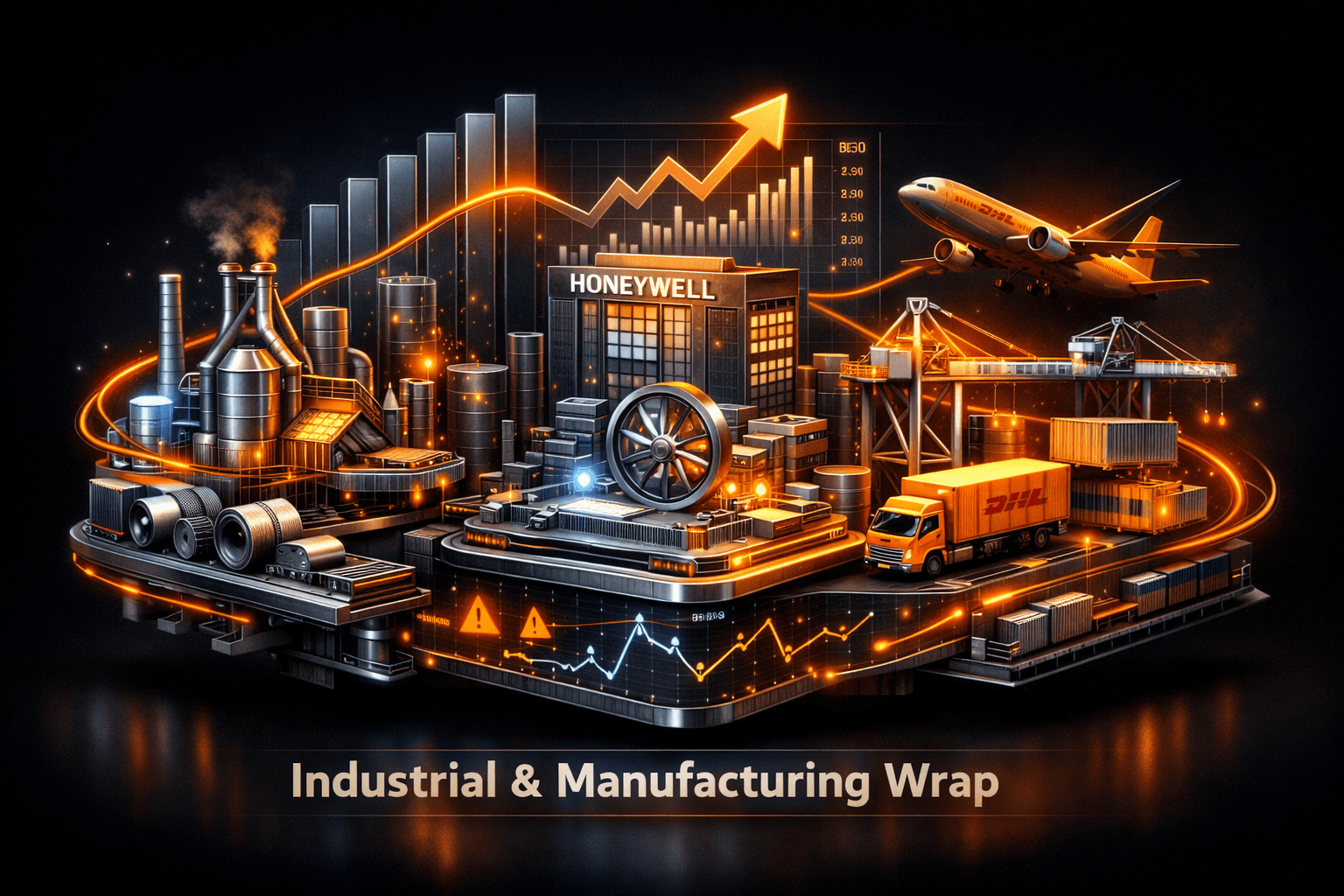
The Big Picture
Today’s biggest development was a clear push toward industrial reinvestment and scaling: U.S. Steel announced a near $3 billion hot strip mill project and corporate leaders including Honeywell Technologies and 3M reported momentum from new products and partnerships. That combination of heavy capex, commercialization wins, and logistics expansion framed a generally positive tone for the sector.
Why does this matter to you as an investor? Capex and commercial rollouts tend to boost supplier demand, sticky revenue streams, and long-term industrial output. At the same time, operational gaps and transition hiccups show there are execution risks you need to watch.
Market Highlights
Quick facts and the top moves from today’s Industrial & Manufacturing news.
- U.S. Steel ($X) boosted funding for a hot strip mill project near Pittsburgh to nearly $3 billion, up from an earlier $2 billion to $2.5 billion range.
- Honeywell Technologies (Honeywell International (HON)) raised its 2026 outlook, citing stronger demand from data centers and AI, after its first quarterly report post-spinoff.
- 3M ($MMM) expanded collaboration with Amazon (Amazon.com (AMZN)) to scale R&D and manufacturing for Expanded Beam Optical products, expecting about $40 million in revenue by end-2026.
- DHL added U.S.-Asia cold chain air corridors, linking Cincinnati with key Asian hubs to support temperature-sensitive healthcare shipments.
- Retail and operations stress showed up in Levi Strauss (Levi Strauss & (LEVI)), which now expects distribution transition benefits in 2027 after a Q3 facility fire and complex SKU mix slowed improvements.
- No uniform price moves were reported in the stories provided; market reactions may appear in open trading and upcoming earnings calls.
Key Developments
U.S. Steel ramps up capacity with nearly $3B mill
U.S. Steel's board approved a substantially larger investment for a hot strip mill at the Edgar Thomson Plant near Pittsburgh, with funding approaching $3 billion. The project will replace some Irvin Plant operations and signals a commitment to domestic capacity for hot-rolled steel, which matters for construction, automotive, and equipment makers.
For you, that means potential upside for suppliers and service providers tied to large-scale steel projects, but it also raises the usual execution questions around timelines, cost control, and permitting.
Corporate wins: Honeywell Technologies and 3M show product and demand tailwinds
Honeywell Technologies raised its 2026 outlook after reporting results that beat expectations, with management pointing to stronger data center and AI-related demand. This is its first earnings cycle after spinning off aerospace operations, so analysts note the clearer growth profile may attract renewed interest.
3M expanded its GSEO partnership with Amazon to scale production of Expanded Beam Optical components, with expected revenue of $40 million by year-end. These wins suggest industrial companies are finding pockets of higher-margin growth tied to tech and logistics customers.
Logistics and supply-chain resilience: DHL, medtech, and Levi’s lessons
DHL Global Forwarding added dedicated cold-chain air corridors between Cincinnati and Asia to support temperature-sensitive healthcare shipments. That improves cross-border resilience for medtech and pharma shippers and could reduce transit time and spoilage risk.
At the same time, medtech executives at AdvaMed emphasized inventory buffers, scenario planning, and deeper chip-supplier relationships to guard against disruption. Contrast that with Levi’s ongoing distribution transition, delayed by a Q3 facility fire and SKU complexity, which pushes benefit realization into 2027 and highlights the costly impact of operational setbacks.
What to Watch
Here are the catalysts and risks that should be on your radar heading into next week.
- Earnings cadence, especially from large industrials and steel producers, will provide clarity on demand and margin trends. Watch management commentary for order backlogs, pricing, and lead times.
- U.S. Steel project milestones and regulatory updates, including permitting and construction schedules, will determine how fast capacity comes online and when related suppliers see revenue lifts.
- Implementation risk tied to maintenance execution gaps, compressed-air inefficiencies, and distribution transitions like Levi’s could produce short-term downtime and margin pressure. Will firms accelerate software and training to close those gaps?
- Logistics capacity for temperature-sensitive freight, as expanded by DHL, is a short-term tailwind for medtech and pharma. Keep an eye on route utilization and any capacity pricing shifts as corridors scale.
- Macro and commodity inputs, including steel prices and energy costs, remain key risk factors for margins. Analysts will be watching semiconductor availability for medtech and high-tech manufacturing supply chains.
Bottom Line
- Sector sentiment is constructive, driven by large-scale capex at U.S. Steel and clearer growth signals from Honeywell Technologies and 3M.
- You should watch execution more than intent, because project delays, maintenance gaps, and distribution setbacks can quickly erode expected gains.
- Logistics upgrades, like DHL’s cold-chain corridors, reduce shipment risk for healthcare and medtech, supporting the broader industrial demand picture.
- Expect next week’s earnings and project updates to be the immediate drivers of price action and analyst revisions.
- Data suggests momentum is building, but selective exposure and close attention to operational KPIs will help you separate winners from laggards.
FAQ Section
Q: What does U.S. Steel’s $3 billion investment mean for the sector? A: It signals renewed domestic capacity spending and potential demand for suppliers, but timelines and execution will determine when benefits hit the supply chain.
Q: How material is Honeywell Technologies’ outlook raise? A: Analysts see it as meaningful because it follows the aerospace spinoff and highlights demand from data centers and AI, which could lift margins and clarity on growth.
Q: Should I worry about supply-chain disruptions like Levi’s transition problems? A: You should monitor operational indicators such as inventory levels, SKU complexity, and incident reports, since disruptions can delay benefits and pressure near-term results.