The Big Picture
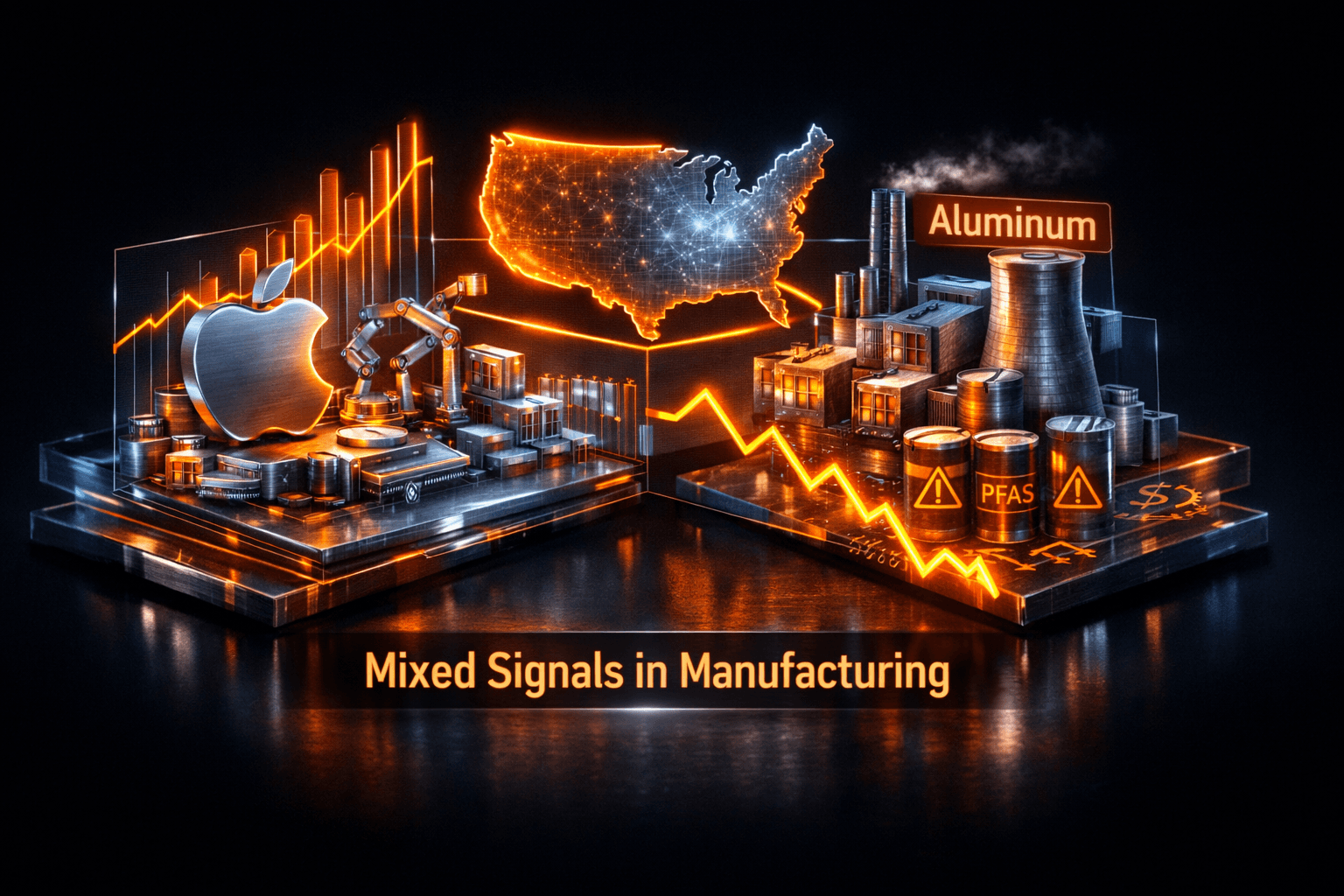
Apple's push to add U.S. suppliers as part of a $600 billion manufacturing pledge grabbed headlines overnight, illustrating continued corporate investment in domestic production. At the same time a new report warns the U.S. lacks critical aluminum smelting capacity for defense needs, and a multi-company PFAS lawsuit in California highlights rising regulatory exposures.
What does this mean for you as an investor paying attention to industrials and manufacturers? The sector is showing concrete pockets of growth, while structural supply and legal risks are complicating the outlook, so selective positioning and monitoring are key.
Market Highlights
Quick facts and price movers to note this morning.
- $AAPL: Added new titanium supplier Perryman and expanded ties with film maker Qnity Electronics as part of its U.S. supplier buildout and $600 billion commitment to U.S. manufacturing.
- Aluminum supply: The U.S. produces roughly 1% of global primary aluminum, a figure cited in a report warning of national security exposure from lack of military-grade smelters.
- PFAS litigation: Hundreds of Los Angeles County residents sued Essity, Edgewell, and Johnson & Johnson over alleged sales of products containing PFOA despite California's ban that began in 2025, introducing potential financial and reputational risks for consumer goods makers such as $JNJ and $EPC.
- Factory and automation moves: Primo Brands opened a new Arkansas plant to boost sparkling water output, while Napa Auto Parts is deploying Hy-Tek Intralogistics and Hai Robotics automation to improve fulfillment efficiency, a nod to ongoing investment in plant-level productivity and logistics.
Key Developments
Apple expands U.S. supplier network
Apple's supplier additions, including a titanium specialist and an advanced film maker, are part of a broader strategy to localize more of its supply chain. For you that means continued demand for high-precision component makers and specialty materials suppliers over the coming years, though the benefits will be distributed across many vendors and will take time to show up in margins.
Aluminum smelter gap and regulatory litigation
The Manufacturing Dive report underscores a strategic shortfall, saying no domestic smelters can produce certain military-spec aluminum grades. With the U.S. accounting for about 1 percent of global aluminum production, the country remains exposed to imports and geopolitical disruption. At the same time, the California PFAS lawsuit naming Essity, Edgewell, and Johnson & Johnson underscores rising regulatory scrutiny of chemical use in consumer products. Together these items are a reminder that material sourcing and compliance pose both supply and legal risks to manufacturers.
Plant-level efficiency and automation gains
On the factory floor, companies are investing to squeeze more output from existing capacity. Primo Brands opened its first new plant since a merger to expand sparkling water production. Meanwhile, Napa Auto Parts said it will use automation partners to raise storage density and order accuracy, and Plant Engineering published a deep guide on compressed air systems to help facilities improve utility efficiency.
These practical upgrades, from compressed air optimization to robots in the warehouse, are likely to improve operating efficiency and reduce per-unit costs if executed well. Are these incremental gains enough to offset macro risks? That depends on capital discipline and the pace of demand in your target subsectors.
What to Watch
Here are the catalysts and red flags to monitor in the coming weeks that could change the sector narrative.
- Policy and defense moves: Watch for statements or funding from the Department of Defense and Congress addressing critical metals and smelting capacity, which could spur multiyear investments if governments push for domestic production.
- Regulatory and legal developments: Follow the California PFAS litigation closely and any state enforcement actions, because outcomes could affect consumer products makers' liabilities and raw-material sourcing decisions.
- Corporate supplier announcements: Keep an eye on $AAPL and other large OEM supplier deals, because major buyer commitments can create durable demand for specialty suppliers and contract manufacturers.
- Capex and automation spend: Earnings season commentary on capital expenditure plans and automation rollouts will tell you whether companies are prioritizing productivity. Look for order books and supplier backlog updates as early signals.
- Commodity prices and energy costs: Aluminum prices and industrial energy costs will affect margins for metal processors and energy-intensive manufacturers, so monitor price moves and shipping constraints.
Bottom Line
- Mixed signals dominate today, with corporate reshoring and factory builds supporting demand, while material shortfalls and litigation raise risk.
- Apple's $600 billion U.S. supply push is a long-term positive for component makers, but benefits will accrue unevenly and over time.
- The aluminum smelting gap is a structural national security and supply-chain risk that could drive policy-driven capital spending, creating winners and losers.
- Plant-level efficiency investments, from compressed air optimization to warehouse robots, offer nearer-term margin relief for operations that adopt them well.
- This briefing is for informational purposes only. Analysts note the landscape is mixed and you should monitor developments rather than assume outcomes.
FAQ Section
Q: What industries could benefit most from Apple’s U.S. supplier expansion? A: Component manufacturers, specialty metals suppliers, and precision contract manufacturers are likeliest to see incremental demand from Apple’s sourcing shifts.
Q: How serious is the aluminum smelter problem for defense production? A: The report argues it is significant because no U.S. smelters currently meet certain military-grade specifications, creating reliance on foreign suppliers and potential disruption risks.
Q: Should you worry about the PFAS lawsuit affecting consumer goods companies broadly? A: The suit raises regulatory and liability risk that could pressure margins and require reformulation or recalls for some products, so watch case developments and company disclosures.