The Big Picture
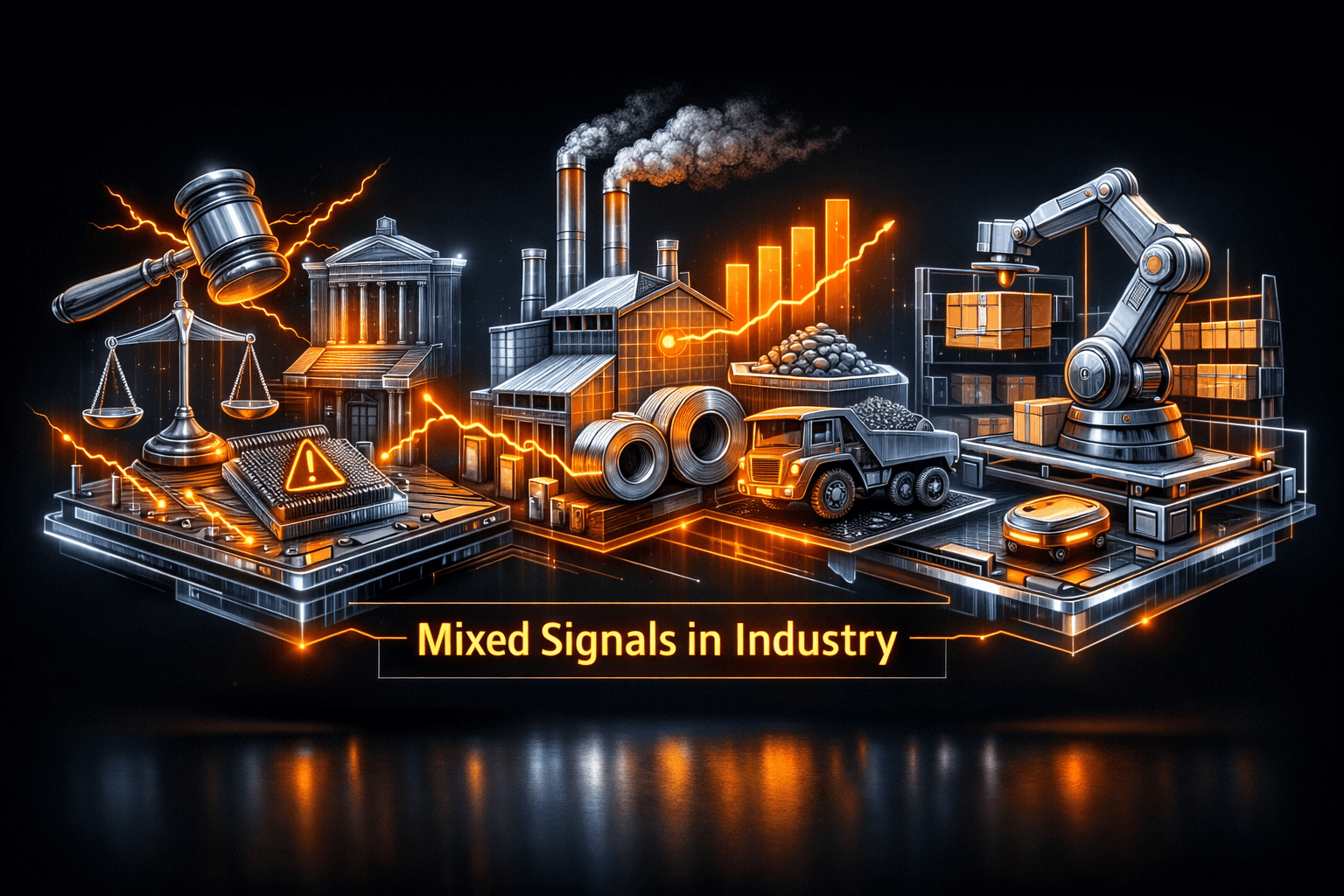
The industrial and manufacturing complex is sending mixed signals this morning, with company-level operational gains colliding with regulatory and supply-chain risks. You get reports of a steelmaker calling its latest quarter the "strongest" in three years and a parts retailer rolling out robotics, while lawsuits and a semiconductor industry warning raise fresh questions about legal and sourcing vulnerabilities.
That mix matters because it affects margins, capital plans, and the pace of onshoring investments for you and other investors following the sector. Which threads matter most to your portfolio over the next few quarters?
Market Highlights
Key facts and snapshots from overnight and recent coverage. These items set the near-term backdrop for industrial stocks and supplier chains.
- Cleveland-Cliffs, $CLF, described its latest quarter as the "strongest" in three years and said it will postpone the Burns Harbor blast furnace relining by one year, citing a supportive automotive market and tariffs.
- Automation moves: NAPA Auto Parts, operated by Genuine Parts Company, is upgrading fulfillment with Hy-Tek Intralogistics and Hai Robotics to boost storage density and order accuracy.
- Regulatory litigation: Hundreds of Los Angeles County residents filed a suit alleging Carefree pantyliners were made with PFOA despite California's PFAS ban, naming Essity, Edgewell, and Johnson & Johnson among defendants. The ban took effect in January 2025.
- Food safety legal risk: Texas sued Nestlé’s Gerber over alleged heavy metals in baby food, while Gerber reiterated its ingredient sourcing and testing controls.
- Supply-chain vulnerability: The Semiconductor Industry Association warned that critical chip inputs remain exposed, calling for closer government-industry collaboration on onshoring and stockpiling.
Key Developments
Cleveland-Cliffs posts a standout quarter
The steel producer told reporters it delivered its strongest quarter in three years. Management cited robust automotive demand and tariff protections as supportive. You should note the company also delayed scheduled capital work at Burns Harbor, pushing a blast furnace relining back one year, which can temporarily ease near-term capital spending and preserve cash flow.
Warehouse automation advances at NAPA
NAPA Auto Parts is implementing compact storage and robotic picking with Hy-Tek and Hai Robotics to improve fulfillment efficiency and order accuracy. For retailers and parts distributors, that means potential cost savings and faster delivery times. If you're tracking supply-chain efficiency plays, this is a reminder that automation continues to be a durable operational lever.
Legal and regulatory pressure on consumer product makers
Two separate legal actions are raising compliance and reputational risk across consumer-facing manufacturers. In California, hundreds of residents allege that Carefree pantyliners contained PFOA in violation of the state's PFAS ban that started in January 2025. The suit names Essity, Edgewell, and Johnson & Johnson, among others.
Separately, Texas sued Nestlé’s Gerber over alleged heavy metals in baby food. Gerber has pointed to testing and supplier controls, but regulators and attorneys are increasingly focused on product safety. These cases highlight persistent regulatory and litigation exposure for consumer manufacturers, which can lead to recalls, higher compliance costs, or reputational impact.
Semiconductor supply-chain alert from SIA
The Semiconductor Industry Association said U.S. supply chains still depend on vulnerable, often opaque inputs. The group is pushing for deeper government-industry collaboration, more onshoring, and strategic stockpiles. You might ask, will this accelerate capital spending in domestic fabs or boost demand for upstream materials and equipment? The timing and funding for those initiatives are key for supply-chain-related industrial names.
What to Watch
Focus on catalysts that will clarify whether the positives outweigh the headwinds. Watch for company updates and policy moves that could reshape near-term risk and return.
- Earnings and guidance: Look for upcoming quarterly reports from steel, supplier, and parts distributors that will reveal demand trends, pricing power, and margin trajectories. $CLF commentary on volumes and pricing is especially relevant.
- Litigation outcomes and regulatory rulings: Track the California PFAS case timeline and any state actions tied to the Gerber suit. Legal costs and potential product restrictions could change expense profiles for defendants.
- Automation rollout metrics: Monitor implementation milestones at NAPA and any commentary from $GPC about fulfillment cost reductions, error rates, or inventory turns.
- Policy and onshoring moves: Watch for federal announcements on semiconductor supply-chain support or incentives. Those could benefit equipment makers and materials suppliers, and affect names tied to $NVDA, $AMD, and $INTC indirectly.
- Commodity and input pricing: Steel, chemicals, and specialty inputs will determine margin flexibility. Any tariff changes or raw material shortages could reverse current strength in industrial margins.
Bottom Line
- The sector shows mixed momentum, with strong operational reports from $CLF and automation wins at NAPA balanced by legal and supply-chain risks.
- Regulatory and litigation headlines could drive episodic volatility for consumer product makers and their suppliers, so follow case developments closely.
- Semiconductor supply warnings underscore the long-term need for onshoring and inventory resilience, which could drive capex and policy action over time.
- If you're watching industrial exposure, focus on companies with transparent capital plans, defensible margins, and execution proofs on automation or local sourcing.
- Data suggests selectivity is prudent, given offsetting forces that could swing sentiment quickly.
FAQ Section
Q: How could the California PFAS lawsuit affect manufacturers? A: Legal actions can lead to settlements, higher compliance costs, and potential product reformulations, which may pressure margins and require revised supply-chain practices.
Q: Will warehouse automation meaningfully cut costs for parts retailers? A: Automation often improves density and accuracy, which can reduce labor and error-related costs, but benefits depend on rollout speed and integration success.
Q: What does the SIA warning mean for chip-dependent industrial manufacturers? A: The SIA view highlights exposure to hidden inputs and logistics risk, suggesting that onshoring and stockpiling policies could become important drivers of near-term capital allocation and pricing dynamics.