The Big Picture
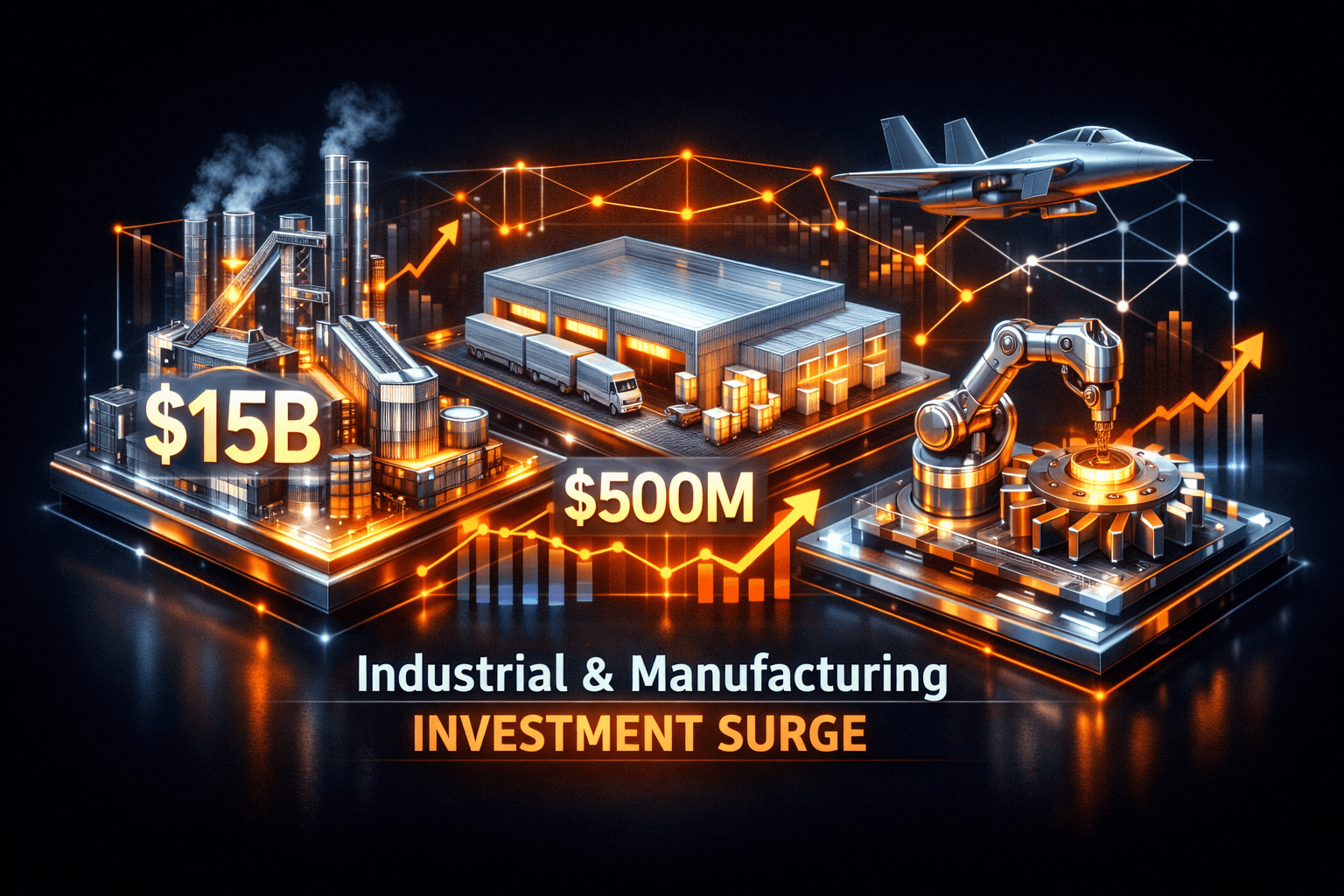
The biggest news in the industrial and manufacturing sector today was the announcement of a $15 billion plan to build the largest U.S. steel mill, a move that immediately focused attention on domestic capacity and job creation. That development, paired with large private investments and manufacturing process gains, suggests expansion momentum in heavy industry and defense supply chains.
Why should you care? These projects change capacity and hiring profiles, and they push supply chains toward reshoring and faster production cycles, which can affect suppliers, logistics providers, and the materials markets you follow every day.
Market Highlights
- Mesabi Metallics plan, Iowa: $15 billion steel mill proposal, 1,750 jobs, and 10 million tons of annual production capacity; the company is also investing $3 billion in a Minnesota iron ore mine.
- Ross distribution center: Ross Stores will invest about $500 million to build a 1.75 million square foot distribution center in California, the retailer's 10th DC, with ground expected in 2027. Company ticker: $ROST.
- Precision manufacturing: Startup Salient Motion, with Saginaw Precision collaboration, cut ball screw production time from years to about eight weeks, affecting parts used in missile systems such as those from Raytheon Technologies, ticker $RTX.
- Corporate sourcing and costs: Electrolux named Daniele Rossi as chief procurement officer to boost sustainable supplier co-development; CPGs including $CL, $KMB and $PG flagged rising material and freight costs at a Barclays conference.
- Workforce: The Department of Defense expanded its BuildFreedom.US program to Ohio, Illinois and Wisconsin to promote defense-industrial-base jobs described as "AI-proof."
Key Developments
Mesabi Metallics unveils a massive domestic steel build
The Mesabi Metallics announcement to build what it calls the largest U.S. steel mill is the day’s marquee story. With a $15 billion capex plan, 1,750 projected jobs, and 10 million tons of new capacity, the proposal is a structural bet on U.S. materials demand and supply-chain security.
For investors, that means you should expect ripple effects across miners, logistics firms, and equipment suppliers. Increased domestic capacity could eventually ease some import reliance, but it may also intensify competition among steel producers as the project progresses.
Retail logistics expands: Ross invests $500M in California DC
Ross Stores is moving ahead with a 1.75 million square foot distribution center in California, the company’s 10th. The $500 million investment underscores ongoing retail logistics expansion and the premium on faster regional fulfillment.
This is a potential tailwind for third-party logistics providers and construction-related suppliers. You're likely to see the story referenced when analysts update warehouse-capacity models for apparel and off-price retail chains.
Defense and precision manufacturing speed up
Salient Motion and Saginaw Precision reported a major process improvement, cutting ball screw manufacturing times from years to roughly eight weeks. Those components are critical for guided systems in defense hardware, including platforms from $RTX.
Combined with the DoD's expansion of BuildFreedom.US into three more states, the news points to faster, more resilient defense supply chains and a focus on workforce skills that are harder to automate. How will that affect defense suppliers and local economies? Expect greater emphasis on capacity and talent development.
What to Watch
Look for permitting and financing progress on the Mesabi project, and any regulatory or community feedback that could affect timing. Big industrial projects often face multi-year approval processes, so you need to track milestones closely.
Keep an eye on logistics and real estate indicators tied to the Ross project, such as regional warehouse vacancy and construction starts. You'll want to watch which contractors and suppliers win contracts, since those wins can be meaningful for smaller-cap suppliers.
Monitor defense procurement calendars and DoD workforce program metrics for signs of contract awards tied to faster ball screw production. Also, follow commodity prices for iron ore and scrap steel, plus freight-cost trends highlighted by $CL, $KMB and $PG, because input-cost pressure could temper margin upside.
Bottom Line
- Major capital commitments dominated the day, signaling growth in domestic capacity across steel, retail logistics, and defense manufacturing.
- Process innovations in precision manufacturing shorten lead times and strengthen defense supply-chain resilience.
- Rising material and freight costs remain a near-term risk for consumer goods makers and suppliers, so margin pressure is still possible.
- Workforce development expansion supports long-term capacity, but project timelines and permitting will determine near-term impact.
- Analysts note that these stories create selective opportunities among suppliers, logistics firms, and materials producers, but you should watch catalysts and regulatory milestones carefully.
FAQ
Q: How soon will the Mesabi steel mill affect steel supply? A: Project timelines for major mills are typically multiple years due to permitting, construction and commissioning, so material impacts are likely medium term rather than immediate.
Q: Will faster ball screw production translate into new defense contracts soon? A: The production-time improvement improves readiness and may accelerate deliveries, but contract awards depend on procurement cycles and DoD timelines.
Q: Should you worry about CPG cost pressures? A: Rising material and freight costs are a real headwind for margins, and they bear watching, especially for companies with limited pricing power or heavy exposure to volatile inputs.