The Big Picture
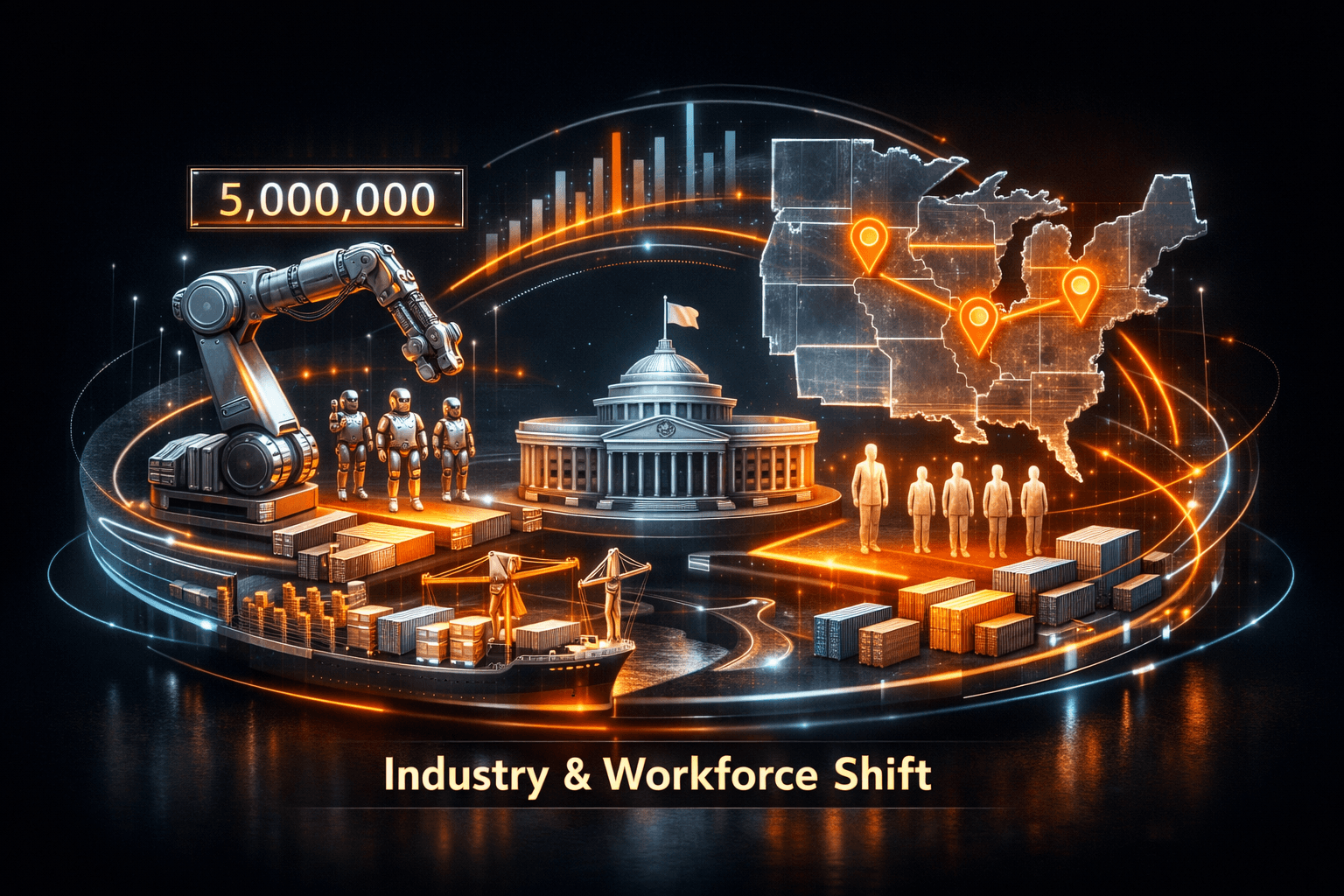
Automation and workforce development took center stage today as the robotics count exceeded 5 million globally while the U.S. Defense Department expanded its BuildFreedom.US workforce program into Ohio, Illinois and Wisconsin. At the same time, trade groups urged the U.S. Trade Representative to keep fees on China-linked shipments paused, easing short-term cost pressure for manufacturers and retailers.
These items matter because they hit three investor-relevant levers: capacity and productivity, talent supply for defense and advanced manufacturing, and near-term cost uncertainty in logistics. Together they suggest the sector is balancing increased capital deployment in automation with targeted workforce initiatives, while policy moves could ease shipping costs for your supply chains.
Market Highlights
Here are the day’s quick facts and what they mean at a glance.
- Robotics milestone: The International Federation of Robotics reports factory robots have surpassed 5,000,000 units worldwide, roughly double the count from seven years ago, underscoring sustained capital spending on automation.
- Defense workforce expansion: The Department of Defense is extending BuildFreedom.US to Ohio, Illinois and Wisconsin, aiming to highlight "AI-proof" roles and broaden the defense industrial base talent pipeline, a positive signal for defense suppliers such as $RTX and $LMT.
- Shipping fee relief push: The National Retail Federation and other trade groups urged the USTR to extend a pause on China-linked ship fees, a request intended to reduce uncertainty and elevated transport costs for retailers and manufacturers, affecting companies like $WMT and $AMZN.
- Optimization and intelligence themes: Sponsored pieces highlighted quantum optimization and network-scale intelligence as next-wave tools for planning and resiliency, pointing to potential software and services demand for providers such as $ROK and $ABB.
Key Developments
Factory robots top 5 million
The International Federation of Robotics says the installed base of factory robots worldwide has exceeded 5 million units, a figure that doubled over the past seven years. For you, that means manufacturers are increasingly deploying automation to offset labor constraints and improve consistency, which can lift capacity and margins over time.
DoD expands BuildFreedom.US to three Midwestern states
The Defense Department will extend its workforce awareness program to Ohio, Illinois and Wisconsin, emphasizing roles less susceptible to AI displacement. This expansion is aimed at strengthening the defense supply chain labor pool, which could help close skills gaps for prime contractors and tier suppliers in your portfolio exposure to defense manufacturing.
Trade groups press USTR on China-linked ship fees
Retail and trade associations asked the USTR to continue the pause on fees tied to China shipments, saying the halt would reduce near-term uncertainty as transportation costs remain elevated. If the pause continues, you may see some relief in input and logistics cost pressure for import-dependent manufacturers and big-box retailers.
What to Watch
Tomorrow and beyond, keep an eye on a few concrete catalysts and risks that could change the picture quickly.
- Policy updates: Watch USTR communications on the fee pause. A continuation would be positive for transport-sensitive margins, while an unexpected resumption of fees would be a headwind.
- Capex and automation spending: Look for company-level commentary from automation suppliers and equipment makers on order trends, backlog and lead times. Are firms seeing sustained demand or a one-off acceleration?
- Talent pipeline outcomes: Monitor state-level implementation of BuildFreedom.US and any related hiring or training announcements from primes and suppliers. Will the program translate into measurable hires or apprenticeships?
- Adoption of advanced planning tools: Expect incremental vendor announcements around quantum optimization pilots and network intelligence deployments. These practical deployments could separate the wheat from the chaff in supply-chain competitiveness, right when you need better planning tools.
- Macro and shipping costs: Global freight rates and port congestion remain wild cards. Even with a fee pause, freight volatility can squeeze margins, so track freight indices and carrier capacity signals.
Bottom Line
- Automation momentum is accelerating, with 5 million factory robots signalling ongoing capex and productivity investments across manufacturing.
- DoD workforce outreach into three Midwestern states addresses a key skills gap, potentially improving labor supply for defense-related manufacturers over time.
- Trade groups pushing for a continued pause on China-linked shipping fees could ease logistics cost uncertainty in the near term, benefiting import-heavy supply chains.
- Quantum optimization and network-scale intelligence are emerging as practical tools for resiliency and margin protection, so expect increased software and services demand.
- Stay selective and watch policy, capex signals and freight trends, because they’ll drive how these stories translate into earnings for your companies.
FAQ Section
Q: How does the 5 million robot milestone affect manufacturers? A: It indicates significant investment in automation, which tends to raise capacity and consistency while reducing reliance on scarce labor, though adoption benefits vary by subsector.
Q: What does BuildFreedom.US expansion mean for defense suppliers? A: It aims to broaden awareness of manufacturing careers and strengthen the talent pipeline, which could help ease hiring pressures for defense primes and suppliers over time.
Q: Will a pause on China-linked ship fees cut costs immediately? A: A continued pause reduces one source of uncertainty, but broader freight rates and capacity still determine short-term logistics costs.