The Big Picture
The biggest development for industrials this week was a flurry of trade and supply-chain moves that will reshape costs and sourcing decisions heading into the long weekend. New tariffs, a trade-court ruling on the de minimis threshold, and corporate reactions from automakers and retailers mean you should expect a clearer focus on reshoring and automation over the next few quarters.
These are not just policy headlines. They affect freight flows, component sourcing, and capital spending plans for manufacturers and logistics providers. If you follow the sector, you need to watch how companies adjust sourcing, pricing, and capex plans when markets reopen on Monday, August 17.
Market Highlights
Key facts and numbers to keep front of mind as you track the sector
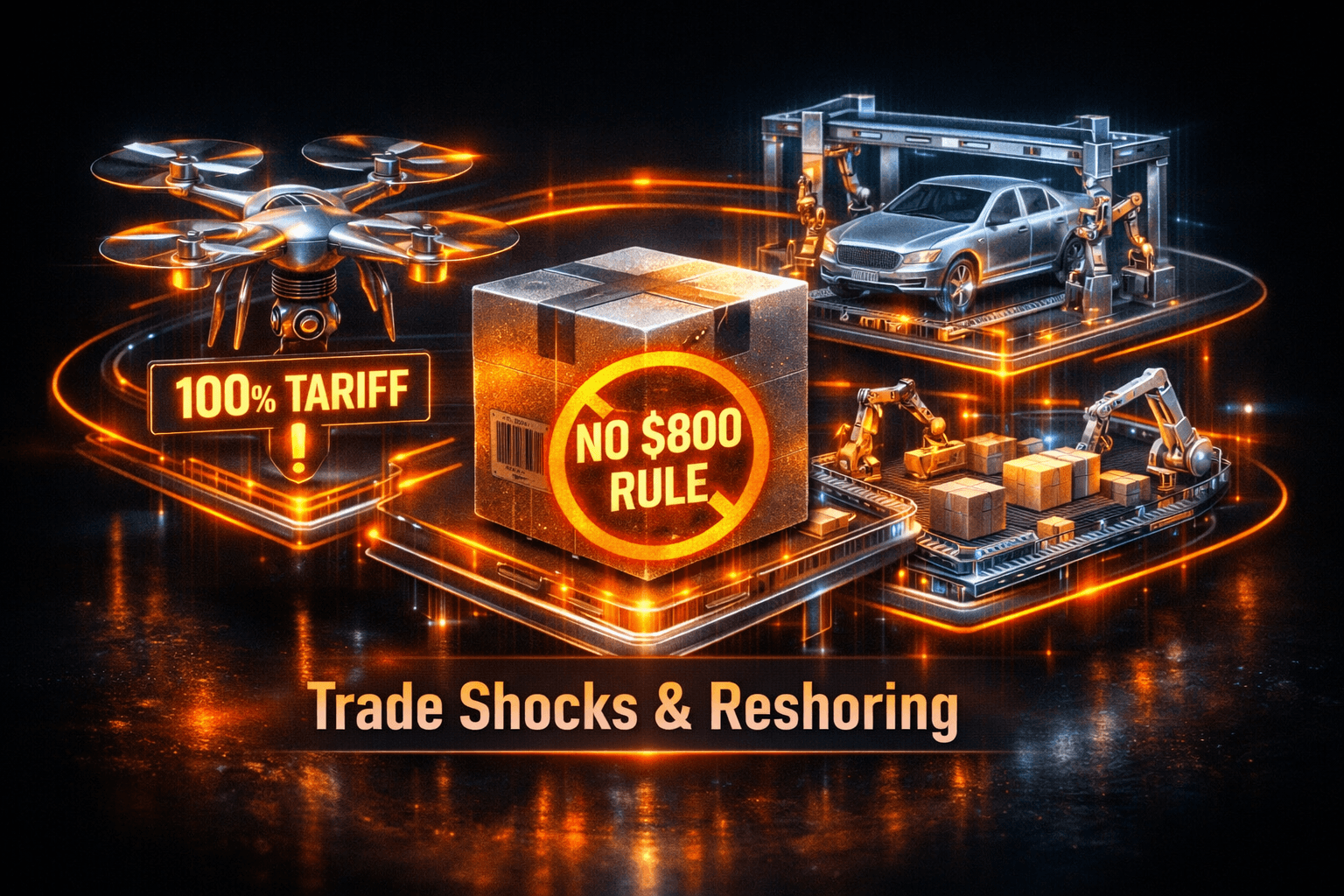
- Tariff shock: The White House moved to impose a 100% tariff on certain unmanned aerial systems and components, a policy aimed at reducing reliance on major exporters, including China.
- China market scale: Analysts note China’s drone market was valued at about $15.6 billion in 2025, underscoring why UAS policy got priority.
- De minimis rule: The Court of International Trade upheld the administration’s authority to rescind the de minimis tariff exemption for sub-$800 imports, removing the previous duty-free treatment for many small shipments.
- Automotive reshoring: $F says it will phase out China-built Lincoln models for the U.S., and plans to boost domestic production to mitigate tariffs and new import rules.
- Retail automation: $WMT is installing Symbotic’s SymMicro fulfillment system in a store, with the system expected to be operational in about six months to speed in-store pickup and delivery.
Key Developments
100% Tariffs on Drones and Components
The administration announced a 100% duty on certain unmanned aerial systems and parts as part of executive directives to shorten risky supply chains. The move targets imports from markets where production is concentrated, and it follows broader efforts to limit strategic reliance on foreign suppliers.
For you, this means equipment makers, suppliers of UAS components, and logistics providers could face higher landed costs and altered procurement plans. Some domestic suppliers may see more near-term demand, but adjustment pains are likely for firms that rely on global sourcing.
De minimis Elimination Upheld by Trade Court
The Court of International Trade confirmed the president’s authority to revoke the sub-$800 de minimis exemption, meaning many small-value shipments that were previously duty-free will now be subject to tariffs and customs processes.
This is a structural change for retailers, e-commerce sellers, and smaller component buyers. You can expect import costs and fulfillment complexity to rise for low-value goods, which could accelerate reshoring and regional sourcing decisions.
Corporate Responses: Ford and Walmart
$F plans to phase out China-built Lincoln models destined for the U.S., a direct reaction to tariffs and new import rules. Ford says it will increase domestic production to reduce tariff exposure and regulatory risk. That speaks to a broader trend of automakers balancing cost with supply-chain security.
$WMT is testing Symbotic’s SymMicro in a store, with the system expected to go live in roughly six months. Automation is a clear response to rising labor and fulfillment costs, and it could speed last-mile execution while changing capital allocation for retailers and logistics partners.
What to Watch
As markets are closed on Saturday, August 15, and will reopen Monday, August 17, here are the catalysts and risks you should monitor when trading resumes.
- Monday reaction: Watch opening moves for industrial suppliers and automation names. Corporate statements or analyst notes over the weekend could widen intraday moves on Monday.
- Earnings and guidance: Look for quarterly commentary from industrial suppliers, component makers, and retailers in upcoming earnings cycles. Management commentary on cost pass-through and reshoring timing will be critical.
- Policy details and exemptions: Monitor Commerce and Customs announcements for carved-out products or phased implementation rules for the 100% UAS tariffs and the de minimis change.
- Supply-chain lift time: Track how quickly OEMs can shift production. Will new domestic capacity be ready fast enough to offset higher import costs? That question will shape margins and capex plans.
- Automation rollouts: Keep an eye on reported timelines and ROI details for Symbotic and similar systems. Adoption speed will affect warehouse employment, capex needs, and logistics partners.
Bottom Line
- Trade policy tightened this week, with a 100% duty on certain drones and a court-approved end to the $800 de minimis rule, both of which raise import complexity and costs.
- Corporate responses from $F and $WMT signal a pivot toward reshoring and automation, which could benefit domestic suppliers but take time to fully offset higher import-related costs.
- Expect differentiated outcomes: some firms face margin pressure, while others may find a silver lining in increased demand for domestic capacity and robotics.
- Monitor policy implementation details and the first corporate guidance updates when markets reopen Monday, August 17.
FAQ Section
Q: How will the 100% drone tariffs affect manufacturers? A: Tariffs raise landed costs for imports and may accelerate sourcing shifts to domestic or allied producers, but implementation details will determine which suppliers are most affected.
Q: What does the de minimis elimination mean for e-commerce and small imports? A: Small-value shipments will generally lose duty-free status, increasing customs costs and processing time for e-commerce sellers and importers.
Q: Will automation and reshoring offset higher tariff costs quickly? A: Not immediately. Automation and domestic capacity take months to scale, so companies may face short-term cost pressure even as they plan medium-term adjustments.