The Big Picture
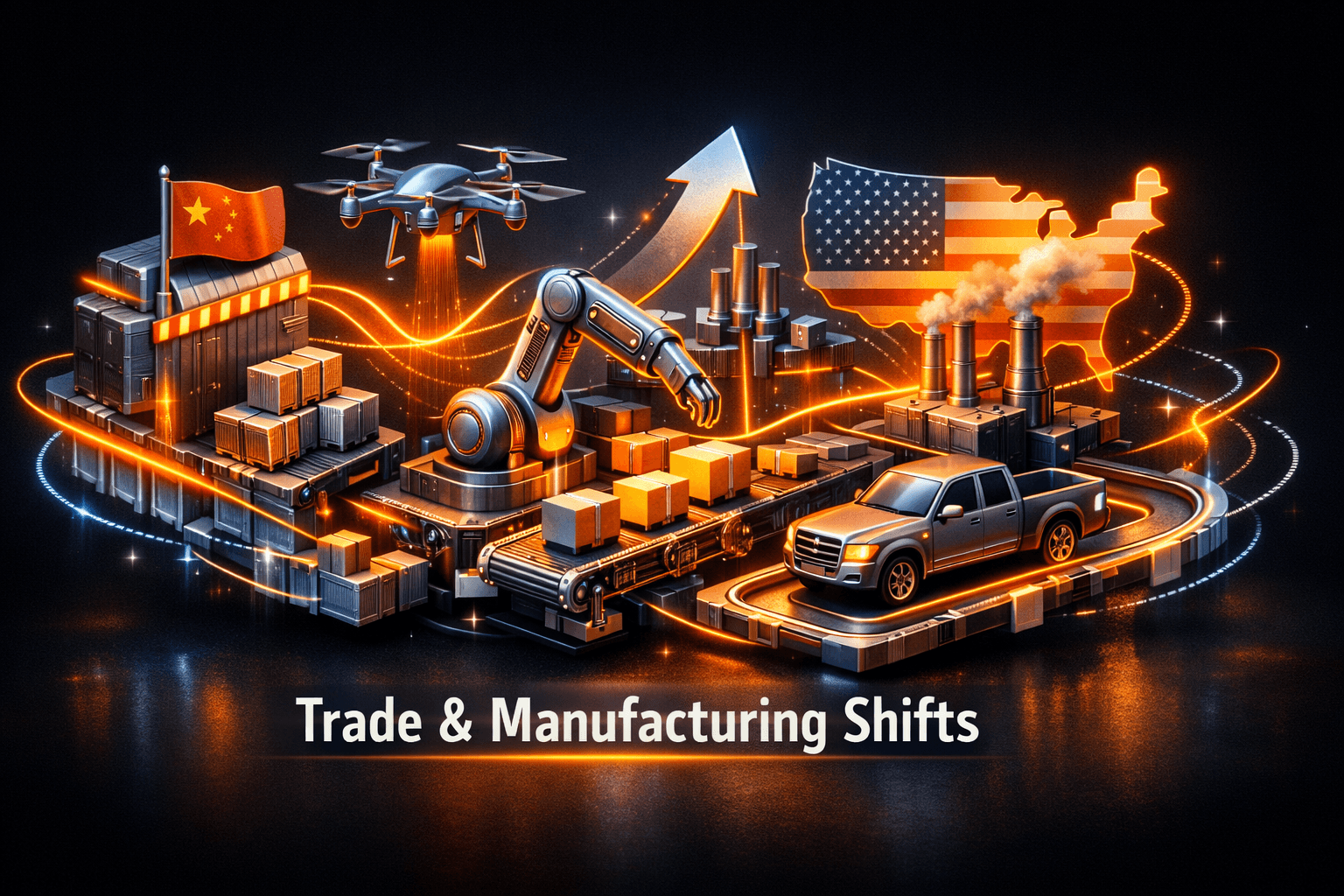
Today the Industrial and Manufacturing complex faced competing forces, with Washington tightening trade rules even as major companies move to boost domestic production and automation. You saw policy and legal shifts that tighten import channels, and you also saw firms planning investments that could help U.S. capacity expand.
That combination matters because it reshapes cost structures and supply chain choices for manufacturers, retailers, and defense contractors. What does it mean for your exposure to the sector in the near term and beyond?
Market Highlights
Trading reflected the mixed news flow, with specific names tied to retail, autos, and automation showing relatively stronger activity than broad suppliers. Here are quick facts to keep on your screen.
- Walmart $WMT, after announcing a Symbotic in-store fulfillment pilot, moved roughly +0.8% in early trade as automation investors tracked execution plans.
- Ford Motor $F, after restating plans to phase out China-built Lincoln models for the U.S., showed an intraday uptick near +1.5% as markets priced potential reshoring benefits.
- Symbotic $SYM, tied directly to Walmart's project, was one of the more active names in the automation group, gaining about +2.3% on the news that SymMicro will be installed in a store within six months.
Key Developments
Tariff push targets drones and components
The administration announced 100% tariffs on certain unmanned aerial systems and parts, a move framed as reducing reliance on foreign supply chains, especially China. That raises costs for importers and could accelerate sourcing changes for defense and commercial drone users.
For you that means manufacturers and service providers who rely on imported UAS parts may face near term margin pressure, while domestic drone suppliers and defense contractors could see demand reallocated to local vendors.
De minimis elimination upheld by trade court
The Court of International Trade affirmed the president's authority to rescind the de minimis tariff exemption for small parcels under $800. The ruling formalizes a higher-duty environment for many low-value imports used across manufacturing supply chains.
This legal clarity reduces regulatory uncertainty but raises operating costs for firms that have relied on low-value cross-border sourcing. You'll want to watch near-term cost pass-throughs into pricing and inventory decisions.
Retail automation and reshoring: Walmart and Ford move forward
Walmart's $WMT selection of Symbotic's SymMicro in-store fulfillment system signals continued investment in automation to speed pickup and delivery. The system is expected to be operational in roughly six months and will be a live test of in-store robotics at scale.
Ford $F said it will phase out China-built Lincoln models for the U.S market, part of a broader push to grow domestic output and create jobs. Both stories point to a durable trend toward onshore manufacturing and digital logistics as ways to mitigate tariff and supply risks.
What to Watch
Look for how companies revise guidance, disclose cost impacts, or accelerate capital spending in response to the tariff and legal developments. Earnings calls over the next several weeks will be a primary venue for new detail.
Key catalysts for you to monitor include upcoming earnings from large industrial suppliers, any Treasury or USTR clarifications on tariff scope, and follow up announcements from retailers about rollouts and investment timelines. Can domestic makers scale fast enough to pick up the slack created by higher duties?
Risks remain in the form of margin pressure for import-heavy supply chains, logistics congestion as firms reconfigure sourcing, and labor constraints if reshoring accelerates. You'll also want to track defense procurement timelines, since some programs could get a shot in the arm from the drone tariffs and related policy shifts.
Bottom Line
- Policy changes tightened the trade backdrop today, with a 100% tariff on select drones and the de minimis rule upheld, raising import costs for some manufacturers and retailers.
- Walmart's $WMT Symbotic installation and Ford's $F reshoring plan offer offsetting operational positives that support U.S. production and automation adoption.
- Expect near-term margin pressure for import-dependent firms, and selective upside for automation and domestic-focused suppliers as businesses retool supply chains.
- Watch earnings, trade clarifications, and rollout timelines closely, since those items will determine how quickly costs and benefits flow through P&Ls.
- Data suggests a transitional period where selective exposure to automation and domestically oriented manufacturers may see clearer tailwinds, but uncertainty remains high.
FAQ Section
Q: How will the drone tariffs affect consumer and defense manufacturers? A: The tariffs raise import costs for drone components, which may lead manufacturers to shift sourcing, increase prices, or accelerate domestic supplier development. For defense, procurement timelines could prioritize vetted U.S. suppliers.
Q: Will Walmart's Symbotic pilot change how retailers manage fulfillment? A: If SymMicro meets performance and cost targets, other retailers may accelerate similar in-store automation pilots to improve pickup and delivery speeds.
Q: What should you watch next week for signs of broader sector impact? A: Monitor earnings calls for cost commentary, any USTR or Treasury guidance on tariff implementation, and vendor contract updates that reveal sourcing shifts.