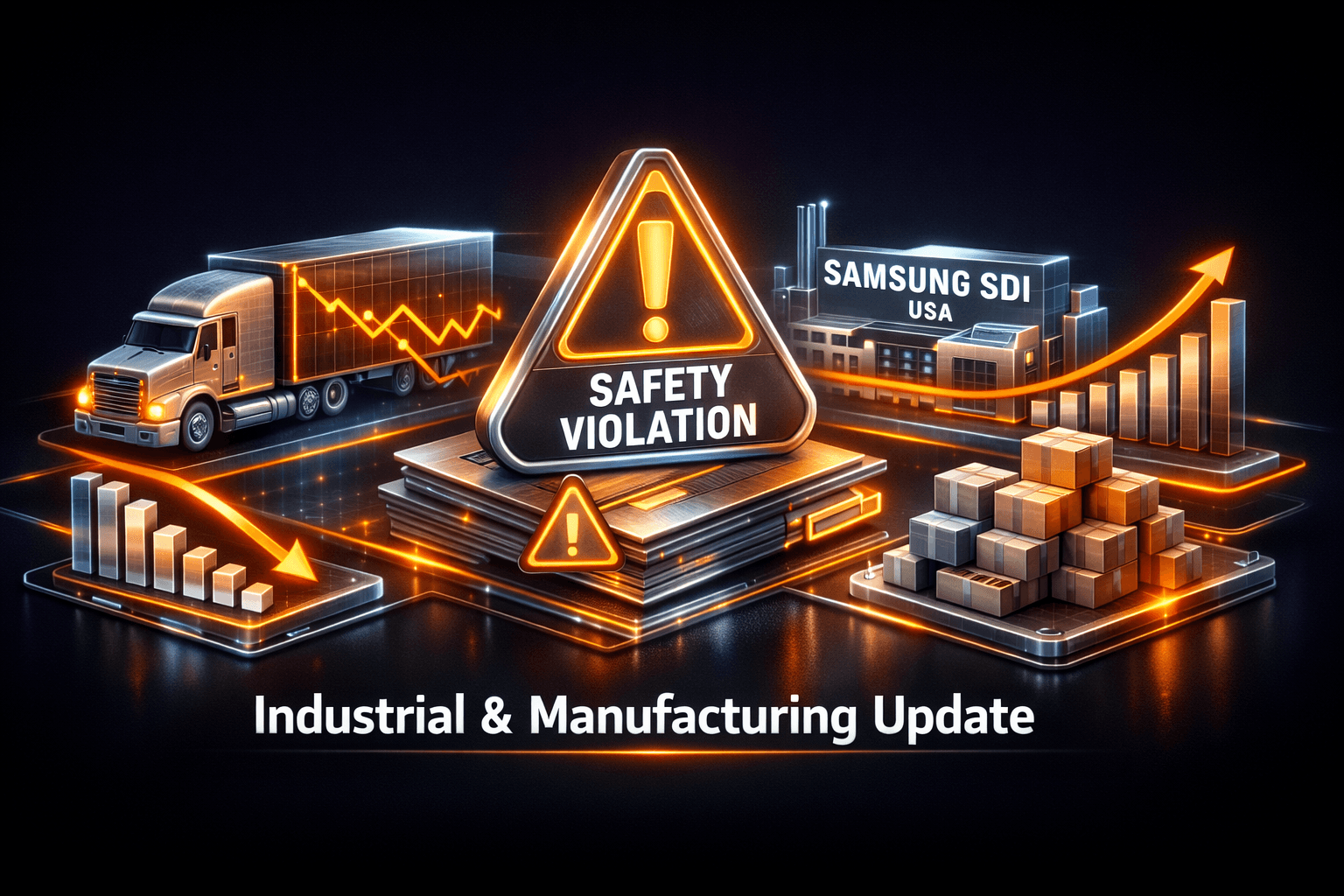
The Big Picture
Today’s Industrial & Manufacturing landscape opens with a clear split between operational headwinds and strategic repositioning. Rising ocean freight rates and a federal safety rebuke for U.S. Steel are putting pressure on costs and reputation, even as firms and suppliers make structural moves that could reshape supply chains.
Why does this matter to you? Higher shipping costs and government scrutiny can compress margins for manufacturers and their customers, while asset deals and inventory shifts can change which companies gain near-term share. Read on to see the headlines, what’s driving market sentiment, and what you should track today.
Market Highlights
Quick facts and moves to note for the open and intraday monitoring.
- Freight rates, Asia to U.S. East Coast: Ocean rates have climbed to new highs, Freightos reports, driven by sustained import volumes during an early peak season.
- Walmart, $WMT: The retailer flagged 754 supplier standard violations in fiscal 2026, a decline of 35% year over year, per its ESG report, suggesting improving supplier compliance.
- U.S. Steel, $X: Federal investigators concluded the Clairton Works explosion should not have happened, spotlighting safety and regulatory risk for the company.
- Samsung SDI and General Motors, $GM: Samsung SDI acquired GM’s stake in an Indiana EV battery plant, making it the South Korean firm’s first wholly owned factory in North America.
Key Developments
Ocean freight rates spike heading into peak season
Freightos and Supply Chain Dive report that Asia to U.S. East Coast ocean rates have hit new highs as sustained import volumes push capacity tight. Retailers had been pulling forward shipments, and data from the National Retail Federation indicate imports at major U.S. ports peaked as companies built inventory ahead of impending tariffs.
For you, that means higher landed costs for goods that rely on container shipping, at least in the near term. How will companies pass those costs on to customers, or absorb them? That question will guide margins and pricing announcements for suppliers and retailers in coming weeks.
Federal safety probe slams U.S. Steel blast
The U.S. Chemical Safety and Hazard Investigation Board issued a blunt finding that the explosion and associated deaths and injuries at U.S. Steel’s Clairton Works last year “should never have happened.” The report identifies systemic issues that contributed to the event and signals potential regulatory and legal follow through.
This is a reputational and operational risk for $X and the broader steel and midstream sectors. You should watch for company responses, remediation plans, potential fines, and any related impacts on production or contract awards.
Policy review: GAO urges Commerce to revise chips plan
The Government Accountability Office says the Commerce Department’s semiconductor and microelectronics programs have stalled and recommends a revamped investment strategy to meet statutory goals. That finding raises questions about timing and execution for federal incentive programs designed to boost domestic chip production.
Given the capital intensity and long lead times for chip fabs, delays or program redesigns could shift supplier roadmaps and investment schedules. If you follow semiconductor supply chain names, keep an eye on Commerce updates and funding timelines.
Strategic moves and supply-chain signals
Samsung SDI’s purchase of GM’s stake in the Indiana EV battery plant makes the factory Samsung’s first fully owned North American site. That’s a sign of vertical consolidation in EV batteries and a vote of confidence in local manufacturing.
Meanwhile, Walmart’s 35% decline in reported supplier standard violations indicates improving compliance discipline among major retailers. Retailers’ inventory buildup ahead of new tariffs shows there are still moving pieces in how companies manage costs and availability.
What to Watch
Here are the catalysts and risk factors that could move stocks and supply-chain equities today and in the near term.
- Shipping rates and capacity: Track Freightos indices and port throughput data. A sustained rate increase will squeeze margins for import-dependent manufacturers and retailers.
- Regulatory fallout from U.S. Steel report: Watch for $X announcements on corrective actions, potential fines, and any production interruptions tied to remediation.
- Commerce Department response: Will DOC revise CHIPS-era investment plans after the GAO critique? Funding guidance or program overhaul would affect semiconductor equipment and materials suppliers.
- Samsung SDI integration: Monitor updates on capital expenditure and production ramp at the Indiana plant, and any supplier contract shifts as the facility moves to full ownership.
- Retail inventory and tariffs: NRF and port import data will tell you whether inventory normalization follows the pre-tariff push, and what that means for retail supply chain lead times.
Want to stay nimble? Focus on companies with pricing power, diversified logistics options, or clear remediation plans. Which names have the balance sheet to weather higher freight and regulatory costs, and which might be squeezed? That’s the key question for positioning.
Bottom Line
- Mixed signals dominate today: cost pressures from shipping and regulatory risk counteract strategic investments and compliance gains.
- Rising Asia to U.S. East Coast ocean rates are an immediate margin risk for import-heavy manufacturers and retailers.
- The U.S. Steel safety report raises regulatory and reputational concerns that could create short-term operational disruption for $X.
- Samsung SDI’s full ownership of the Indiana battery plant underscores ongoing supply-chain consolidation in EVs and could shift regional supplier dynamics.
- Keep an eye on policy updates from Commerce and port import data for clues on capital spending and inventory normalization.
FAQ Section
Q: How will higher ocean freight rates affect manufacturers? A: Higher ocean rates raise landed costs and can compress gross margins for manufacturers that rely on imported components or finished goods, unless firms can pass costs to customers or shift sourcing.
Q: What should you expect after the US Steel safety report? A: Expect regulatory scrutiny, required remediation actions, and potential legal or financial impacts for $X, along with industry reviews of safety protocols.
Q: Why does the GAO critique of Commerce’s chips strategy matter? A: It matters because federal funding and program execution influence semiconductor buildouts and supplier timelines, so any program delays could ripple across equipment makers and materials suppliers.