The Big Picture
The industrial and manufacturing complex got a clear shot in the arm today as federal funding and massive private investment signaled growing momentum for domestic battery capacity, critical minerals and factory-scale manufacturing. You don’t see $2 billion in Department of Defense conditional commitments and a $16.8 billion private project announcement on the same day very often.
Those headline moves reinforce a multi-year shift toward onshore critical supply chains and automation, even as retailers and logistics operators wrestle with port congestion and select project pullbacks. For you, that means opportunities to watch suppliers, equipment makers, and logistics technology providers as trend leaders emerge.
Market Highlights
Key facts and market-moving numbers from today's news:
- DOD backing: More than $2 billion in conditional loan commitments from the Department of Defense Office of Strategic Capital to firms including Sila Technologies, Sunrise Energy Metals and Niron Magnetics.
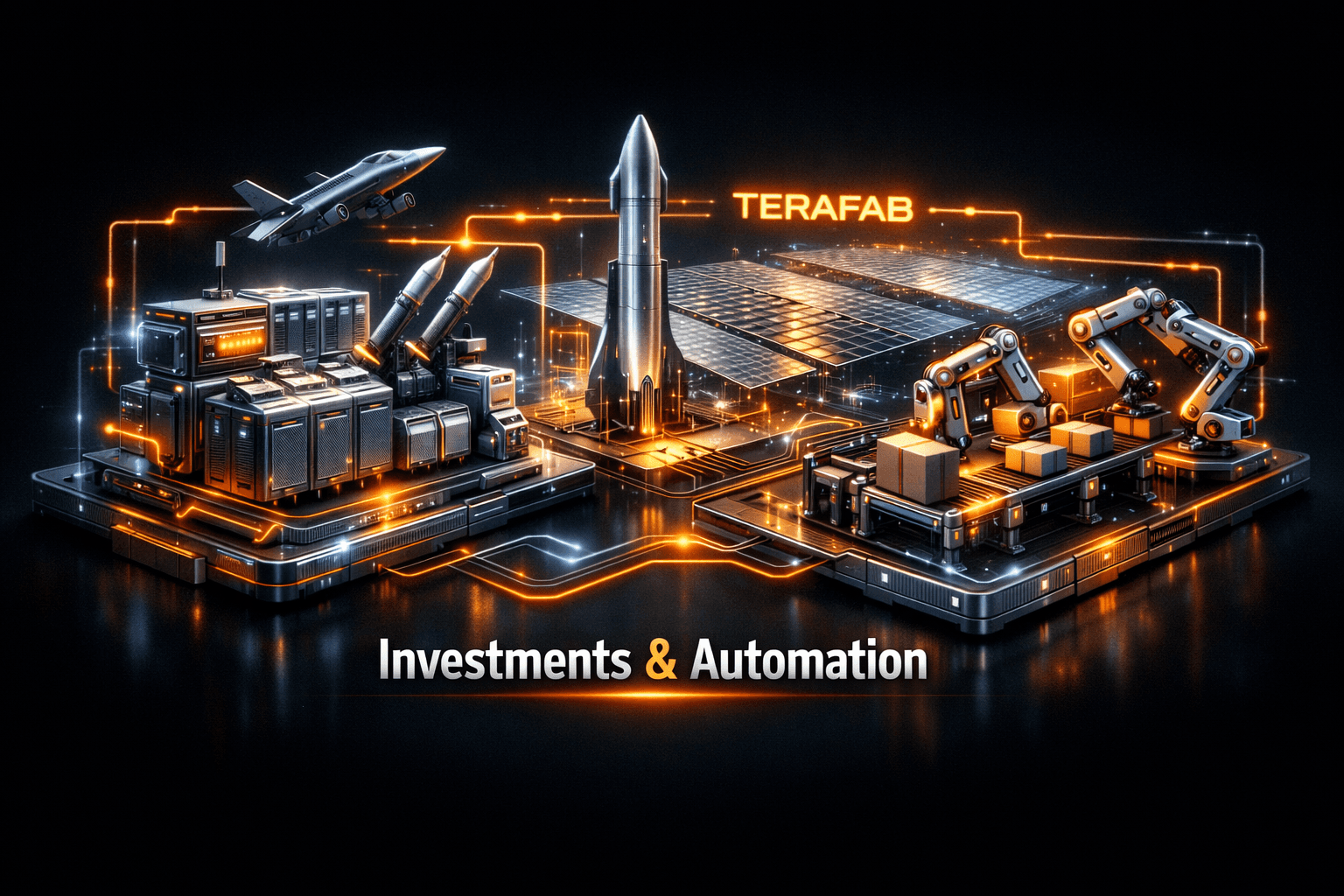
- SpaceX Terafab: $16.8 billion committed for the first phase of Terafab, with construction starting this year, a projected 3,000 jobs in phase one, and a $30 million state grant in Texas.
- Automation momentum: FedEx ($FDX) has deployed trailer loading robotics at a Maryland hub, while Amazon ($AMZN) plans to double its robotic arms fleet this year, underscoring increased capital spending on automation.
- Retail and logistics strain: Capri Holdings ($CPRI), owner of Michael Kors, cited port congestion for inventory delays and is shifting some freight to air to accelerate receipts.
- Project pullback: Ahold Delhaize ($AHOD) and partner Americold ($COLD) are winding down one automated frozen warehouse and halting another, highlighting uneven returns on certain automation investments.
Key Developments
Defense backs batteries and critical minerals
The Department of Defense's Office of Strategic Capital issued conditional loan commitments topping $2 billion to firms focused on batteries and critical minerals. Companies named include Sila Technologies, Sunrise Energy Metals and Niron Magnetics, which are positioned in battery materials, critical mineral processing and rare-earth solutions.
For you, the implication is straightforward: federal support is de-risking scale-up for upstream supply chains. Analysts note this may accelerate capital spending across battery materials suppliers and associated equipment makers as demand signals and policy alignment converge.
SpaceX's Terafab signals mega-scale manufacturing
SpaceX announced a $16.8 billion first-phase investment in its Terafab project with construction due to begin this year and 3,000 jobs planned in phase one. The state awarded $30 million tied to the Texas project, underscoring local incentives for advanced manufacturing.
That size of private capital commitment suggests long-term demand for high-throughput factory tooling, semiconductor-like clean processes, and large equipment suppliers. Where will automation and supplier bottlenecks emerge, and how fast will local labor markets adapt? Those are the questions to watch as the project advances.
Automation expands even as some projects pause
Amazon's plan to double its robotic arms fleet and FedEx's deployment of trailer-loading systems show continued investment in robotics across logistics. Those moves point to productivity gains and lower long-term labor intensity for high-volume hubs.
At the same time Ahold Delhaize and Americold are winding down or halting two automated frozen warehouse projects, and Capri Holdings flagged inventory delays tied to port congestion. That mix shows automation is not a one-size-fits-all fix. You’ll want to separate structural automation winners from site-specific or concept-stage disappointments.
What to Watch
Look for near-term catalysts that could shape sector momentum. DOD final approvals and loan closings, SpaceX construction permits and milestone spending, and capital expenditure updates from major logistics and automation vendors will matter. You should also monitor quarterly commentary from logistics operators and equipment makers for CAPEX cadence and backlog trends.
Macro and operational risks remain. Port throughput and container rates are leading indicators of inventory pressure and airfreight substitution costs. Watch published port congestion indexes and weekly shipping data to see if Capri-like inventory delays spread. How quickly will automation providers translate deployments into measurable cost savings? That question will influence valuations.
Bottom Line
- Federal backing and mega-capital projects are creating momentum for domestic battery supply chains and large-scale manufacturing.
- Automation adoption is expanding across logistics, but project execution and site economics vary, as shown by the Ahold/ Americold pause.
- Port congestion remains a near-term headwind for retailers and shippers, and it may push more firms to premium freight or onshore sourcing.
- Watch defense loan closings, SpaceX construction milestones, and CAPEX updates from automation vendors for directional signals tomorrow and in coming weeks.
- Data suggests selective exposure and close monitoring of execution risk will be key, not broad assumptions about uniform gains or losses.
FAQ Section
Q: How will DOD loan commitments affect battery supply chains? A: The commitments lower financing risk for scale-up, which could speed capacity adds for battery materials and related equipment suppliers.
Q: Does SpaceX's Terafab mean more U.S. manufacturing jobs? A: SpaceX projects 3,000 jobs in phase one, and large projects typically spur supplier and construction employment, though timing and local impact vary.
Q: Should you worry about automation projects being halted? A: Winding down individual projects highlights execution risk, so you should focus on firms with proven scale deployments and clear unit-economics.