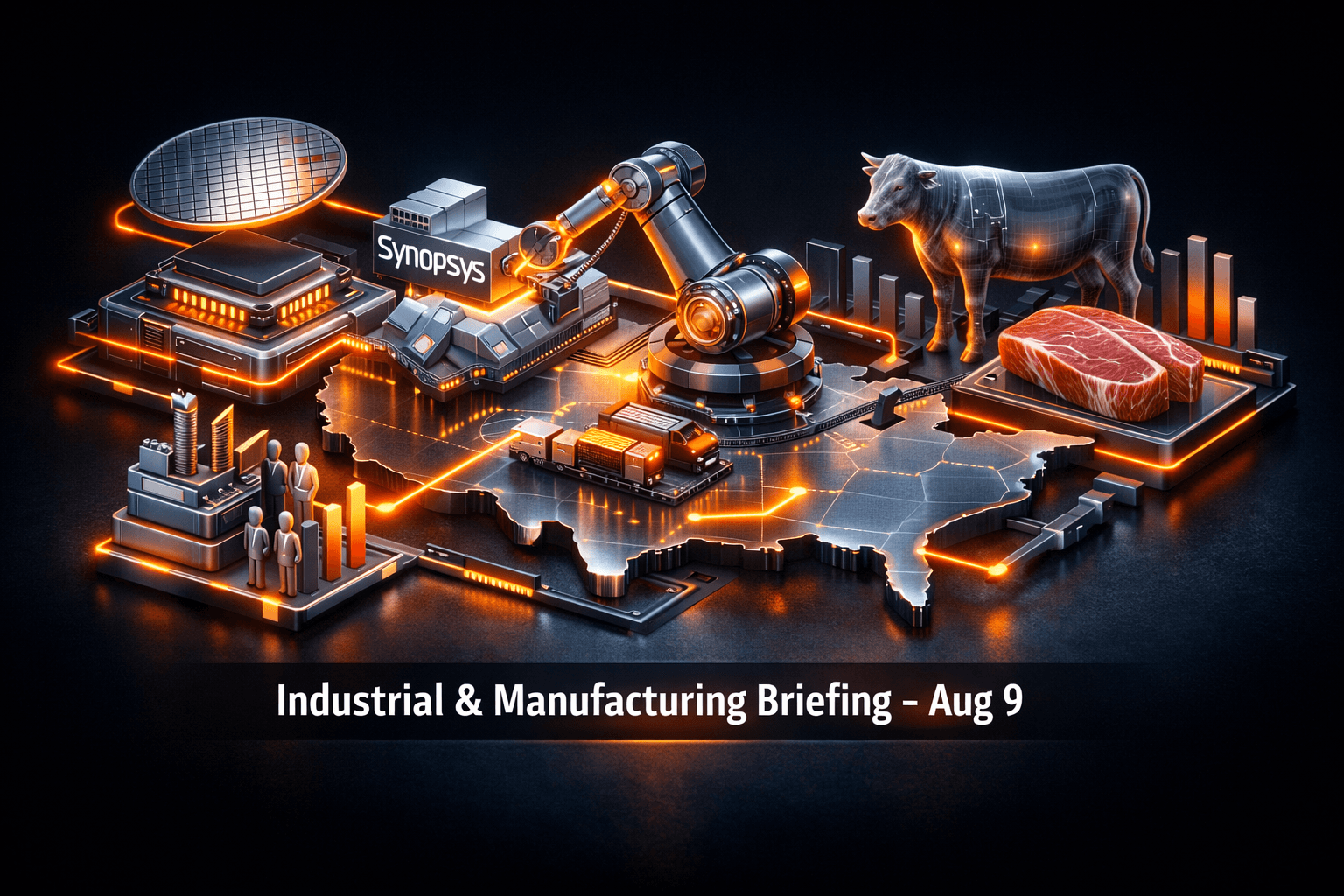
The Big Picture
GlobalFoundries' stronger-than-expected Q2 performance and a major FCC policy shift on foreign robotics stand out heading into the long weekend. Those developments, together with steady payroll gains in manufacturing, suggest selective momentum for domestic industrial suppliers even as food and meat segments face pressure.
Markets were closed Sunday, so all market references are as of Friday, August 7. You should view this as a situational update, not market action from today. Why does this matter to you? These stories affect supply chains, capital spending plans, and where manufacturing profits might show up next.
Market Highlights
Quick facts and numbers to keep on your radar as you prepare for the trading week ahead.
- Payrolls: Manufacturing added 5,000 jobs in July, with transportation equipment leading at roughly 12,000 new hires and the food industry shedding about 6,000 workers.
- Semiconductors: GlobalFoundries reported Q2 revenue of $1.79 billion, beating guidance, and cited 60% year-over-year growth in communications infrastructure and data center end markets. The company completed its strategic deal with $SNPS.
- Trade and policy: U.S. Customs and Border Protection has paid roughly $100 billion in IEEPA tariff refunds to date, while a Department of Justice appeal keeps final processing steps unresolved.
- Regulation and supply chains: The FCC's sweeping block on imports of humanoids, quadrupeds and mobile robots is being framed as a nearshoring tactic that could reinvigorate domestic robotics suppliers and their ecosystem.
- Consumer staples: $TSN flagged that elevated beef prices are likely to take a long time to normalize, signaling cost and margin pressure for the meat segment.
Key Developments
GlobalFoundries posts upside, seals Synopsys tie-up
GlobalFoundries reported $1.79 billion in Q2 revenue, which exceeded the high end of guidance ranges and was driven by strong demand in communications infrastructure and data centers. The company also completed a deal with $SNPS aimed at strengthening its software and design tool access, a move analysts note could improve its competitive position in AI-relevant chips.
For investors, that combination of revenue beat and strategic partnership points to improving fundamentals in foundry capacity and higher-value end markets. Will GlobalFoundries sustain this momentum as chip demand shifts? Watch guidance and capital spending tone in the next earnings commentary.
FCC robotics block seen as nearshoring catalyst
The FCC moved to block imports of certain foreign robotics hardware citing cybersecurity risks. Industry experts are calling the step a de facto nearshoring incentive, since it restricts some lower-cost foreign options and opens procurement windows for U.S. suppliers and integrators.
If domestic robotics firms can scale quickly, you could see increased contract wins for automation vendors and higher demand for industrial controls. The question is whether U.S. supply chains and manufacturing capacity can expand without creating cost bottlenecks.
Labor, tariffs and food inflation create mixed signals
Overall manufacturing payrolls climbed modestly in July, led by gains in transportation equipment, while food manufacturing lost workers. That divergence highlights where hiring and investment are concentrated.
At the same time, $TSN warned that high beef prices will linger, and CBP's $100 billion in IEEPA refunds underscores ongoing uncertainties in trade policy and litigation. Those factors can compress margins and complicate planning for firms exposed to food and imported inputs.
What to Watch
Events and data to track as markets reopen Monday, August 10. You want to prioritize catalysts that could change near-term sector momentum.
- Earnings and guidance updates, especially from semiconductor suppliers and industrial automation firms, for clarity on demand and capacity spending.
- Regulatory timelines around the FCC robotics ruling and any implementing guidance that defines which imports are affected and when restrictions take effect.
- Trade litigation: the Department of Justice appeal related to CBP's tariff refunds is unresolved, and any court developments could alter cash flows for importers and logistics firms.
- Macro data: inflation and consumer spending metrics that affect commodity prices, including beef, which bears on processors and retailers.
- Labor trends in manufacturing and sector-specific hiring reports, to see if the July gains broaden or narrow by subsector.
Bottom Line
- GlobalFoundries' Q2 beat and the Synopsys agreement strengthen the case for select semiconductor suppliers, with demand concentrated in communications and data center markets.
- The FCC's import restrictions on certain robotics hardware could boost domestic automation suppliers, but scaling constraints could limit near-term gains.
- Manufacturing payrolls rose modestly, but the jobs mix shows winners and losers, notably transportation equipment vs food manufacturing.
- Tyson's warning on sustained high beef prices and the unresolved DOJ appeal over CBP refunds underline inflation and policy risks that could hit margins in food and import-reliant sectors.
- Stay selective, watch guidance and regulatory milestones, and keep an eye on capacity signals that will determine who benefits from nearshoring.
FAQ
Q: How will the FCC robotics ban affect equipment makers? A: The ban narrows sourcing options and can increase near-term demand for U.S. robotics suppliers, but benefits depend on suppliers' ability to scale production and meet contracts.
Q: What does GlobalFoundries' beat mean for chip supply chains? A: Strong revenue and the Synopsys deal suggest improved positioning in higher-margin markets, which could support investment in capacity for AI and networking chips.
Q: Should I be worried about CBP tariff refunds and trade litigation? A: The $100 billion figure shows material fiscal impact, and the DOJ appeal means some uncertainty persists; you should monitor legal developments and how companies disclose related cash flow impacts.