The Big Picture
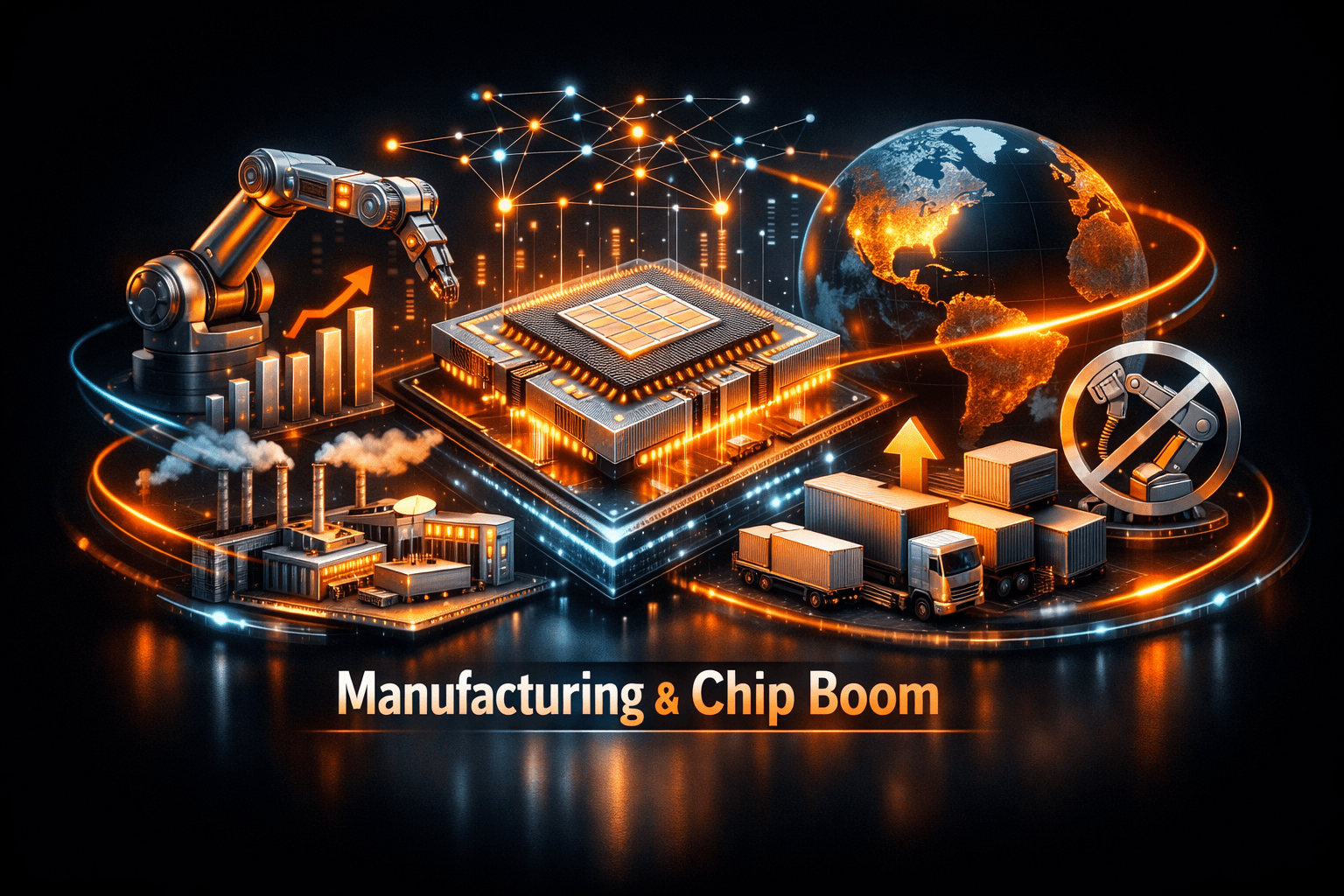
Today brought a string of developments that point to renewed strength across parts of the industrial and manufacturing complex, and you may feel the effects sooner than you think. July payroll data showed manufacturing employment rising by 5,000, GlobalFoundries delivered stronger-than-expected Q2 revenue at $1.79 billion and closed a Synopsys deal, and a new FCC stance on foreign robotics could redirect demand to U.S. suppliers.
These items matter because they touch hiring, capital spending and supply chain sourcing all at once. For you that means more differentiated opportunities, but it also means you should watch policy moves and commodity-price trends closely.
Market Highlights
Quick facts and numbers to scan before you dive deeper.
- Jobs: U.S. manufacturing employment rose by 5,000 in July, with transportation equipment adding nearly 12,000 jobs while the food industry shed over 6,000 workers.
- Semiconductors: $GFS posted Q2 revenue of $1.79 billion, topping the high end of guidance, and reported 60% year-over-year growth in the communications infrastructure and data center end market.
- Policy: The FCC moved to block certain imports of humanoid, quadruped and mobile robots, a step experts call a nearshoring tactic that could boost domestic robotics suppliers.
- Trade and refunds: U.S. Customs and Border Protection announced it has paid about $100 billion in IEEPA tariff refunds, though a capability to process finally liquidated entries remains pending due to an outstanding appeal.
Key Developments
Labor and Hiring: Modest gains, mixed by subsector shifts
July's net manufacturing gain of 5,000 workers shows hiring momentum, led by transportation equipment with an increase near 12,000. You should note the uneven picture, because the food sector cut more than 6,000 jobs, underscoring that growth is concentrated rather than broad based.
The labor mix matters for wage pressure and capacity planning. If you follow industrial names tied to autos and transport equipment, these are the areas likely to see the most immediate benefit.
Policy: FCC restrictions seen as a nearshoring catalyst
The FCC's block on imports of humanoid, quadruped and mobile robots is framed as a cybersecurity safeguard. Experts quoted in reports say it also functions as a nearshoring incentive, potentially redirecting procurement toward domestic robotics suppliers.
Could that policy nudge lead to renewed capital investment in U.S. automation suppliers? If you track industrial automation, this is a story that could lift order books for domestic vendors over the coming quarters.
Chips and corporate wins: GlobalFoundries and Synopsys deal
$GFS beat its guidance range with $1.79 billion in Q2 revenue, and the company completed a strategic transaction with $SNPS that executives say strengthens design-to-manufacturing ties. Communications infrastructure and data center demand drove a 60% year-over-year gain in those end markets.
For investors focused on the semiconductor supply chain, this is a clear sign that pockets of chip demand remain robust. The results also show the potential for more consolidation or strategic partnerships as firms chase scale and design integration.
What to Watch
Here are the catalysts and risks that could move the sector next. Stay selective and keep your time horizon in mind.
- Policy timelines: Watch for further FCC rulemaking details and implementation timelines, and monitor any legal challenges. Those will determine how quickly procurement shifts to U.S. suppliers.
- Tariff litigation and CBP systems: The Department of Justice appeal tied to finally liquidated entries could delay full processing of IEEPA refunds. That leaves some refund flows and working capital effects uncertain for importers and their supplier networks.
- Commodity and food pricing: $TSN warned that high beef prices may take a long time to normalize. That keeps pressure on grocery inflation and could influence margins for food processors and packaging suppliers. What does that mean for consumer demand down the line?
- Upcoming earnings and orders: Track quarterly reports from industrial automation suppliers, semiconductor equipment makers and major OEMs for order trends. Early-integration strategies on greenfield projects also matter, since they reduce commissioning risk and can accelerate revenue recognition.
Bottom Line
- Manufacturing job growth and a strong Q2 at $GFS signal pockets of momentum in the sector, particularly in transportation equipment and semiconductors.
- FCC policy on robotics could be a nearshoring catalyst, creating a potential tailwind for domestic automation suppliers and systems integrators.
- Trade developments are mixed: $100 billion in IEEPA refunds is notable, but process gaps and legal appeals leave some uncertainty for supply chains.
- High beef prices, per $TSN, are a headwind for food-related manufacturers and could weigh on consumer spending in related categories.
- For you, the story is selective opportunity, not blanket strength, so watch policy actions, order books and commodity trends closely.
FAQ Section
Q: How will FCC restrictions on foreign robotics affect U.S. suppliers? A: The block is likely to redirect some procurement to domestic vendors, potentially boosting order pipelines for U.S. robotics and systems integrators, though timing will depend on rule details and compliance timelines.
Q: Should tariff refunds change how companies manage inventories? A: The $100 billion in IEEPA refunds improves past cash flows, but unresolved processing capabilities and legal appeals mean some companies may remain cautious about changing inventory policies right away.
Q: What does GlobalFoundries' Q2 beat mean for the chip cycle? A: $GFS's revenue beat and 60% growth in key end markets suggest demand pockets remain strong, particularly for communications infrastructure and data center chips. Analysts note this points to selective strength rather than a uniform recovery.