The Big Picture
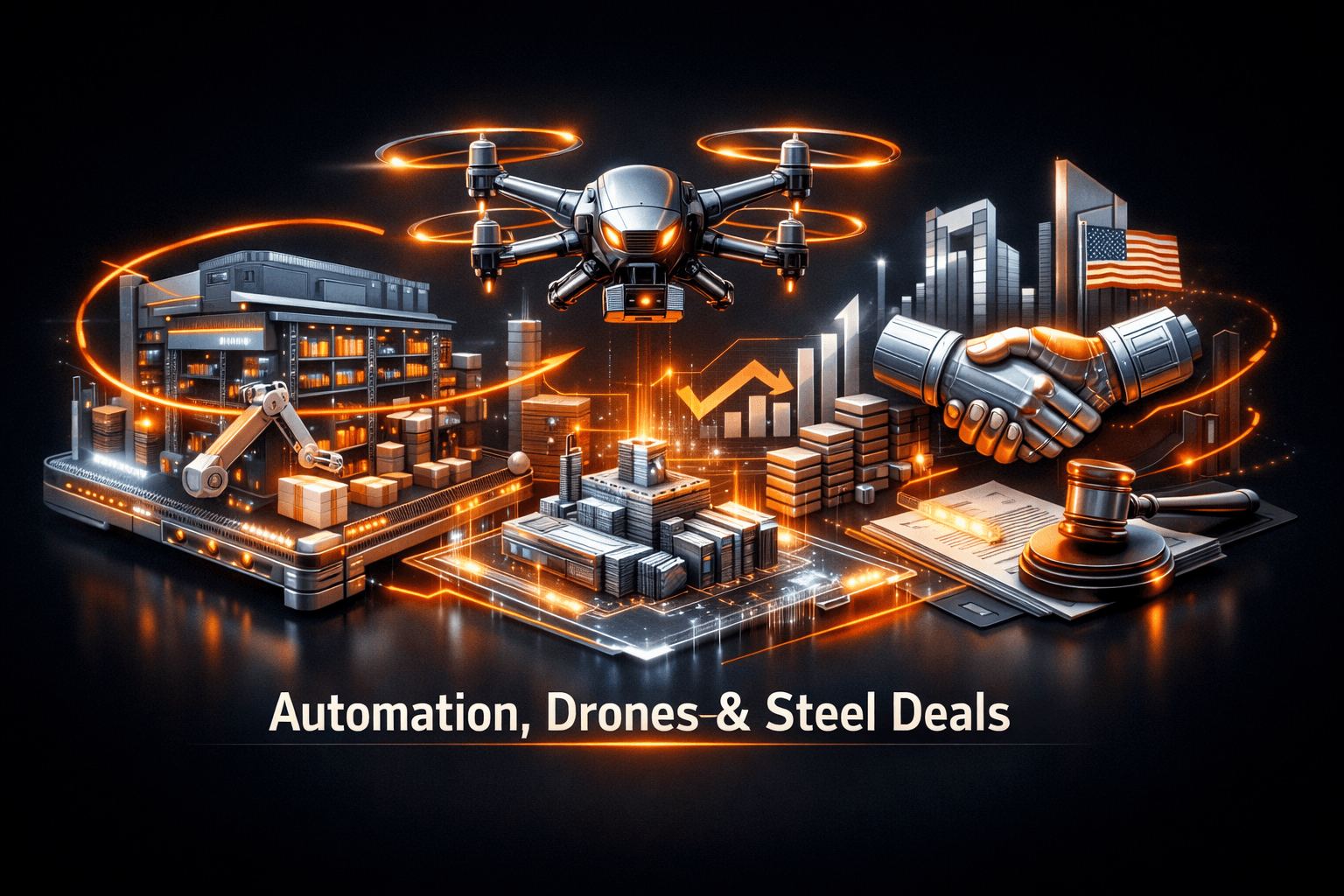
Today the Industrial & Manufacturing sector moved on clear growth signals, as automation, targeted capital and operational gains surfaced across several subsegments. You saw expansion in defense supply chains and faster fulfillment throughput, while steelmakers pointed to improving U.S. demand.
That momentum matters because capital deployment and productivity gains tend to compound, and they can translate into higher output or margin relief over the next several quarters. At the same time you should note rising policy risk, as litigation over tariffs creates uncertainty for trade-sensitive firms.
Market Highlights
Quick facts and takeaways from the day's top stories.
- Amazon $AMZN is operating a highly automated fulfillment center in Kent, Washington, using Hercules robots and advanced packing systems to speed order throughput.
- PDW, an Alabama component maker, secured an $820 million conditional loan aimed at expanding drone part production and workforce capacity.
- Nippon Steel raised full-year guidance after US Steel emerged as a growth driver one year following its deal, citing U.S. market improvement and operational gains.
- Logistics players including $UPS and $AMZN are using fuel surcharges to blunt higher energy costs and protect margins.
- Legal risk surfaced as 25 states filed suit over Section 301 tariffs tied to forced-labor rules, creating potential headwinds for tariff-reliant sourcing strategies.
- Plant Engineering emphasized preventive and evolving maintenance practices as a foundation for safe, reliable manufacturing operations.
Key Developments
Amazon's automated Kent fulfillment center showcases scaled efficiency
Supply Chain Dive walked readers through an automated Washington warehouse where Hercules robots and advanced packing tech handle a large share of order staging and packing. The setup reduces manual touches and should help throughput and consistency at larger volumes.
For you that means automation remains a practical lever for fulfillment efficiency and cost control, not just a headline. Expect other e-commerce and logistics operators to accelerate similar investments if the ROI holds up under higher-volume conditions.
$820M conditional loan backs PDW and defense supply expansion
Manufacturing Dive reported that PDW, a component maker in Alabama, signed a conditional $820 million loan to scale drone part production, expand its footprint and hire more workers. The backing, tied to defense industrial policy, aims to tighten domestic supply chains for critical components.
This is a shot in the arm for U.S. defense manufacturing capacity. If you follow suppliers to aerospace and defense prime contractors, this kind of capital infusion signals stronger order flow and a longer runway for production growth.
Steel sector turnaround, logistics surcharge tactics and policy risk
Nippon Steel's updated guidance, citing US Steel as a growth driver, shows operational improvements and U.S. demand recovery are driving better outlooks for large steelmakers. That matters for capital goods, construction and equipment makers that rely on stable steel supply.
On the logistics side, $UPS and $AMZN are protecting margins with fuel surcharges that largely pass costs to shippers. That softens inflationary pressure inside delivery networks but shifts cost to customers. Meanwhile, 25 states suing over Section 301 forced-labor tariffs raises uncertainty about future tariff enforcement and cross-border sourcing, which you should factor into scenario planning.
What to Watch
Look ahead to catalysts and risks that could move the sector tomorrow and beyond.
- Defense contract awards and DoD announcements could accelerate supplier bookings tied to PDW and similar players. Monitor federal procurement calendars and statement timing.
- Steelmakers' margin execution and volume trends. Watch quarterly updates from $X and Nippon Steel $NSSC for more granular guidance on demand and pricing.
- Logistics pricing actions. If carriers keep surcharges in place, input-cost pressure for downstream shippers will persist. That could affect margins for retailers and manufacturers with tight freight exposure.
- Legal and policy developments around Section 301 tariffs. Expect near-term volatility if court outcomes force changes to current tariff structures.
- Operational signals from automation pilots. If $AMZN's automation model proves repeatable, you may see capex announcements or partnership deals from robotics suppliers.
Bottom Line
- Expansion and capital flow dominated today's headlines, pointing to growth momentum across defense, fulfillment and steelmaking.
- Automation and maintenance remain core to productivity gains, and you should watch implementation outcomes closely.
- Logistics surcharges are providing near-term margin relief for carriers, but they transfer cost pressure to shippers and customers.
- Policy and legal risk from the Section 301 lawsuit injects uncertainty for global supply chains and tariff exposure.
- Overall the sector is showing bullish operational momentum, though selectivity matters as you weigh exposure to trade-sensitive subsegments.
FAQ Section
Q: How will the $820M loan to PDW affect supply chains? A: The conditional loan is meant to expand domestic drone part production, which should increase capacity and reduce reliance on overseas suppliers for defense components.
Q: Should you worry about the 25-state lawsuit over Section 301 tariffs? A: The suit creates policy uncertainty, and it could alter tariff regimes if courts or lawmakers act; companies with heavy import exposure should monitor developments closely.
Q: Does Amazon's warehouse automation mean fewer jobs? A: Automation shifts job roles toward supervision, maintenance and systems work, while routine tasks may decline; maintenance and upskilling become more important for plant and warehouse workforces.