The Big Picture
Heading into the long weekend, the industrial and manufacturing landscape looks constructive, with multiple capacity expansions and process improvements announced on Friday, July 31. Major investments and partnerships are signaling that manufacturers are scaling to meet demand across pharma, semiconductors, aerospace and electronics.
That momentum isn't uniform. You should note sustainability challenges have appeared alongside progress, as higher data center demand pushed one major retailer's emissions up. Still, overall the headlines point to growth and efficiency gains that could move the needle for related supply chains and suppliers.
Market Highlights
Key facts and quick numbers from the weekend's top items, reported as of Friday, July 31.
- Resilience and Eli Lilly are investing $750 million to scale GLP-1 injectable production in Cincinnati, creating about 400 jobs, boosting contract manufacturing capacity for injectables.
- ADM, BeOne Medicines, H-One, Jabil and TTM Technologies announced openings and expansions across agriculture, automotive, oncology and electronics, reflecting broad-based industrial investment.
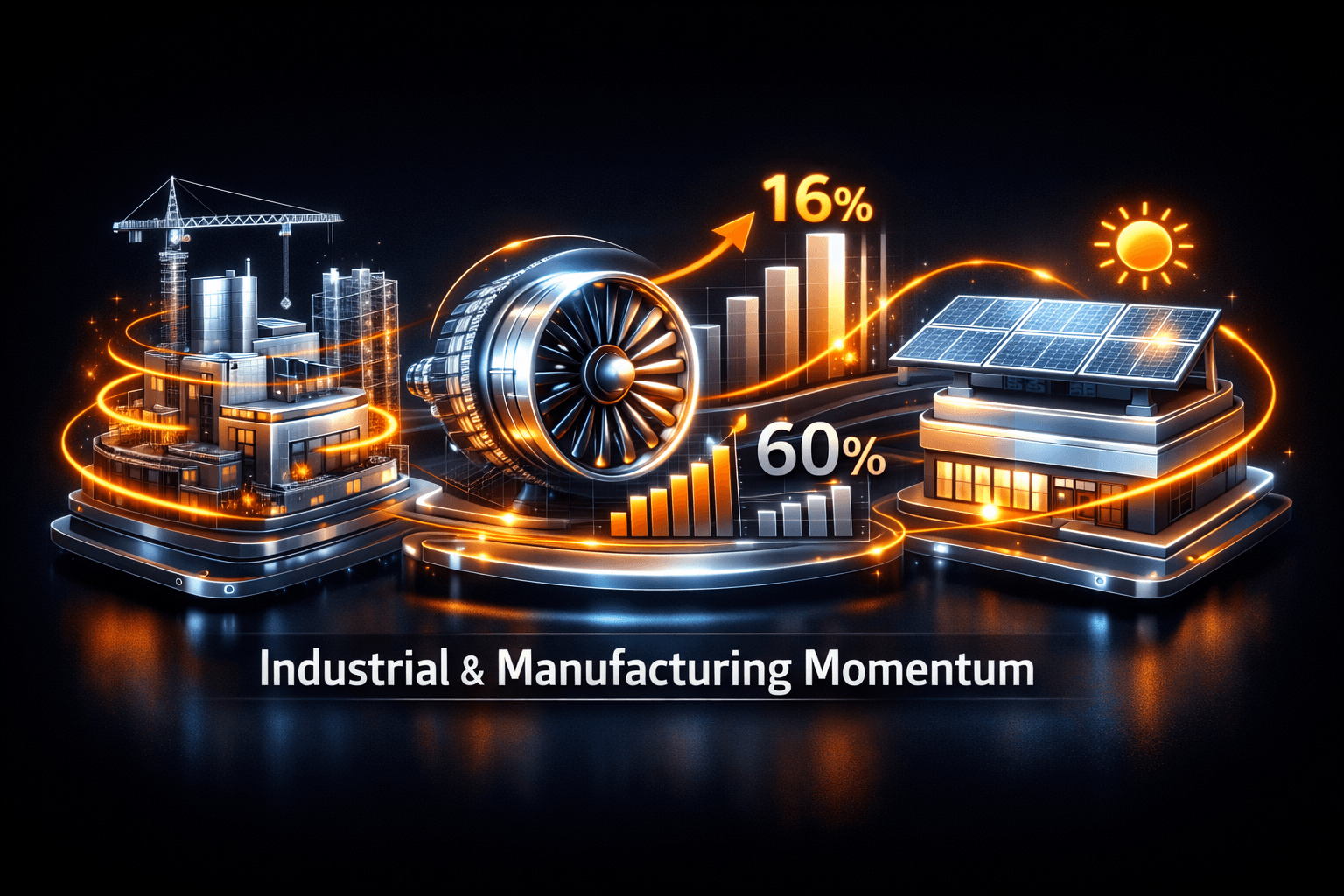
- Amazon reported a 16% year-over-year rise in absolute carbon emissions for 2025, driven largely by scope 3 emissions as AI-driven data center capacity increased.
- Best Buy added a solar field to power a California distribution center, a concrete move to cut supply-chain emissions and energy costs for logistics operations.
- Qnity partnered with the University of Delaware to advance semiconductor materials R&D and workforce pipelines, tying academic talent to industry needs.
- GE Aerospace trimmed lead times by 60% in the quarter, with faster F110 engine deliveries after consolidating processes and reducing travel distances within production.
Key Developments
Biopharma scale-up: $750M Cincinnati expansion
Resilience and $LLY are committing $750 million to expand injectable manufacturing capacity in Cincinnati, with roughly 400 new jobs focused on GLP-1 products. For you that means contract manufacturers and suppliers that serve sterile injectable lines could see higher demand for components, packaging and quality services.
The move underscores a broader trend of reshoring and capacity investment in pharma manufacturing. Analysts note it also reduces bottlenecks for high-growth therapeutic categories, and could improve supply resilience for drug makers that need large-scale sterile fill-finish capacity.
Sectors broadening: openings, OEM and electronics investments
Announcements from $ADM, BeOne Medicines, H-One, Jabil and TTM Technologies show capital deployment across agriculture, automotive, oncology and electronics. These are not isolated projects. You're seeing a mosaic of expansions that suggests firms are positioning for demand across end markets rather than betting on one sector.
That diversity matters if you want exposure to industrial momentum without relying on a single cycle. Equipment suppliers, automation vendors and local contractors will likely be the nearer-term beneficiaries of this wave of projects.
Operational gains and sustainability tensions
$GE reported a 60% cut in lead times after process consolidation, and it saw a healthy bump in F110 engine deliveries in Q2. Shorter lead times usually translate to better cash conversion and order fulfillment, which is a positive signal for aerospace suppliers and MRO providers.
On the flip side, $AMZN's 16% rise in absolute emissions for 2025 highlights how rapid data center growth and AI demand can push supply-chain footprints higher. Meanwhile, $BBY is adding a solar field at a California distribution center, showing how some retailers are addressing emissions while improving operational resilience.
What to Watch
Look for earnings and capital spending updates from major industrial suppliers in early August. You should watch for comments about backlog, lead times and capex plans that will confirm whether these announcements turn into sustained demand.
Policy and labor will matter too. Are federal incentives or state grants accelerating pharma and semiconductor projects? Will local hiring for new plants face constraints? Those answers will shape project timelines and cost dynamics.
Finally, sustainability signals are worth monitoring. Can solar projects and efficiency gains offset emissions growth from AI and data center expansion? How companies report scope 3 improvements will influence long-term cost and reputational risk.
Bottom Line
- Multiple capacity expansions and partnerships point to growing industrial demand, especially in pharma, semiconductors and electronics.
- Operational improvements, such as $GE's 60% lead-time reduction, indicate margin and delivery upside for some manufacturers and suppliers.
- Sustainability outcomes are mixed, with $AMZN reporting higher emissions while $BBY adopts solar — you'll want to follow scope 3 strategies closely.
- Workforce and supply-chain bottlenecks remain potential risks to project timelines, particularly for specialized manufacturing roles.
- Overall, the news suggests constructive momentum for the sector heading into the new trading week, but selectivity is advised as execution and sustainability remain key.
FAQ Section
Q: How will the Resilience and Eli Lilly investment affect suppliers? A: The $750 million buildout and 400 new jobs expand demand for sterile-fill equipment, packaging, quality testing and local services, which should benefit component suppliers and contract vendors.
Q: Does GE Aerospace's lead-time cut indicate broader industrial improvement? A: It signals that process consolidation and shorter internal logistics can materially speed deliveries, and similar efficiency programs could appear across aerospace and heavy manufacturing.
Q: Should you be worried about Amazon's emissions rise? A: It’s a red flag that rapid AI-driven growth can increase footprint, but parallel initiatives like distribution-center solar installations show companies are pursuing offsets and efficiency improvements over time.