The Big Picture
Today the industrial and manufacturing sector delivered mixed signals that investors will want to parse carefully. Operational moves and funding efforts suggested momentum in domestic capacity building, while sweeping trade action and a corporate retreat on climate targets underlined policy and ESG friction.
If you own stocks in supply-chain reliant firms or basic materials, you should note both the potential near-term winners from protectionist measures and the reputational and regulatory risks that could create volatility ahead.
Market Highlights
Quick facts and market reactions that shaped the session.
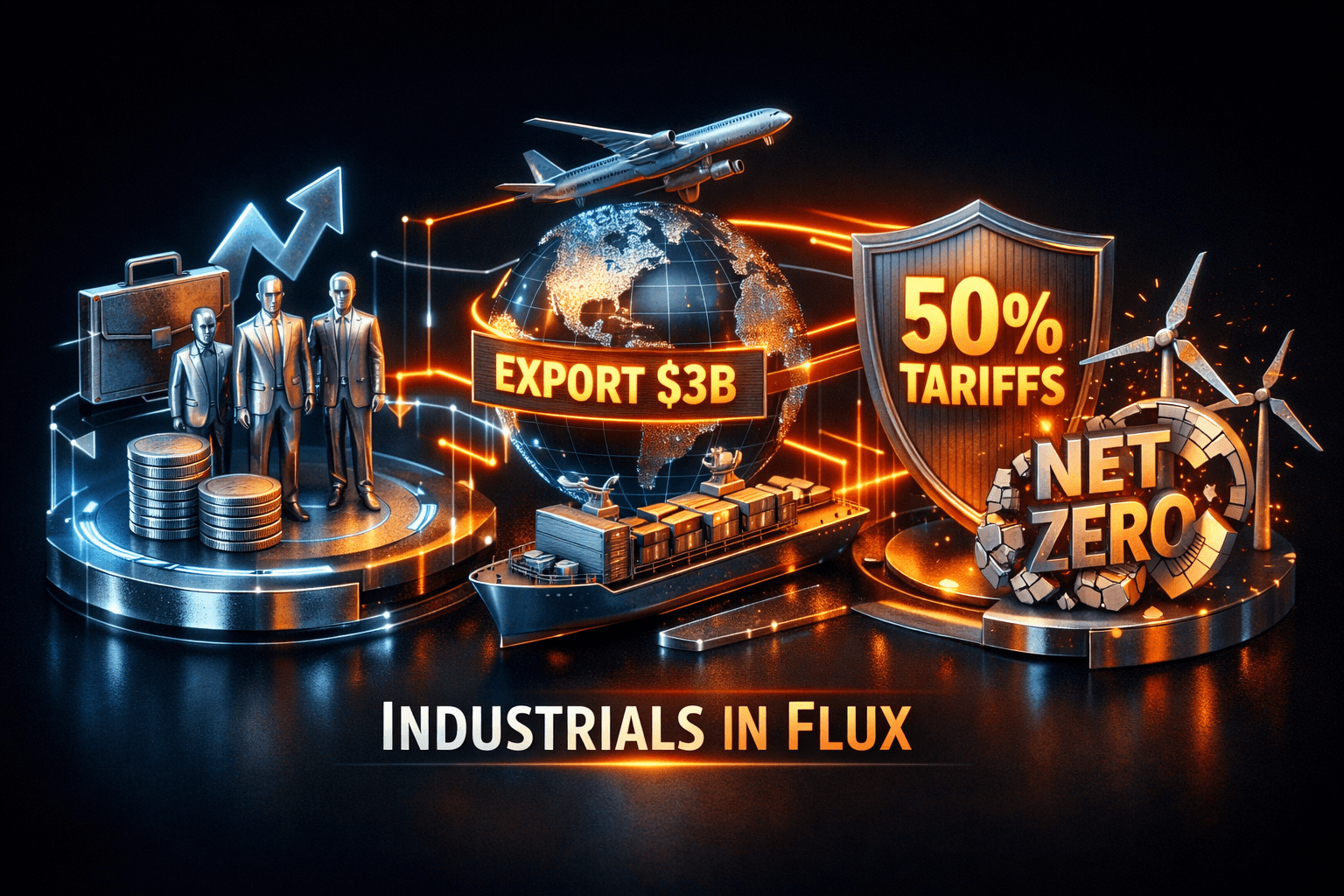
- Trade policy shock: The US announced 50 percent Section 338 tariffs on many Canadian imports, a sizable duty that will affect cross-border flows and input costs for manufacturers.
- Funding push: JetZero filed an Export-Import Bank letter of interest for roughly $3 billion under the Make More in America Initiative, signaling continued federal support for domestic industrial projects.
- Operational hiring and leadership: $SJM hired a seasoned operations and supply chain executive from $HSY, while $BBY named a head of fulfillment and operations to centralize sourcing and delivery work.
- Materials pricing: Steel Dynamics reported recycled steel prices were up about $105 per ton during Q2, a tailwind to margins despite headwinds in its aluminum business.
Key Developments
Leadership moves aim to tighten operations
JM Smucker $SJM announced Douglas Guilherme as its new senior vice president of operations and supply chain, effective July 29. Guilherme brings over 30 years of experience including time at Hershey $HSY and Procter & Gamble, and the hire comes as companies push to reduce inventory friction and improve fulfillment performance.
Best Buy $BBY also elevated Duane Scarboro to lead fulfillment and operations after the role went into effect last week. For you that means companies are still investing in people to smooth supply chains and improve service levels, which can help margins over time if execution follows through.
Capital for domestic manufacturing, and what it implies
JetZero submitted an Export-Import Bank letter of interest seeking up to $3 billion to help fund a North Carolina plant under the Make More in America Initiative. This program is designed to help manufacturers secure capital for facilities, equipment, and infrastructure in the U.S., and it points to continuing federal emphasis on reshoring advanced manufacturing.
Funding like this tends to create long-term jobs and capability, but it also requires patient capital and execution. If you follow aerospace and advanced manufacturing, ask whether projects have the supply chain depth and workforce ready to meet timelines.
Tariffs and materials: winners and losers
The administration imposed 50 percent tariffs on a wide array of Canadian imports under Section 338. That action will raise costs for companies relying on cross-border inputs and may prompt near-term price pass-through or sourcing shifts. At the same time, domestic producers of affected goods could see demand lift.
Steel Dynamics $STLD posted an upbeat Q2 headline, helped by recycled steel prices rising roughly $105 per ton this quarter as tariffs and tight domestic supplies supported pricing. However, its aluminum segment recorded losses that tempered overall results. Data suggests pricing momentum is uneven across metals, so sector returns will depend on product mixes and hedging strategies.
ESG retreat: JBS drops 2040 net-zero goal
Meat giant JBS said it will no longer pursue a 2040 net-zero greenhouse emissions target and has dropped scope 3 reduction commitments. That move highlights execution challenges around supply-chain emissions reductions in food and agriculture sectors, and it raises questions about how investors and customers will respond.
Will this change how lenders and large buyers assess JBS and its suppliers? It could increase scrutiny and potentially affect contract terms or access to sustainability-linked financing for the company and its peers.
What to Watch
Key items to monitor that could move stocks and sentiment tomorrow and in the weeks ahead.
- Policy fallout from 50 percent Canada tariffs, including potential retaliatory measures or exemptions. Watch which product lines and companies are most affected and whether input costs lead to revised guidance.
- Progress on JetZero financing and any other EXIM activity tied to the Make More in America Initiative. Announcements of definitive loans or guarantees could catalyze supplier and regional economic activity.
- Earnings and margin color from basic materials firms, especially on aluminum and steel spreads. Steel pricing strength helped $STLD, but aluminum losses illustrate volatility across commodities.
- Corporate ESG positioning after JBS's announcement, including lender responses and buyer contracts. Expect investors and customers to probe how emissions are measured and what practical reduction pathways exist.
- Operational execution at $SJM and $BBY after leadership changes. You should watch inventory turns, fulfillment costs, and service metrics in upcoming reports for signs of improvement.
Bottom Line
- Mixed signals dominate the sector today, with operational hires and funding interest offset by major trade and ESG disruptions.
- Policy moves, especially the 50 percent Canada tariffs, are likely to cause near-term re-shoring and sourcing adjustments that create winners and losers.
- Materials pricing shows pockets of strength, but look at company-level exposure to aluminum versus steel when you evaluate names.
- Leadership and execution will matter more than ever, so track operational metrics and capital allocation closely in the coming quarters.
- Data suggests selective opportunities may arise, but caution is warranted because policy and ESG shifts can create abrupt volatility.
FAQ Section
Q: How will the 50 percent tariffs on Canadian imports affect manufacturers? A: The tariffs will raise input costs for companies using Canadian parts and commodities, prompt sourcing shifts, and may benefit some domestic producers, but effects will vary by product and supply-chain exposure.
Q: Does JetZero’s $3 billion EXIM letter mean the project is funded? A: A letter of interest signals intent and eligibility under the Make More in America Initiative, but it is not a final loan commitment. Final approvals and terms are still required.
Q: Should JBS dropping its 2040 net-zero goal change how I view food and agriculture stocks? A: The move adds reputational and policy risk for JBS and peers, and analysts note it could influence buyer and lender behavior. It does not directly change fundamentals today, but it is a factor to monitor for contract and financing terms.