The Big Picture
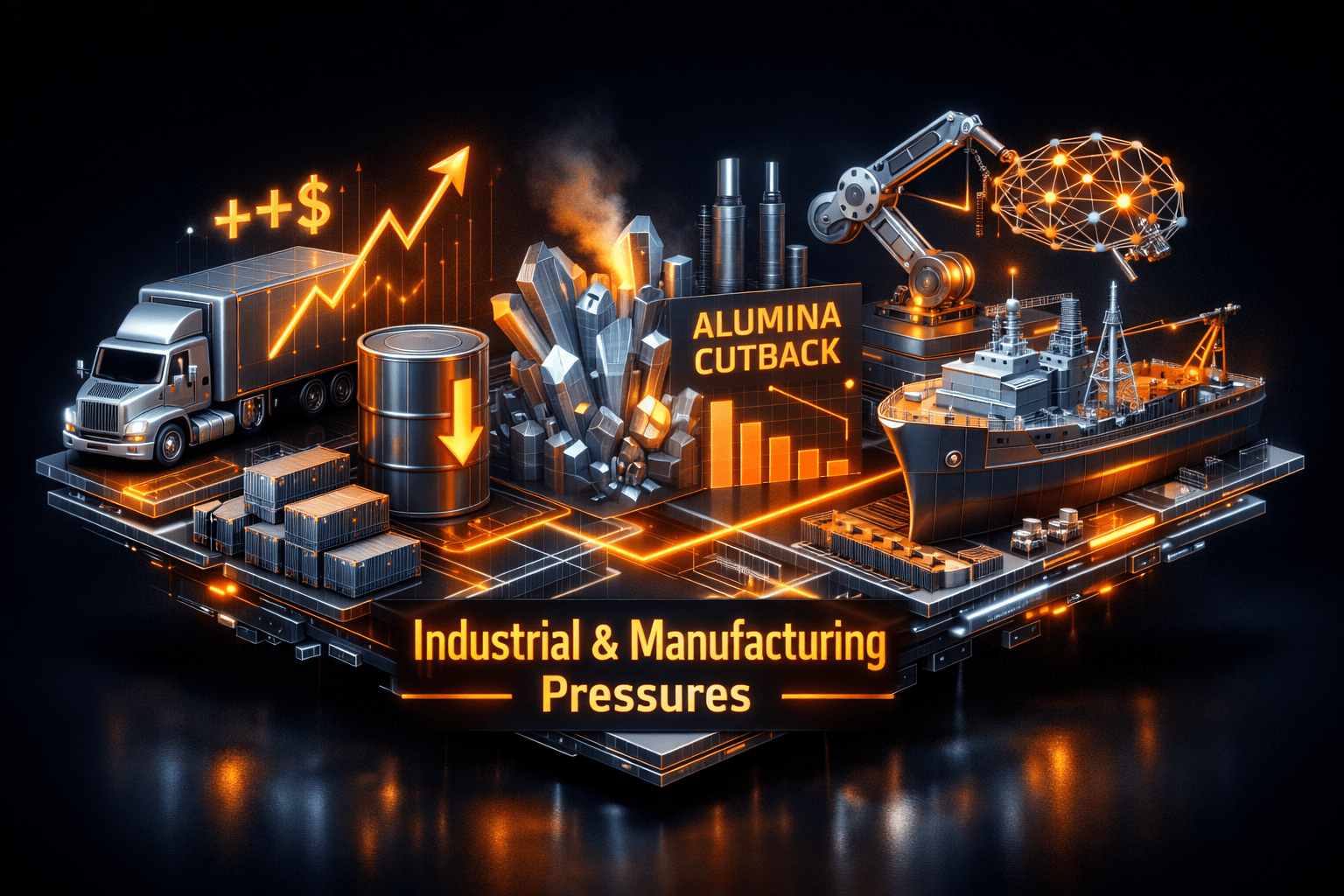
Cost and capacity stressors pushed to the top of the industrial and manufacturing news cycle today, as fuel surcharges, geopolitical supply shocks and a major production cut combined to tighten near-term outlooks for several companies.
That matters for you because margins, shipping rates and input availability drive earnings in this sector, and today’s developments suggest investors should expect heightened volatility and selective earnings risk in the weeks ahead.
Market Highlights
Key items to track from today, listed for quick reading.
- Saronic Technologies pledges a $3.3 billion autonomous shipyard at the Port of Brownsville, Texas, aiming to create a new manufacturing hub and leverage a large foreign trade zone.
- Fuel surcharges are squeezing shippers and their customers, a dynamic highlighted by the TD Cowen/AFS Freight Index and coverage noting Amazon’s expanding delivery footprint is pressuring market pricing, an ongoing threat for $FDX and $UPS.
- Alcoa, $AA, lowered its full-year alumina production outlook while working to return the Pinjarra refinery to normal operations, creating short-term supply concerns for aluminum chains.
- WD-40, $WDFC, reported as much as a 100% spike in some sourcing costs tied to the Iran war, signaling notable margin pressure for consumer and industrial products makers.
- Industry leaders are flagging logistics resiliency as a critical priority, with Maersk leadership warning that future disruptions are increasingly hard to predict.
Key Developments
Fuel surcharges and the shipping price squeeze
Reports show fuel surcharges have materially raised costs for shippers and shippers' customers, with the TD Cowen/AFS Freight Index noting behavior shifts as buyers seek discounts and alternate carriers. $FDX and $UPS face a dual pressure, where rising fees hit customers' margins and Amazon, $AMZN, may further compress pricing power over time.
For you, that means shipping cost volatility can translate into earnings surprises across retail, industrials and logistics names. Are carriers able to pass through costs, or will demand erosion force concessions?
$3.3 billion autonomous shipyard lands in Texas
Saronic Technologies selected the Port of Brownsville for a $3.3 billion autonomous shipyard project, a large-scale manufacturing investment that could create long-term demand for regional suppliers and port services. The site sits inside one of the largest U.S. foreign trade zones, which should help with duty and supply-chain economics.
This is a long-term positive for U.S. shipbuilding and local manufacturing jobs, but it won’t offset immediate cost shocks in the wider sector. Investors should treat it as a strategic growth story rather than a near-term earnings relief.
Input-cost shocks, production cuts and supply risks
Alcoa, $AA, cut its alumina production outlook, citing refinery issues at Pinjarra in Australia, and said it is working on a recovery plan. Separately, WD-40 disclosed spikes of up to 100% in some sourcing costs driven by the Iran war, a clear example of how geopolitics is hitting industrial supply chains.
Data suggests margins could be squeezed across components and finished goods makers if these cost pressures persist, a wake-up call for anyone tracking industrial earnings and supply sensitivity.
What to Watch
Look ahead to these catalysts and risk points, and make sure you monitor them closely.
- Alcoa updates, including Pinjarra recovery timelines and revised alumina guidance, expected to influence aluminum-linked suppliers and downstream fabricators.
- Fuel price trends and freight indices, which will determine whether surcharges ease or become a structural cost for shippers and customers.
- Developments around the Iran conflict and related commodity sourcing disruptions, given the sharp cost moves reported by $WDFC.
- Progress on permits, financing and construction milestones for the Saronic shipyard, which will signal when the project shifts from plan to active demand for suppliers.
- Adoption metrics for practical AI use cases described in Manufacturing Dive’s AI coverage, which could affect productivity and long-term margin improvement for manufacturers.
How should you think about timing and exposure amid this backdrop? Focus on company-level disclosure, not sector headlines, and watch earnings for margin detail and pass-through assumptions.
Bottom Line
- Cost pressures dominated today, with fuel surcharges and geopolitical sourcing shocks creating immediate margin risk for shippers and manufacturers.
- Saronic’s $3.3 billion shipyard is a material long-term growth signal, but it does not alleviate current headwinds for most firms.
- Alcoa’s alumina production cut raises supply risk for downstream metals and industrial users, and you should expect tighter input availability in the near term.
- Logistics resiliency remains a priority, as executives note unpredictability of future disruptions, which could drive higher inventory and capex choices.
- Analysts note selective exposure is prudent, monitor company updates closely, and pay attention to oil, freight indices and geopolitical developments for the next leg of sector moves.
FAQ Section
Q: How will fuel surcharges affect manufacturing earnings? A: Higher surcharges raise transportation costs across supply chains which can compress margins if firms can’t pass costs to customers, analysts note.
Q: Will Saronic’s shipyard meaningfully boost industrial demand this year? A: The $3.3 billion project is a major long-term investment, but construction and supply-chain effects will be gradual, so near-term impact on sector revenue is limited.
Q: What should you watch from Alcoa next? A: Look for updates on Pinjarra refinery restart timing, revised alumina guidance and any commentary on downstream supply implications for the metals sector.