The Big Picture
Healthcare’s latest developments point in two directions: research is identifying possible new ways to address disease, while affordability and access remain persistent pressure points. A study on cancer metabolism and work to stabilize chromosomes in aging eggs offer early scientific promise, but neither is an approved treatment or near-term commercial catalyst based on the reports available.
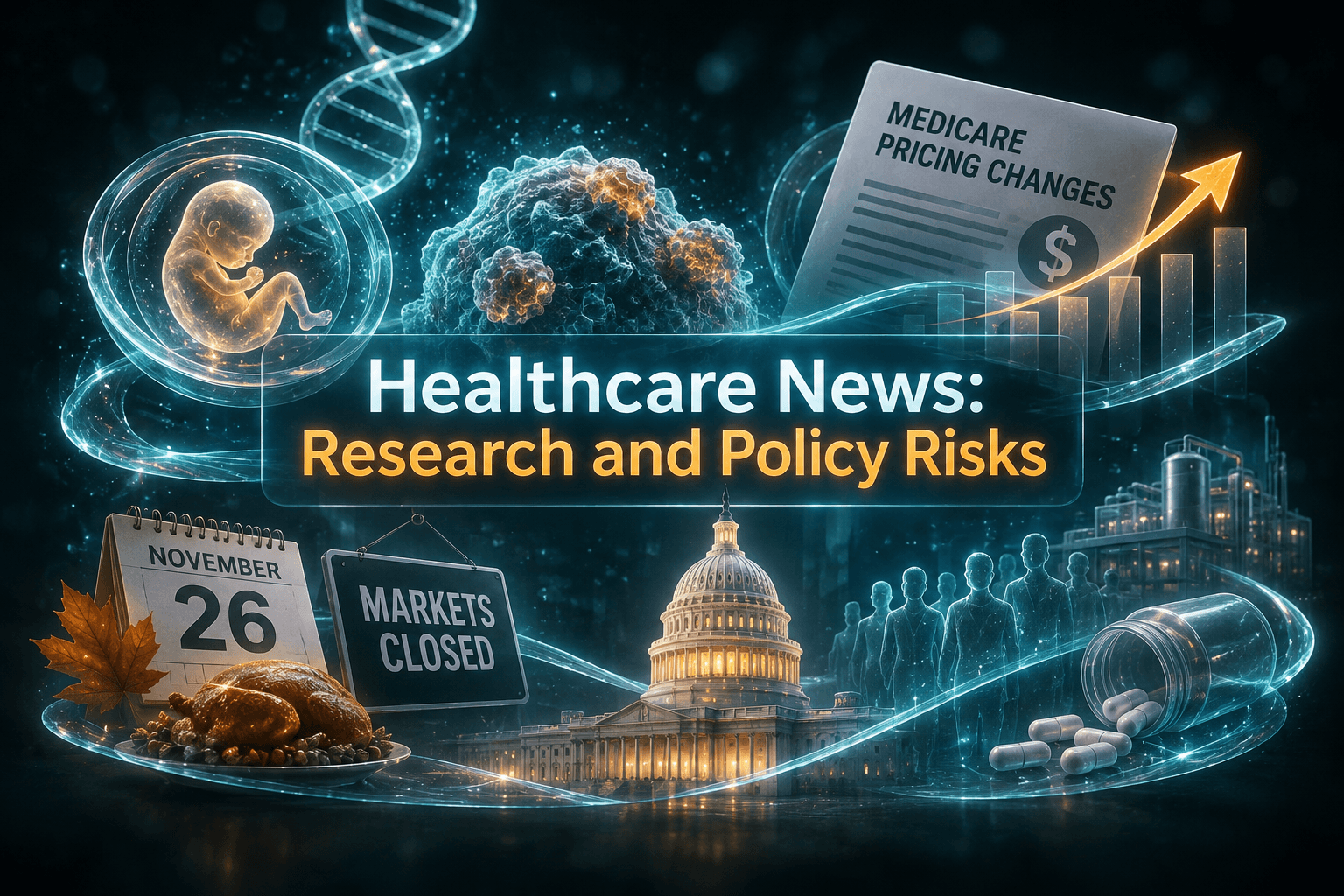
At the same time, Medicare drug pricing and physician payment changes, concentrated insurance markets, and difficulty finding primary care underscore the policy and delivery challenges facing the sector. US stock markets were closed Thursday for Thanksgiving, so there was no US healthcare trading session today. The next session is Friday, November 27, and the stories below are developments to assess heading into it.
Market Highlights
There were no US stock price moves to report for Thursday. The provided stories also contain no share-price or percentage-change data from Wednesday, November 25, so this wrap focuses on the news and its potential significance rather than suggesting a market reaction.
- Medicare named 13 additional drugs for 2028 prices under the Inflation Reduction Act. The report says medicines nearing or past patent expiration face steep reductions, but doesn’t provide individual drug names or price changes.
- The American Medical Association said 95% of metro health insurance markets remain highly concentrated, renewing concern about limited payer competition.
- Amgen ($AMGN) advanced its effort to develop a biosimilar to Opdivo. Bristol Myers Squibb ($BMY) named a new finance chief, while reports also noted a Cogent cancer-drug approval and setbacks at Arcus Biosciences ($RCUS) and Belite Bio ($BLTE).
- A review found oral nutrition supplements were generally linked to modest short-term health improvements for older adults, with interventions often judged cost-effective or cost-saving.
For you, the key distinction is timing: research findings may take years to translate into products, while reimbursement and pricing decisions can shape industry economics more directly. Without a US session, it’s too early to read these headlines as a same-day change in investor expectations.
Key Developments
Research offers possibilities, not near-term proof
A new platform study described by Medical Xpress examines how cancer-causing mutations can shape the metabolism of cancers, including tumors in the same organ. Cancer cells can redirect nutrients to support growth, but different mutations may create different metabolic needs. That could help researchers identify targets for more tailored treatment strategies, although the report doesn’t establish a therapy, clinical benefit, or timeline for patient use.
Two reports covered engineered molecular glue designed to stabilize chromosomes in aging eggs. Researchers restored normal chromosome connections in mouse eggs, raising the possibility of future applications in fertility treatment and IVF. The result is preclinical: you shouldn’t treat it as evidence that the approach improves human IVF outcomes or is ready for clinical use.
Medicare decisions sharpen cost and reimbursement questions
The 2028 Medicare prices for 13 drugs add to the reach of the Inflation Reduction Act’s drug-price provisions. The report says some medicines close to or beyond patent expiration face steep cuts. For drugmakers, the policy may factor into revenue planning and commercial strategy, but the available details don’t identify the medicines or quantify the effect on any one company.
Separately, changes to 2027 Medicare physician pay for certain same-day services worry some specialists, with effects likely to differ across medical fields. These changes highlight how reimbursement policy can influence providers as well as manufacturers. What matters next is the final, service-specific impact and how affected practices respond; the supplied report doesn’t give a dollar estimate.
Access, competition, and company execution remain in focus
Boston’s reputation as a medical hub hasn’t prevented many residents from struggling to find primary care, according to STAT. Limited access can make it harder to receive screenings, treatment, and medical advice. The AMA’s finding that 95% of metro insurance markets are highly concentrated adds a separate competition concern, though concentration alone doesn’t establish how costs or access will change in any particular market.
Industry headlines were mixed. Amgen’s progress toward an Opdivo biosimilar points to continued competition in biologic medicines, while Bristol Myers’ finance leadership change adds another executive transition this month. Cogent reported a cancer-drug approval, but Arcus and Belite faced setbacks. HLTH 2026 coverage also described AI’s growing influence across care delivery and costs, a broad trend that still leaves questions about implementation and financial returns.
A systematic review of oral nutrition supplements offers a practical counterpoint: for older adults who are malnourished or at risk, interventions were generally associated with modest short-term health gains and favorable economics, often through reduced healthcare use such as hospitalizations. That evidence may matter to care providers and health systems evaluating nutrition programs, though it doesn’t show that every intervention or patient group will have the same outcome.
What to Watch
When US trading resumes Friday, monitor whether companies or analysts respond to the Medicare pricing and physician-pay stories. No immediate market reaction can be inferred from a holiday news cycle, and the available reports don’t include company-specific estimates of financial impact.
For the longer term, watch for details on the 13 drugs subject to 2028 prices, including which products are affected and the size of changes. Follow developments in Medicare’s 2027 payment rules, insurance-market scrutiny, and primary-care access. These issues can shape the operating environment for drugmakers, insurers, and providers in different ways.
On the science side, the useful milestones are further validation of cancer-metabolism targets and evidence that chromosome stabilization can move beyond mouse eggs toward human research. Also watch for additional detail on Cogent’s approval and the reported setbacks at Arcus and Belite. For you, keeping clinical evidence separate from early-stage promise can help put research headlines in perspective.
Bottom Line
- US markets were closed for Thanksgiving; the next trading session is Friday, November 27.
- Early cancer and fertility research is scientifically interesting, but the reports do not establish near-term treatments or commercial products.
- Medicare’s 2028 drug prices and 2027 physician-payment changes may affect companies and providers, though specific financial impacts remain unclear.
- High insurance-market concentration and primary-care access problems keep healthcare delivery and competition in focus.
- Company news is mixed, with an Amgen biosimilar step and a Cogent approval alongside setbacks at Arcus and Belite.
FAQ
Q: Were healthcare stocks open for trading on November 26? A: No. US stock markets were closed for Thanksgiving, and the next trading session is Friday, November 27.
Q: Do the aging-egg findings mean a new IVF treatment is available? A: No. The reported chromosome-stabilization work was demonstrated in mouse eggs and is not evidence of an available human treatment.
Q: What is the significance of Medicare setting prices for 13 drugs? A: The move expands the medicines covered by the Inflation Reduction Act’s price controls for 2028. The reports don’t specify each drug’s price change or the impact on individual companies.
This article is for informational purposes only and is not personalized investment advice or a recommendation to buy, sell, or hold any security.