The Big Picture
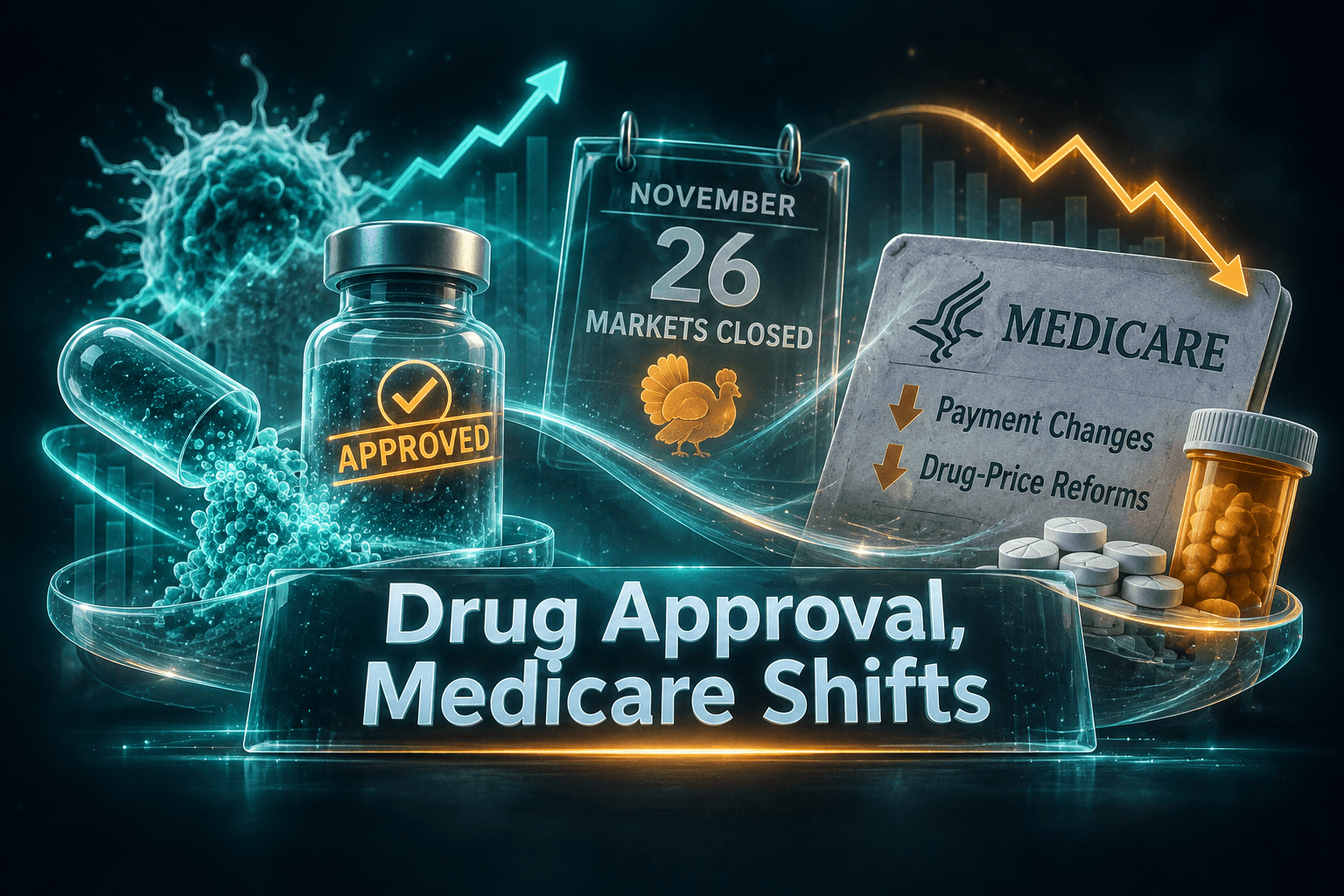
Healthcare enters the Thanksgiving break with a meaningful biotech win and policy changes that could reshape costs for drugmakers and physician practices. The FDA approved Cogent Biosciences’ treatment for a rare stomach cancer, while Medicare set 2028 prices for 13 additional drugs under the Inflation Reduction Act.
These developments point in different directions for companies across the sector. With U.S. markets closed Thursday, November 26, there is no regular-session trading today; you can look for investors to digest the news when markets reopen Friday, November 27. What matters most is how approval and reimbursement changes translate into business results over time.
Market Highlights
The headlines range from an FDA decision and federal pricing policy to concerns about insurance competition and specialist payments. The available reports don’t provide share-price moves or percentage changes, and no U.S. stock trading is taking place today.
- Cogent Biosciences, $COGT, received FDA approval for a treatment for a rare stomach cancer, to be used with Pfizer’s older drug Sutent, Pfizer (PFE).
- Medicare established 2028 prices for 13 new drugs under the Inflation Reduction Act. The report says drugs nearing or past patent expiration face steep cuts.
- The American Medical Association says 95% of metro health insurance markets remain highly concentrated, renewing calls for regulatory scrutiny.
- Medicare’s 2027 physician payment changes reduce rates for certain same-day services, with some specialists potentially more affected than others.
- Amgen, $AMGN, took another step toward a biosimilar version of Bristol Myers Squibb’s, $BMY, cancer drug Opdivo. The report also noted setbacks at Arcus Biosciences, $RCUS, and Belite Bio, $BLTE.
Key Developments
Cogent approval lifts one corner of biotech
The FDA approval gives Cogent a regulatory milestone in rare stomach cancer. The treatment is approved in combination with Sutent, a much older Pfizer medicine. The reports supplied here don’t provide the drug’s name, sales expectations, launch timing, or detailed approval terms, so the commercial impact is not yet clear from this news alone.
For investors, approval is a concrete positive, but it doesn’t settle questions about how many eligible patients may receive treatment or how quickly sales could build. The wider biotech picture is mixed: BioPharma Dive also reported setbacks for Arcus and Belite, alongside Amgen’s progress toward an Opdivo biosimilar. Those separate developments underline why company-specific results can diverge even when the sector is in focus.
Medicare decisions put costs and access in focus
Two policy stories carry potential financial implications. Medicare’s newly set 2028 prices cover 13 additional drugs under the Inflation Reduction Act, with the report highlighting steep reductions for medicines nearing or past patent expiration. Separately, changes to 2027 Medicare physician payments affect certain same-day services and may weigh more heavily on some specialties.
The details matter: the reports do not specify the drugs, exact price reductions, or the specialties facing the largest payment impact. For drugmakers, lower Medicare prices may affect revenue expectations for selected products; for physician groups, payment changes could influence service economics. You’ll want to distinguish the exposure of individual companies and practices rather than treating these policies as uniform across healthcare.
Competition and research offer a broader view
The AMA’s finding that 95% of metro health insurance markets are highly concentrated adds to scrutiny of payer competition. That concentration may keep attention on oversight and the bargaining position of insurers, providers, and employers, though the report does not describe a new rule or enforcement action. At HLTH 2026, Healthcare Dive’s coverage also pointed to AI’s expanding role across care delivery and costs, a broad theme rather than a specific near-term financial catalyst.
Other health news is informative but not an immediate company catalyst in the summaries provided. A study of women with inflammatory bowel disease found low flare rates during assisted reproductive technology and live birth rates comparable to the general population. Researchers at King’s College London reported that neuron identity and electrical activity influence developing brain connections in mice. Meanwhile, coverage of California’s West Nile virus surge described a severe paralysis case, a reminder of public-health risks without reporting case totals in the supplied summary.
What to Watch
When U.S. trading resumes Friday, watch how healthcare stocks respond to the Cogent approval and the policy headlines, while separating market reaction from the longer-term business questions. For $COGT, future company updates on launch plans, access, and demand may help clarify the approval’s commercial significance. For larger drugmakers, pay attention to further information about which products are affected by the 2028 Medicare prices and how companies discuss that exposure.
Physician groups and health systems may provide more detail on which specialties are most exposed to the 2027 payment changes. Any further regulatory attention to concentrated insurance markets could also matter to payers and providers, but no specific action was announced in the supplied reports. Across biotech, updates on Amgen’s biosimilar progress and the setbacks at Arcus and Belite are worth monitoring for company-specific implications.
AI remains a longer-horizon theme raised at HLTH, while the research and public-health stories may shape scientific or clinical discussion rather than near-term earnings. Since the market is closed for Thanksgiving, there are no U.S. stock moves to interpret today. A measured approach means checking company disclosures and policy details as they emerge instead of reading too much into headlines alone.
Bottom Line
- Cogent’s FDA approval is a positive regulatory milestone, but the supplied reports don’t establish its expected sales or launch trajectory.
- Medicare has set 2028 prices for 13 additional drugs, and separate 2027 physician payment changes may affect some specialists more than others.
- The AMA’s 95% figure for highly concentrated metro insurance markets keeps competition and possible oversight in focus.
- Biotech developments are mixed, with Amgen’s biosimilar progress alongside reported setbacks at Arcus and Belite.
- U.S. markets are closed Thursday for Thanksgiving. The next regular trading session is Friday, November 27.
FAQ Section
Q: Why is Cogent Biosciences in the news?
A: The FDA approved Cogent’s treatment for a rare stomach cancer, to be used with Pfizer’s Sutent. The reports provided don’t include launch or sales estimates.
Q: What do the new Medicare drug prices mean?
A: Medicare set 2028 prices for 13 additional drugs under the Inflation Reduction Act. The report says drugs nearing or past patent expiration face steep cuts, but does not list the specific products or reductions.
Q: Are U.S. stock markets open on November 26, 2026?
A: No. U.S. markets are closed for Thanksgiving Day and are scheduled to reopen Friday, November 27.