The Big Picture
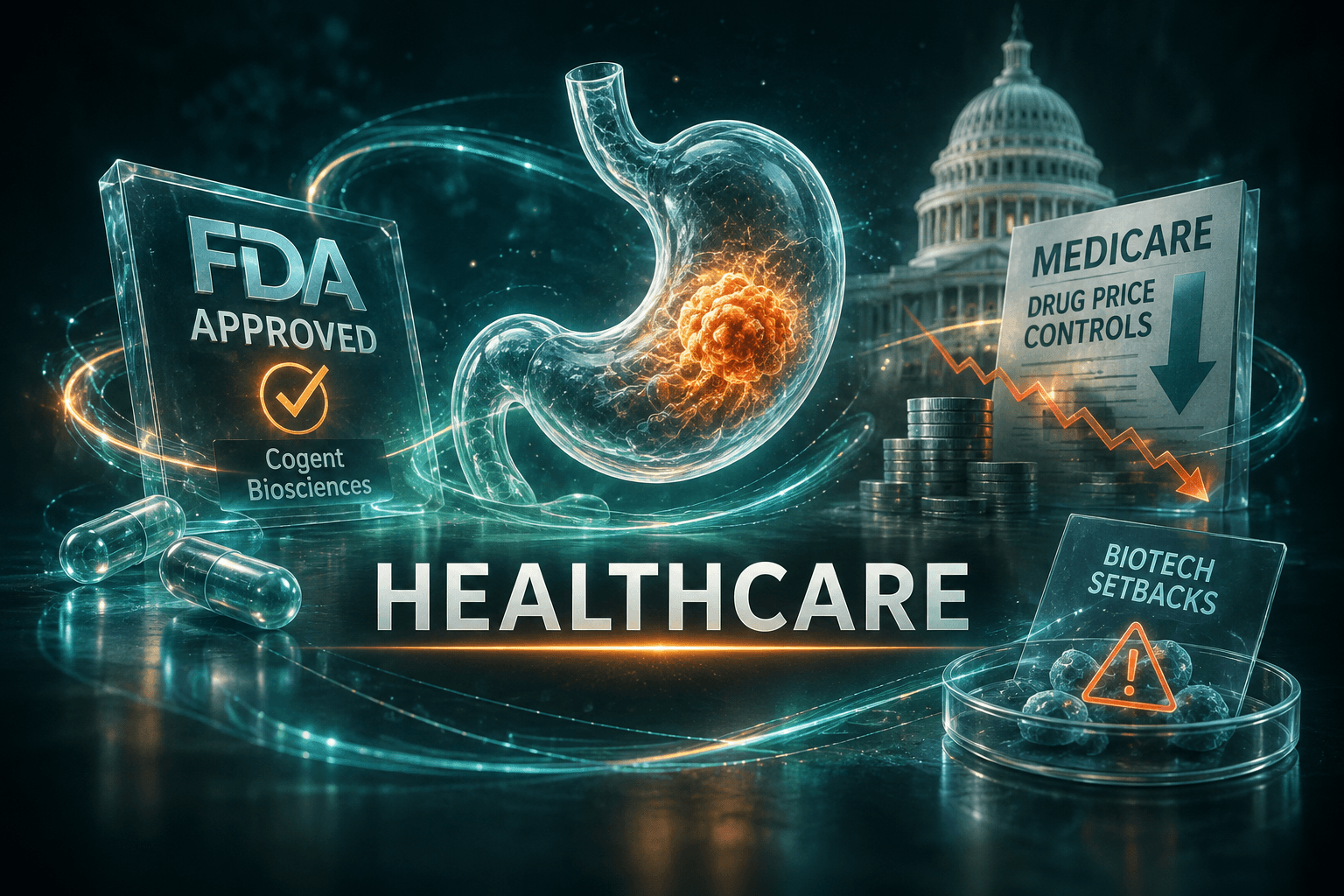
Healthcare’s biggest company-specific headline today was an FDA approval for Cogent Biosciences’ treatment for a rare stomach cancer, to be used with Pfizer’s older drug Sutent. The decision is a tangible regulatory win for Cogent, but it arrived alongside news that Medicare is setting prices for 13 additional drugs under the Inflation Reduction Act, underscoring the sector’s competing forces: new treatment opportunities and pressure on medicine revenues.
There’s no clear sector-wide market signal in the reports provided: they don’t include stock-price changes or trading-volume data. For you, the takeaway is a selective, event-driven news cycle rather than evidence of a broad healthcare rally or selloff. Investors will need to weigh individual company catalysts against policy and commercial risks.
Market Highlights
Drug development and pricing were the clearest investor-focused themes. Cogent’s approval offers a new commercial milestone, while the Medicare price-setting news points to potential revenue pressure for selected products as the program expands its reach.
- Cogent Biosciences received FDA clearance for a stomach cancer drug in combination with Pfizer’s Sutent. No sales estimates or stock reaction were included in the reports.
- Medicare set 2028 prices for 13 new drugs under the Inflation Reduction Act. The reported impact includes steep reductions for medicines nearing or past patent expiration, but no individual price figures were provided.
- The cofounders of BioNTech are reportedly in talks to raise about $1 billion for a new oncology company, a sizable financing ambition, not a completed fundraising round.
- The American Medical Association said 95% of metro health insurance markets remain highly concentrated, renewing calls for regulatory scrutiny.
Other company updates were mixed. Amgen took another step toward a biosimilar version of Bristol Myers Squibb’s Opdivo, while BioPharma Dive also reported setbacks for Arcus Biosciences and Belite Bio. The reports didn’t detail related share moves, so the news alone doesn’t establish how investors priced these developments today.
Key Developments
Cogent’s FDA win meets a tougher pricing backdrop
The FDA approval gives Cogent Biosciences a new regulatory milestone in rare stomach cancer. The treatment will be used with Sutent, a much older Pfizer medicine. For investors, approval can open a path to commercialization, but the reports don’t provide a launch timeline, expected patient numbers, pricing, or revenue guidance. Those details will matter in assessing the commercial significance of the decision.
At the same time, Medicare’s 2028 prices for 13 drugs show how policy can shape the outlook for established medicines. The reported price cuts particularly affect drugs near or beyond patent expiration. This doesn’t establish an impact on every drugmaker, but it reinforces why you’ll want to distinguish exposure by product and patent timeline instead of treating the news as a uniform industry-wide change.
Biotech pipelines and competition remain in focus
Amgen’s progress toward an Opdivo biosimilar brings competition into view for a major cancer medicine. The update is relevant to Amgen and Bristol Myers Squibb, but the report doesn’t specify launch timing or expected market share. Those are key details to watch before drawing conclusions about potential revenue effects for either company.
Elsewhere, reports of setbacks at Arcus Biosciences and Belite Bio temper the positive Cogent headline. The news also described BioNTech’s founders as seeking about $1 billion for a separate oncology startup. That could signal continued interest in funding cancer research, but talks to raise capital aren’t the same as secured financing or a clinical result. Together, these updates show a sector where pipeline progress, competition, and funding conditions can quickly diverge.
Research, care delivery, and market structure raise longer-term questions
Medical Xpress reported that an obesity definition extending beyond BMI may identify more older adults at risk of dementia than BMI alone. Another study focused on how endothelial-cell identity and developmental stage may help explain why the same cancer-associated mutation causes malformations in some blood vessels but not others. These findings add to scientific understanding, but the reports don’t establish immediate commercial products or investment catalysts.
A separate article explored whether creatine could help older adults maintain strength and independence. It raises a question about healthy aging, not proof of a clinical benefit. Healthcare Dive’s HLTH 2026 coverage highlighted AI’s influence across care delivery and costs, while the AMA’s concentration findings could keep insurer competition under regulatory scrutiny. STAT also reported concerns about the planned detonation of degraded toxic material in Iowa; the supplied report describes anticipated health risks, not a confirmed outcome of the plan.
What to Watch
For the next session and beyond, track company disclosures around Cogent’s launch plans and any details on the approved treatment’s commercial opportunity. Watch for follow-up from Amgen on its Opdivo biosimilar, as timing and competitive positioning will help clarify the implications for both $AMGN and $BMY. The reports provide no price data for these shares, so any assessment of today’s market reaction should be checked against actual trading information.
On policy, monitor further details about Medicare’s 2028 prices, including which products are affected and how manufacturers describe the financial impact. The AMA’s concentration figures could also prompt additional scrutiny of health insurers, though no specific regulatory action was announced in the supplied reports. For you, the practical approach is to separate confirmed decisions from proposals, research findings, and fundraising discussions.
Finally, watch for clinical or commercial evidence behind the obesity, dementia, creatine, and AI stories. Research can shape future healthcare markets, but it often takes time to translate into approved products, changed practice, or measurable revenue. The Iowa material story also warrants attention for confirmed developments and official public-health guidance, rather than assumptions about an event’s outcome.
Bottom Line
- Cogent’s FDA approval is the day’s clearest positive company milestone, though launch and revenue details remain unknown.
- Medicare price setting adds a counterweight, particularly for drugs nearing or past patent expiration.
- Amgen’s biosimilar progress and reported setbacks at Arcus and Belite highlight uneven biotech fortunes.
- Healthcare AI, insurer concentration, and emerging research are longer-term themes, not demonstrated near-term earnings catalysts in these reports.
- No stock-price changes were supplied, so today’s news should not be treated as a measure of market performance or as personalized investment advice.
FAQ
Q: What was the most significant healthcare company announcement today? A: The FDA approved Cogent Biosciences’ rare stomach cancer treatment for use with Pfizer’s Sutent.
Q: How could Medicare’s 2028 drug prices affect healthcare companies? A: The reported price cuts may pressure revenue for selected medicines, especially those nearing or past patent expiration; company-specific impacts weren’t detailed.
Q: Did the reports show how healthcare stocks performed today? A: No. The supplied stories didn’t include share-price or sector-index movements, so they don’t establish a market reaction.