The Big Picture
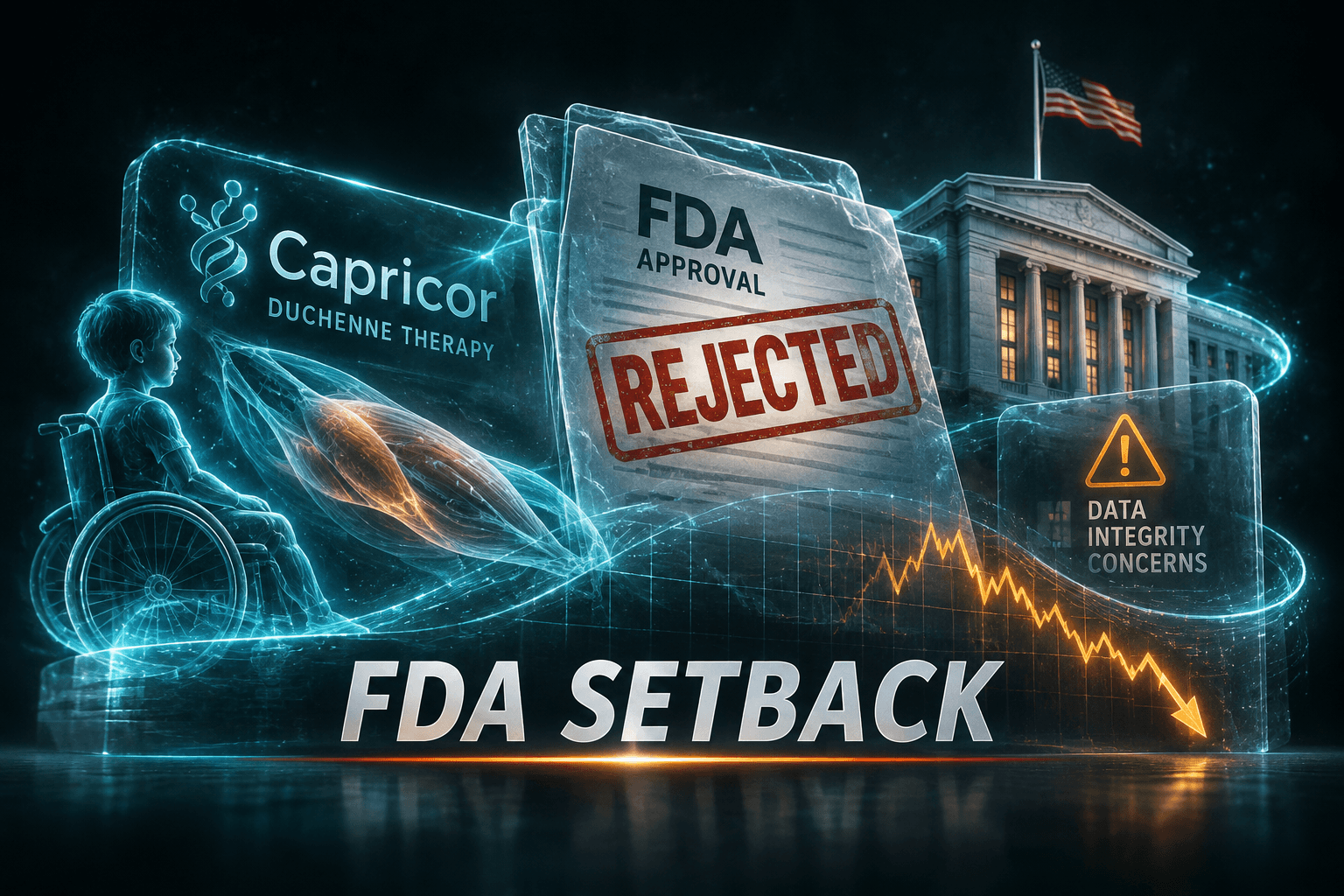
The FDA's second rejection of Capricor Therapeutics' Duchenne muscular dystrophy cell therapy, this time alongside allegations of serious data-integrity violations, is the most consequential company-specific development in this healthcare news cycle. The decision puts the therapy's path forward in doubt and underscores how regulatory scrutiny of clinical evidence can outweigh a treatment's promise.
Markets were closed Sunday, November 22, so there was no U.S. stock trading today. The FDA news was reported Friday night, and no price moves are provided in the available reports; the next regular session is Monday, November 23. Alongside the company setback, new studies and reports highlight potential advances in metabolic and muscle biology, as well as persistent gaps in maternal care and rural health funding. What should you separate from the immediate headlines? Early research signals are not the same as near-term commercial catalysts.
Market Highlights
The Capricor decision is the clearest direct corporate catalyst in the group. The FDA has now rejected deramiocel twice since 2025, according to coverage, and its latest statement said alleged data-integrity violations compromised study findings. That raises questions about the company's regulatory options and the evidence needed to support any future application. No share-price or percentage change was reported, and U.S. equities did not trade Sunday.
The other major figures concern healthcare access and public funding, rather than listed-company earnings or guidance:
- Thirty-two percent of postpartum women in a survey spanning 16 states said they needed mental health care.
- Eighteen congressional Democrats asked CMS chief Mehmet Oz for answers about delays to states' second-year awards under the $50 billion Rural Health Transformation Program.
- Two studies reported Sunday examined caveolin-1's role in fat storage and intermittent fasting's effects on injured muscles in mice. Neither summary establishes a treatment or commercial outcome.
For you as an investor, the headlines point to distinct risk categories: clinical and regulatory execution for biotech, and funding, access, and policy oversight for healthcare providers and communities. They don't provide a basis for inferring a sector-wide market move.
Key Developments
Capricor faces renewed regulatory and credibility questions
Capricor's deramiocel was rejected by the FDA for a second time since 2025. BioPharma Dive reported that the agency accused the company of “serious data integrity violations,” saying the issues compromised study findings. STAT also reported the rejection, describing the decision as long anticipated.
The allegations make this more than a routine regulatory delay: they put the reliability of the underlying evidence at the center of the dispute. For $CAPR, the immediate investor questions are what the company says about the FDA's concerns, whether it can address them, and what further evidence or process may be required. The reports provided do not specify a timeline or resolution, so the therapy's prospects remain uncertain. You may want to distinguish the therapy's potential from the separate question of whether the submitted data can satisfy regulators.
Research offers biological clues, not clinical proof
A Medical Xpress report describes a newly identified transport pathway that helps explain how caveolin-1 supports fat storage in cells. The work relates to lipodystrophy, a condition in which fat may accumulate in organs and other tissues instead of being stored normally in adipose tissue. The resulting metabolic consequences can include fatty liver and type 2 diabetes. The report frames the finding as a better understanding of disease biology, not as an approved therapy or a demonstrated clinical benefit.
Separately, researchers at Koç University found that alternating fasting and feeding helped injured muscles regenerate in mice. The reported effect involved repair cells multiplying and joining into muscle fibers, and depended on a pathway previously linked to muscle wasting in cancer. The animal-study result may inform future research, but it does not show that intermittent fasting regenerates injured muscle in people. These stories are scientifically encouraging, while remaining distant from evidence of near-term product revenue.
Care access and public funding remain unresolved
A survey across 16 states found that 32% of postpartum respondents reported needing mental health care. Medical Xpress cited CDC data from 2017 to 2019 indicating that mental health conditions are the leading cause of pregnancy-related death in the United States, and that almost all such deaths are considered preventable with effective screening and connection to care. The survey highlights demand, but the supplied report does not say what proportion of respondents received the care they needed.
Meanwhile, 18 Democrats in Congress pressed CMS for answers about delayed second-year state awards from the $50 billion Rural Health Transformation Program, citing a lack of public transparency. The delay is a policy and implementation issue, not evidence that the program has been canceled. KFF Health News also covered measles, pediatric care, and the Democrats' post-election healthcare agenda; a STAT opinion piece argued that Kennedy and the MAHA movement could demonstrate support for vaccination by promoting the MMR vaccine. These updates underscore ongoing debate about public-health priorities and how funding reaches communities.
What to Watch
On Monday, November 23, markets reopen after the weekend. Watch for any company response from Capricor and for additional reporting on the FDA's stated concerns. The supplied stories contain no analyst rating changes, target prices, earnings announcements, or reported Friday share moves, so the company's next disclosures and any regulatory clarification may matter more than unsupported assumptions about how the stock reacted.
For the wider sector, monitor whether states receive further information about the rural-health awards, and whether CMS provides a timeline or explanation for the delays. Follow-up data on postpartum screening and access to mental health services could help distinguish reported need from actual care received. Research readers should also look for replication and human studies before treating the caveolin-1 or mouse fasting findings as clinical catalysts. What would change the outlook? Clear regulatory steps, confirmed funding decisions, or evidence that research findings translate into patient outcomes.
Risk remains concentrated in execution and uncertainty: regulatory findings can interrupt a drug program, funding delays can complicate care planning, and early-stage science can take years to reach clinical use. The headlines support a selective, evidence-focused reading rather than a broad conclusion about healthcare stocks.
Bottom Line
- The FDA's second rejection of Capricor's Duchenne therapy and reported data-integrity concerns are the most significant direct company risk in this news cycle.
- No U.S. equities traded Sunday, and the supplied reports do not provide stock price changes. The next session is Monday, November 23.
- The caveolin-1 and intermittent-fasting findings are research developments, with the latter based on mice, not established human treatments.
- Postpartum mental health needs and delayed rural-health awards point to continuing access and implementation challenges.
- Use company disclosures, regulatory updates, and follow-up research to assess these stories; this summary is informational and not personalized investment advice.
FAQ
Q: Why did the FDA reject Capricor's Duchenne therapy? A: The FDA said serious data-integrity violations compromised study findings, according to BioPharma Dive. The available reports do not provide further detail on a path to resolution.
Q: Did healthcare stocks move on Sunday, November 22? A: No. U.S. stock markets were closed Sunday. The next trading session is Monday, November 23, and no specific price changes are included in these reports.
Q: Do the fasting results show a benefit for people with muscle injuries? A: Not yet. The reported regeneration effect was observed in mice, so human studies would be needed to establish whether it applies to patients.