The Big Picture
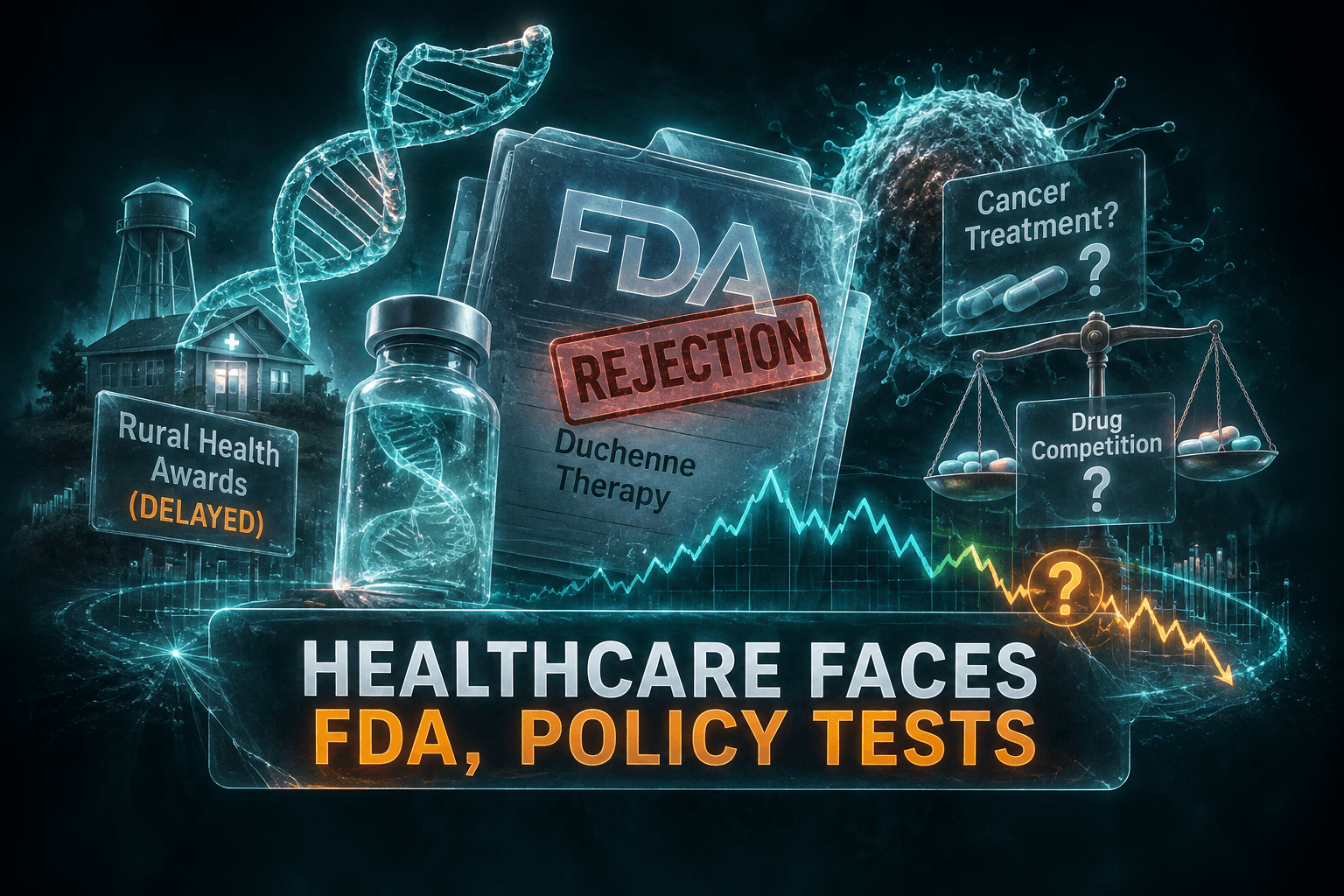
Healthcare ended the weekend with a mix of scientific promise and practical setbacks, led by the FDA’s rejection of Capricor Therapeutics’ Duchenne muscular dystrophy therapy and congressional scrutiny over delayed rural health funding. Those developments put regulatory execution and public-sector support in focus, while new research raised questions about everyday alcohol use and cancer immunotherapy.
There were also potential long-term catalysts: researchers reported a faster way to map brain tissue at nanoscale detail, and companies are competing to bring the first approved psychedelic treatment to market. What does this mean for your portfolio outlook? The evidence points to a selective, wait-for-clarity picture rather than a sector-wide direction. U.S. stock markets were closed Saturday, November 21. Friday, November 20, was the last trading day, and no share-price reactions were included in the reports.
Market Highlights
The news combines company-specific regulatory and competitive risks with research findings that could matter over a longer horizon. But most stories didn’t include new financial results, valuation information, or reported stock moves, so the headlines alone don’t establish a measurable market reaction.
- FDA rejection: Capricor Therapeutics’ Duchenne therapy was rejected, a setback for the company’s development program. Capricor trades as $CAPR.
- Rural health funding: 18 congressional Democrats sought answers from CMS chief Mehmet Oz about delays to states’ second-year awards under the $50 billion Rural Health Transformation Program.
- Oncology competition: Erasca’s data add competitive pressure for Revolution Medicines’ cancer drug Rasonque. Erasca trades as $ERAS and Revolution Medicines as $RVMD.
- Psychedelic drug race: Compass Pathways and nonprofit Usona are vying to be first to win FDA approval for a psilocybin treatment. Compass trades as $CMPS; coverage, pricing, and access remain commercial questions.
For investors, the key distinction is between near-term company milestones and research that may take years to affect products or revenue. The reports provide no percentage changes or closing prices for the named companies. Their next possible equity-market response will be on Monday, November 23.
Key Developments
FDA decision and oncology competition sharpen drug-development risks
The FDA’s rejection of Capricor’s cell therapy is a direct regulatory setback. The report described the decision as long anticipated, but didn’t provide the agency’s reasoning or next steps. Those details matter: until the company’s response and any further regulatory path are clearer, the headline offers limited basis for assessing timing, costs, or the therapy’s remaining prospects.
In oncology, Erasca’s data were reported as adding pressure on Revolution Medicines’ Rasonque, which has already had one of the strongest cancer-drug launches in history, according to BioPharma Dive. The report says limitations in the existing treatment could leave an opening for competing approaches, with Erasca nearing the start of a Phase 3 trial. That is a competitive signal, not a confirmed commercial outcome. You’ll want to distinguish trial progress from evidence of approval, uptake, or revenue.
Research advances meet questions about treatment and access
Harvard Medical School and the University of California San Diego researchers sped up an imaging technique enough to map large volumes of brain tissue at nanoscale detail. The method revealed fine structures that connectomes, or brain wiring maps, can miss. This is an advance in research capability, but the report doesn’t describe a commercial product or a near-term impact on healthcare company earnings.
Separately, early research published in Science Signaling examines whether regular alcohol consumption may weaken cancer immunotherapy. The finding may prompt further study of how routine habits interact with treatment, but it isn’t presented as definitive clinical guidance. Patients shouldn’t change treatment or health decisions based on a preliminary report; your care team can advise on individual circumstances.
The race to commercialize a first approved psychedelic also highlights the gap between clinical development and a viable business. Compass and Usona are competing for an FDA first, but pricing, insurance coverage, and patient access could determine which approach gains traction. Approval alone wouldn’t settle those questions.
Public health and policy remain in the spotlight
Democrats’ questions about the delayed $50 billion Rural Health Transformation Program awards raise issues of transparency and timing for states and providers. The letter from 18 lawmakers calls out what they describe as an “alarming lack of public transparency.” The coverage doesn’t specify the financial effect on individual health systems, so the consequences will depend on which awards are delayed and when funding is distributed.
Measles and pediatric care also featured in weekend coverage. A STAT opinion writer argued that Robert F. Kennedy Jr. and the MAHA movement could demonstrate support for vaccination by promoting the MMR vaccine. KFF Health News journalists discussed measles, pediatric care, and Democrats’ post-election healthcare agenda. These are policy and public-health debates, not evidence of a new federal decision. An opinion piece in STAT also raised questions about medical-school length and pediatric emergency care, underscoring broader workforce and service-delivery concerns.
What to Watch
On Monday, November 23, watch for any company statements or analyst commentary following Friday’s FDA rejection and the competitive oncology report. No share-price reaction is available in the supplied coverage, and the market was closed Saturday, so Monday’s trading may provide the first observable equity response to these headlines.
For Capricor, the important follow-up is the company’s explanation of the FDA decision and its plans from here. For Erasca and Revolution Medicines, monitor clinical-trial milestones and additional data rather than treating early competitive signals as a settled change in market share. For Compass, payer coverage, pricing, and the FDA process will be central to judging commercial prospects.
Policy watchers can track whether CMS responds to lawmakers and clarifies the timing of the rural health awards. Investors following neuroscience and immunotherapy research should look for independent validation and clinical evidence. The imaging advance and alcohol study are notable, but their path to practical or commercial impact remains uncertain.
Bottom Line
- Healthcare signals are mixed: the weekend brought a regulatory setback and funding questions alongside research progress.
- The FDA rejected Capricor’s Duchenne therapy; the report didn’t specify the agency’s rationale or the company’s next steps.
- Rural health funding delays affect a $50 billion program, with 18 Democrats pressing CMS for answers.
- Competition in oncology and psychedelic drug development is worth tracking, but trial progress and commercial access remain unresolved.
- Markets were closed Saturday. Watch for company updates and the first potential equity response when trading resumes Monday, November 23.
FAQ Section
Q: Were U.S. healthcare stocks trading on November 21? A: No. Saturday markets were closed; Friday, November 20, was the last trading day, and Monday, November 23, is the next session.
Q: What was the main regulatory setback? A: The FDA rejected Capricor Therapeutics’ cell therapy for Duchenne muscular dystrophy. The report didn’t detail the agency’s reasons or the company’s next steps.
Q: What should investors monitor in the psychedelic drug race? A: Follow FDA progress, pricing, insurance coverage, and patient access for Compass Pathways and Usona. Approval alone may not determine commercial success.