The Big Picture
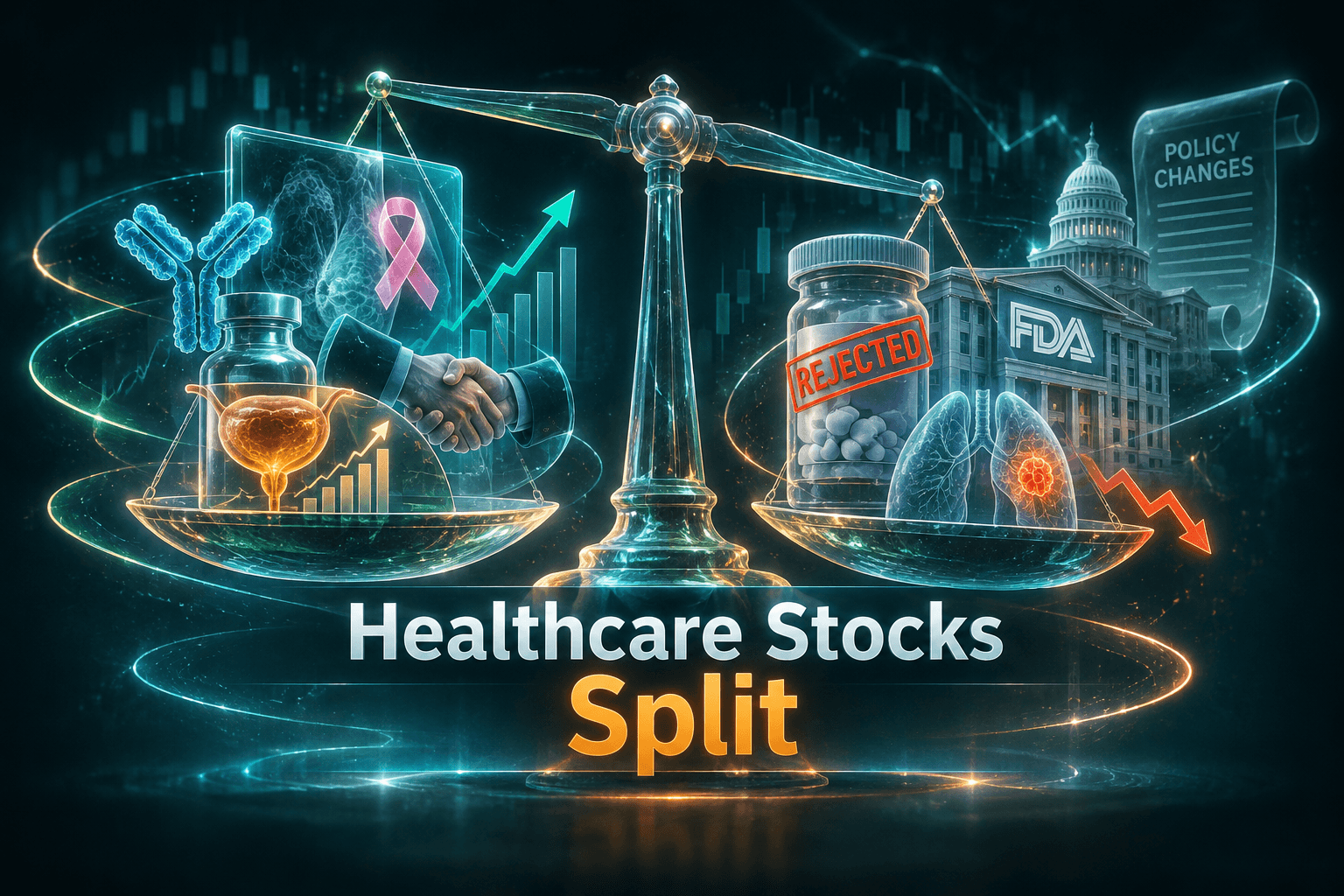
Healthcare's most consequential news was a pair of sharply different FDA decisions: the agency approved Roche's new breast cancer drug, while rejecting Summit Therapeutics' closely watched lung cancer treatment. That contrast put the sector's uneven drug-development outlook in focus, with clinical evidence and regulatory judgment driving very different company narratives.
There were also encouraging results from CG Oncology, a $2.2 billion Johnson & Johnson deal in eye care, and research into HIV-related brain effects and liver scarring. For you, the takeaway is a mixed signal rather than a broad sector trend: individual catalysts matter, but approval, trial, and policy risks remain distinct.
Market Highlights
Monday's U.S. market session was open for regular trading. Reports described Summit shares falling after its FDA setback and CG Oncology shares rising on trial results, but the supplied news did not include closing prices or percentage moves. No broader healthcare-sector index performance was provided.
- Roche's new breast cancer drug won FDA approval, opening the way for launch. The company has said the medicine could become its top-selling product ever.
- Summit Therapeutics' shares fell after the FDA rejected ivonescimab for a form of lung cancer. The agency cited the drug's failure to initially extend survival.
- CG Oncology said cretostimogene cut bladder cancer recurrence risk by 68% when given after surgery, a result described as exceeding Wall Street expectations. Shares rose on the news.
- Johnson & Johnson agreed to pay $2.2 billion for Ollin's vision-loss drug, adding a potential treatment to its eye-care portfolio.
Those reactions show how company-specific evidence can outweigh sector-wide themes. What should you make of a day when one cancer drug clears the FDA and another does not? The underlying data and the exact regulatory decision matter more than the broad label of healthcare.
Key Developments
FDA decisions reshape oncology outlooks
Roche's FDA approval provides a new treatment option for some people with breast cancer and marks a commercial milestone for the company. Roche has positioned the medicine as a potential future top seller, but the approval itself doesn't establish how quickly uptake will develop or whether sales will meet that ambition. Investors will be watching launch details and subsequent demand signals.
Summit's outcome offers the counterpoint. The FDA declined to approve ivonescimab after the drug failed to initially extend survival in a form of lung cancer, delaying the company's first U.S. approval opportunity. The decision highlights the risk that promising drug profiles may still fall short of the evidence regulators require. For Summit, the next important information will be any company update on its regulatory path and supporting data.
CG Oncology trial results and J&J's eye-care bet
CG Oncology reported that cretostimogene reduced the risk of bladder cancer recurrence by 68% when administered after surgery. The result was characterized as exceptional and substantially above Wall Street expectations, helping lift the company's shares. It is a notable clinical signal, but trial results aren't the same as an FDA approval; further development and regulatory steps remain relevant.
J&J's $2.2 billion agreement for Ollin's vision-loss drug points to a different strategy: adding a potential asset that could complement an existing eye-care franchise. The drug would enter a crowded, competitive market, so its eventual differentiation and development progress will be important. The deal sets out a potential opportunity, not a guarantee of commercial success.
Research and policy updates bring longer-term implications
Two research reports explored biological mechanisms rather than near-term product launches. One examined how HIV and opioid exposure may contribute to cognitive problems, while another found that softer surroundings favored liver-cell states associated with regeneration and stiffer conditions favored fibrosis-linked gene expression. A separate Parkinson's study examined daytime brain waves resembling deep sleep as a possible explanation for hallucinations. These findings may inform future research, but the reports don't establish an available treatment or a near-term revenue catalyst.
Policy news also bears watching. A federal judge issued a final ruling blocking a plan to limit the length of stay for graduate students and postdoctoral researchers, preserving the duration-of-status approach. The FDA also created a new regulatory category for the supplement NAC, which has long been available in a legal gray area. Separately, CMS gave states another six months, through the end of June, to implement Medicaid work requirements while they clarify eligibility and exemptions. These changes could affect research staffing, supplement regulation, and state Medicaid administration, though the news supplied no company-level financial estimates.
What to Watch
For the coming sessions, track Roche's launch updates and evidence of demand, along with any additional details on CG Oncology's trial and development plans. Summit's next communication on ivonescimab will help clarify how the FDA decision changes its timeline. You can also monitor J&J's disclosures on the Ollin transaction and how the company describes the asset's fit with its eye-care business.
Policy implementation is another watch point. States have until the end of June to prepare Medicaid work requirements, and differences in eligibility rules or exemptions may shape how the delay affects coverage and administration. The FDA's new NAC category also merits follow-up as details emerge. Research headlines should be kept in perspective: promising mechanisms need validation and translation before they become clinical or financial outcomes.
Near-term risk remains concentrated in clinical evidence and regulatory review. A strong trial readout can move expectations quickly, while a setback can postpone a first approval, as Summit's case shows. With no precise share-price changes or sector index data supplied, a selective approach to interpreting today's headlines is more useful than assuming a uniform healthcare trend.
Bottom Line
- The sector's signals were mixed: Roche secured an approval, while Summit's FDA rejection delayed its U.S. opportunity.
- CG Oncology's reported 68% reduction in recurrence risk was a positive trial catalyst, but it is not an approval.
- J&J's $2.2 billion Ollin deal expands its eye-care pipeline, with competition and development progress still to assess.
- Visa, NAC, and Medicaid policy decisions may have longer-term effects, but company-level financial impacts weren't provided.
- For your watchlist, distinguish confirmed regulatory actions from early research and future commercial possibilities.
FAQ
Q: Why did Summit shares fall? A: The FDA rejected ivonescimab for a form of lung cancer after it failed to initially extend survival, setting back Summit's first U.S. approval opportunity.
Q: What was notable about CG Oncology's results? A: The company reported that cretostimogene cut recurrence risk by 68% when used after bladder cancer surgery, lifting shares. The result is a trial finding, not an FDA approval.
Q: What does the CMS Medicaid delay mean? A: States have another six months, through the end of June, to implement work requirements while they work through eligibility and exemptions.
This article is for informational purposes only and is not personalized investment advice or a recommendation to buy, sell, or hold any security.