The Big Picture
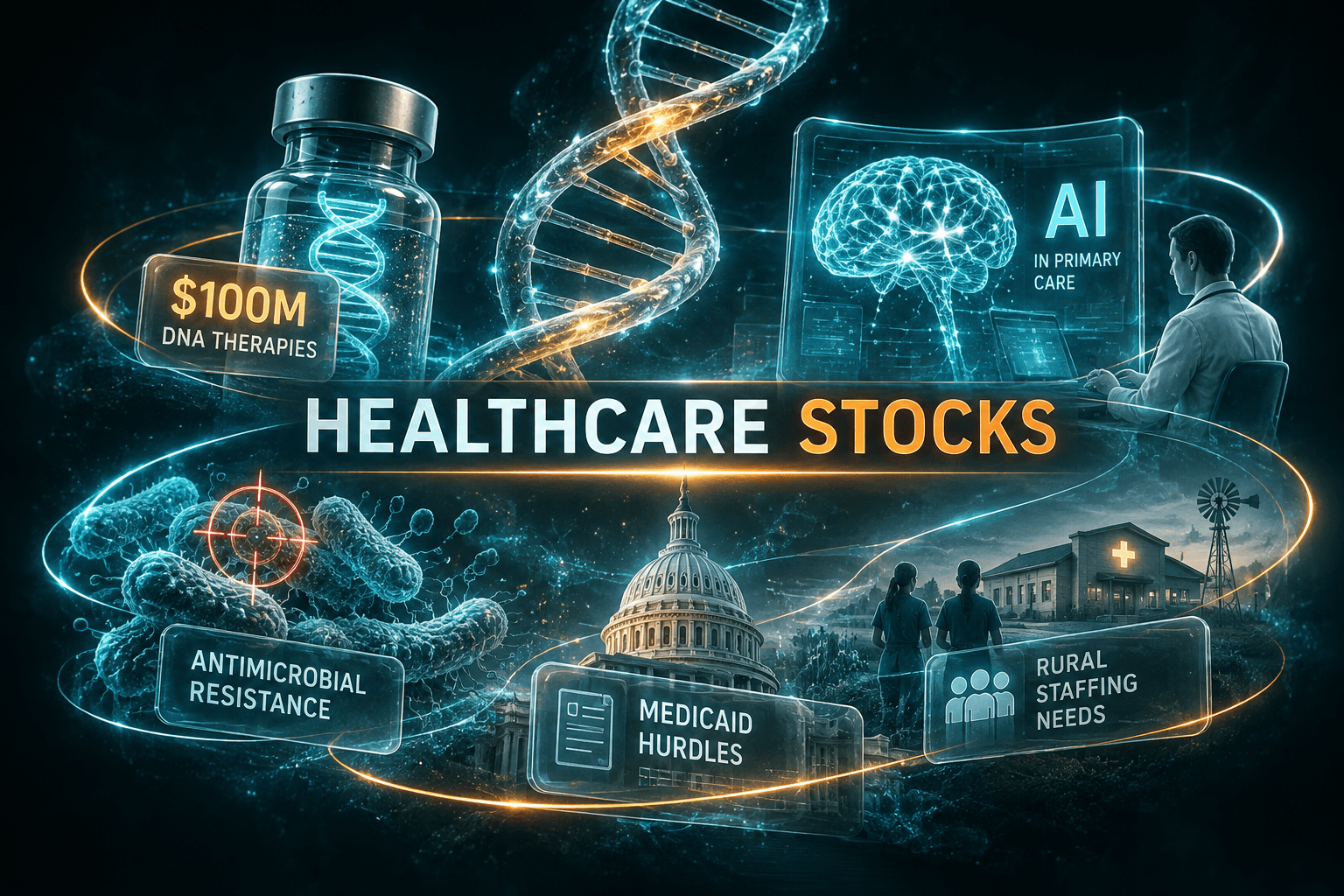
A $100 million financing for DNA therapeutics startup Seawolf, alongside a disclosed partnership worth up to $1.2 billion with Sanofi, is Monday’s clearest sign of investor appetite for tackling difficult problems in gene therapy. Eli Lilly and other prominent life-sciences investors are backing the company, even as the broader healthcare news mix highlights obstacles in access, staffing and public health.
For you, the takeaway is a sector with promising innovation but no single, clear market direction. Reports also point to an AI tool aimed at primary care, while warnings on antimicrobial resistance and the complexities of expanding Medicaid reinforce that healthcare’s opportunities come with operational and policy risks.
Market Highlights
Monday’s coverage spans early-stage biotech financing, care delivery and health-system pressures. The stories don’t provide share-price changes, earnings results or market-wide performance data, so there’s no basis here to quantify how healthcare stocks are trading today.
- Seawolf Therapeutics drew $100 million from investors including Versant Ventures, MPM BioImpact, Eli Lilly and Novartis’ venture arm. It also disclosed a partnership with Sanofi worth up to $1.2 billion.
- Venture capitalist John Doerr called Tom Health, a new AI tool for primary care, one of AI’s best possible uses. The report does not provide financial terms or evidence of commercial adoption.
- WHO officials warned that antimicrobial resistance continues to threaten modern medicine. Separately, states are using part of a $50 billion rural-health program to attract providers, with incentives tied to five-year service commitments.
These developments touch different parts of the sector, from biotech research and digital health to provider access. What should you look for beyond the headline numbers? Whether promising projects translate into validated products, sustainable funding and measurable improvements in care.
Key Developments
Seawolf financing puts gene therapy challenges in focus
Seawolf’s $100 million backing brings together Versant, MPM BioImpact, Lilly and Novartis’ venture arm around a startup focused on a difficult gene-therapy problem. The company also disclosed an agreement with Sanofi valued at up to $1.2 billion. The reports don’t specify the deal’s milestones or how much funding Seawolf could receive under particular conditions, so the headline value shouldn’t be treated as guaranteed revenue.
For publicly traded companies, the news is a signal of continued strategic and venture interest in DNA therapeutics, not an immediate measure of financial impact. Eli Lilly and (LLY), $NVS and Sanofi, which trades in the U.S. as $SNY, have different business lines and exposure to this early-stage effort. Investors will need more detail on the program and its progress to assess any potential effect on those companies.
AI in primary care meets persistent public-health needs
Doerr’s endorsement of Tom Health draws attention to the possibility of using AI in primary care, where tools could be designed to support care delivery. But an investor assessment depends on evidence beyond an endorsement, including the tool’s capabilities, clinical validation, implementation and ability to fit into existing workflows. The report provides no adoption, revenue or outcomes figures.
Other health stories show why care delivery matters. Research reported by Medical Xpress found an association between pandemic-era declines in social participation and cognitive decline in older adults. The finding adds to concerns about isolation and healthy aging, but an association alone does not establish that reduced participation caused cognitive decline.
Policy and operating constraints remain material
WHO officials warned that antimicrobial resistance threatens modern medicine despite progress against drug-resistant bacteria. The report offers no new company-specific financial estimates, but the issue highlights continuing pressure on health systems and the need for effective responses to resistant infections.
In U.S. policy, newly elected governors in several states campaigned on Medicaid expansion, but KFF Health News reports that recent program changes, including looming work requirements, could complicate implementation. Rural workforce incentives face their own trade-off: the $50 billion Rural Health Transformation Program is supporting provider recruitment, but incentives come with a five-year service commitment.
Two Healthcare Dive articles also point to day-to-day operational concerns: senior living facilities face changing prices and product availability for environmental services procurement, while healthcare organizations are considering cybersecurity measures beyond HIPAA compliance. A separate article discusses independent dispute resolution in emergency medicine. These pieces identify management priorities, but don’t provide company-specific performance data.
What to Watch
For biotech, watch for more information on Seawolf’s gene-therapy program, the terms and milestones of its Sanofi partnership, and any clinical progress. Funding and partnership headlines can help support development, but they don’t settle questions about scientific results, timelines or eventual commercial potential.
For digital health, the next useful signals for Tom Health and similar tools would include clinical validation, provider adoption and evidence that the technology fits into primary-care operations. You can also watch how companies address data security, since healthcare cybersecurity needs can extend beyond minimum compliance requirements.
On the policy and care-delivery side, track how states approach Medicaid expansion and work requirements, whether rural recruitment incentives result in sustained staffing, and how health organizations respond to antimicrobial resistance. The social-participation research may also keep healthy aging and community support in view, though the reported association is not proof of cause and effect. Taken together, the stories call for selectivity and patience rather than a broad sector conclusion.
Bottom Line
- Seawolf’s $100 million financing and up to $1.2 billion Sanofi partnership put gene therapy on the day’s innovation agenda, but deal terms and clinical progress matter.
- Tom Health underscores interest in AI for primary care; the report offers no adoption or financial metrics yet.
- Antimicrobial resistance, Medicaid implementation and rural staffing remain substantial health-system challenges.
- Cybersecurity, procurement costs and emergency medicine reimbursement are additional operational themes, with no company-specific market impact reported.
- No stock-price moves or sector performance figures were provided in these stories. Treat the news as context, not a standalone signal about any security.
FAQ
Q: What is the main biotech development today? A: Seawolf raised $100 million from a group including Versant, MPM BioImpact, Lilly and Novartis’ venture arm, and disclosed a partnership with Sanofi worth up to $1.2 billion.
Q: Is there evidence that Tom Health is already improving primary care? A: The report describes Doerr’s endorsement of the AI tool but provides no clinical outcome, adoption or revenue data.
Q: What could complicate Medicaid expansion in states with newly elected governors? A: Recent Medicaid changes, including looming work requirements, may make expansion more difficult to carry out.
This article is for informational purposes only and is not personalized investment advice or a recommendation to buy, sell or hold any security.