The Big Picture
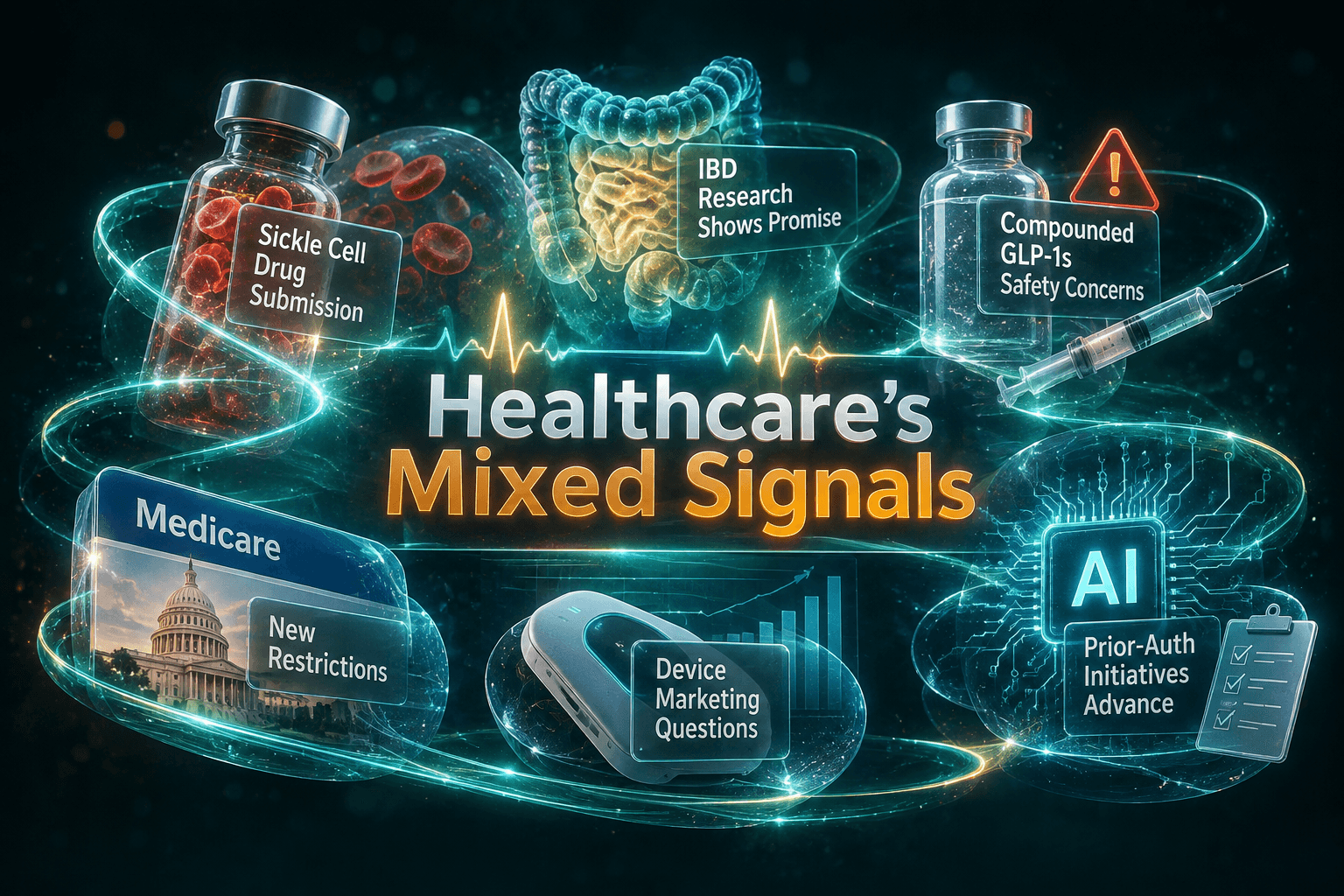
Healthcare ended Friday with a set of developments that point in different directions: drug research and pipeline progress offered reasons for optimism, while safety scrutiny and Medicare restrictions underscored persistent industry risks. For investors, the day’s central theme was not a broad sector catalyst but a widening gap between innovation and the evidence, oversight, and execution needed to support it.
Novo submitted a sickle cell drug for review, and researchers reported a method that could help identify harmful gut bacteria linked to inflammatory bowel disease. At the same time, a study raised questions about additives in compounded GLP-1 products, and Medicare extended its pause on new home health and hospice enrollments. What should you take from that mix? Selectivity and close attention to regulatory follow-through matter more than a single sector-wide narrative.
Market Highlights
The stories included potential catalysts for biopharma and research, but also operational and reputational risks across healthcare delivery and medical devices. The articles provided no company share-price changes, percentage moves, or sector-index returns, so a specific market reaction can't be confirmed from the available reporting.
- Novo’s sickle cell drug submission advances a program the company acquired in a deal valued at about $1 billion, though a submission is not an approval.
- A study identified two inflammation-promoting bacterial species and compounds that selectively inhibit their growth, a possible foundation for future IBD research and therapies.
- Medicare extended its six-month enrollment ban for new home health agencies and hospices, while a new study highlighted untested additive combinations in compounded GLP-1 medicines.
- Boston Scientific’s Boston Scientific (BSX) Watchman implant faced scrutiny in an investigation examining whether marketing outpaced the science. No share-price reaction was reported.
Other developments included federal testing support for electronic prior authorization, polling on patient views of AI in care, and new industry research and clinical-trial activity. These updates may shape longer-term adoption and operations, but the reports don't establish an immediate financial impact.
Key Developments
Drug pipeline and research progress, with evidence still to come
Novo submitted etavopivat, a sickle cell disease drug it acquired in a billion-dollar deal and views as a potential future blockbuster. The filing marks a regulatory milestone, but investors will still need to track the review, potential label, and evidence supporting the medicine’s use. The report did not specify a decision date or provide trial results, so the timing and commercial outlook remain uncertain.
Separately, an international team reported identifying two gut bacteria that promote intestinal inflammation and compounds that selectively inhibit them. Published in Gut, the work may inform personalized treatments for Crohn’s disease and ulcerative colitis, but it is research rather than an approved therapy. A mouse brain mapping study on complex movement adds to basic neuroscience knowledge, though it is not a near-term commercial catalyst.
Other pipeline news included a Flagship and Gates Foundation tie-up, an RNA-editing agreement between startups, and Astellas’ plans for two pancreatic cancer trials. The available report offered few details on milestones or economics, so the significance will depend on trial design, progress, and future disclosures. For you, these announcements are best viewed as early signals, not evidence of near-term revenue.
Safety, oversight, and access remain pressure points
A new study found that compounded GLP-1 weight-loss medicines commonly include vitamin B12 analogs that have not been tested for safety in combination with GLP-1 drugs. The study also reported that compounded products make up a large majority of weight-loss medicines. That finding raises questions about the evidence base for combinations, but it does not by itself demonstrate that the products cause harm. Regulators, clinicians, and manufacturers may face increased scrutiny as use grows.
The American Society of Addiction Medicine issued the first national guidance for recognizing and treating medetomidine withdrawal. The guidance responds to a clinical need; the report did not identify a related company or commercial catalyst. Meanwhile, Medicare’s six-month extension of its pause on new home health and hospice enrollments keeps a constraint in place amid fraud concerns. Existing providers may face less new competition, but expansion opportunities for would-be entrants are delayed.
Device marketing, digital health, and care delivery
A Boston Globe investigation covered by STAT examined whether Boston Scientific’s marketing of its Watchman cardiac implant moved ahead of the science, while doctors raised questions about the device. The report does not establish a regulatory finding or the eventual effect on sales. Still, the issue may bring attention to clinical evidence, physician confidence, and the reputational risks of how devices are promoted.
The Office of the National Coordinator for Health IT invited organizations to test electronic prior-authorization processes in a virtual environment ahead of a federal deadline. Successful testing could help payers and providers prepare, but implementation and workflow integration remain important hurdles. A Gallup poll also found that patients may be more comfortable with AI clinical decisions than providers assume, provided a human clinician oversees the process. That suggests trust and governance will be central to adoption.
What to Watch
Next, monitor regulatory updates on Novo’s sickle cell submission, including any review milestones or additional evidence disclosed by the company. For the IBD findings, watch for follow-up studies that test whether selective targeting can work safely and effectively in people. Neither development has an approval or commercial timeline in the supplied reports.
For GLP-1s, track whether regulators or professional groups respond to the study’s findings on compounded combinations. The Medicare enrollment pause also warrants attention: its end in six months could affect providers’ growth plans, while continued restrictions may shape competition and access. You can also watch for details on the electronic prior-authorization deadline, clinical evidence and physician response around Watchman, and concrete trial milestones from the cancer and RNA programs.
Across the sector, the key risk is treating early research, a regulatory submission, or a poll as proof of clinical adoption or financial returns. Friday’s reports provide no reported stock moves or price targets, so company-level market performance should be checked against current trading data and subsequent disclosures.
Bottom Line
- Healthcare signals were mixed, with innovation and pipeline progress offset by safety, access, and evidence concerns.
- Novo’s submission is a notable milestone, but regulatory review and supporting data remain key.
- The compounded GLP-1 study raises questions about untested combinations, not a confirmed finding of harm.
- Medicare’s six-month enrollment pause may limit new provider entry while fraud concerns persist.
- Watch clinical evidence, regulatory actions, and implementation details before drawing conclusions about commercial impact.
FAQ Section
Q: What was the main positive healthcare development today? A: Novo submitted its sickle cell drug for regulatory review, while new IBD research identified bacteria and compounds that may guide future therapies.
Q: What risks stood out for healthcare investors? A: Reports raised questions about compounded GLP-1 additives, Medicare enrollment restrictions for new home health and hospice providers, and the evidence behind Watchman marketing.
Q: Were healthcare stocks up or down on Friday? A: The supplied reports did not include share-price changes or sector-index performance, so the day’s market reaction cannot be quantified here.