The Big Picture
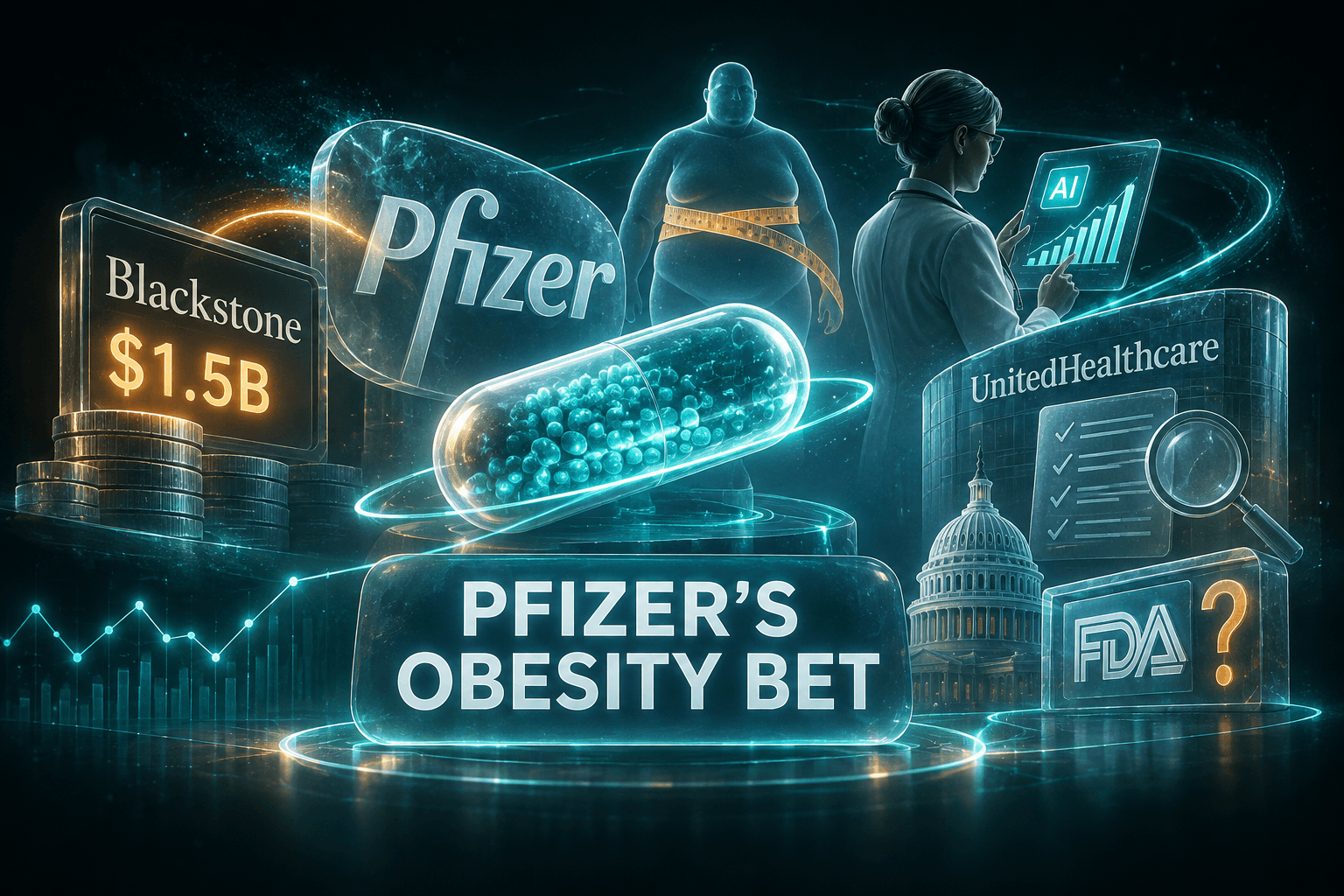
A $1.5 billion commitment from Blackstone to support Pfizer’s obesity-drug program was the day’s most consequential healthcare business development, putting a major financial backer behind a costly Phase 3 push. For investors, the deal highlights both the scale of competition in obesity treatments and the resources companies may need to advance candidates through late-stage testing.
But the rest of the day’s headlines offered no single direction for the sector. Physicians are using AI more often despite concerns, UnitedHealth’s review left questions about how coverage rules are applied, and leadership and policy uncertainty remain in view. What should you take from that mix? Selectivity matters, especially because the reports provided no stock-price moves or new clinical results.
Market Highlights
Today’s reports centered on financing, healthcare operations, and research rather than earnings or market performance. No share-price changes were included in the supplied coverage, so it isn’t possible to say how Pfizer (PFE), $BX, UnitedHealth Group (UNH), or $BMY traded in response.
- Blackstone committed $1.5 billion to support Pfizer’s Phase 3 program for a monthly obesity shot. Pfizer acquired the drug’s former owner, Metsera, last year in a deal valued at up to $10 billion.
- A survey cited by Healthcare Dive found that physician use of AI surged this year, including for reviewing medical literature and supporting clinical decisions. The report also noted concerns about accuracy and effects on less-experienced employees.
- UnitedHealth’s audit found minor issues in how UnitedHealthcare develops medical policies, but did not assess how the criteria are applied to care approvals or denials.
- Bristol Myers Squibb said research chief Robert Plenge is departing as the company reorganizes R&D. No financial impact or stock reaction was reported in the supplied story.
For your watchlist, the key distinction is between a large investment in a clinical program and proof that the treatment works. The Blackstone commitment supplies funding, but the reports don’t provide trial results or a regulatory outcome.
Key Developments
Blackstone backs Pfizer’s monthly obesity-drug program
Blackstone’s $1.5 billion commitment will help support Pfizer’s sprawling Phase 3 program for a monthly GLP-1 shot. Pfizer acquired Metsera, the drug’s previous owner, last year after a bidding contest, spending up to $10 billion. Bringing in an outside financial partner can help fund development, but the arrangement doesn’t remove the clinical and regulatory uncertainty that comes with a late-stage drug program.
For $PFE, the story reinforces the strategic importance of building an obesity-treatment pipeline, while also underscoring the cost of trying to compete in a fast-moving market. You’ll want to watch for disclosed trial milestones, program details, and any updates on how the financing is structured. The headline is a significant commitment, not evidence of efficacy or future sales.
AI adoption rises as insurer-policy questions persist
Physician use of AI has become more common in daily workflows, according to a new survey reported by Healthcare Dive. Clinicians are using the technology to review medical literature and inform clinical decisions, but respondents’ concerns about accuracy and the effect on newer employees point to implementation risks. Wider use may create opportunities for healthcare technology providers, although the report doesn’t identify specific companies, revenue figures, or measured clinical outcomes.
Separately, UnitedHealth’s review of UnitedHealthcare’s medical-policy development found minor issues but did not examine whether those policies were applied consistently when deciding coverage. That distinction is important: a review of how rules are written doesn’t resolve questions about how care is approved or denied in practice. For $UNH, scrutiny of coverage decisions remains a relevant issue to monitor, but the reported audit alone doesn’t establish how often denials were inappropriate.
Research advances and leadership shifts point to longer timelines
Bristol Myers Squibb is combining parts of its R&D organization as it seeks to speed development and make use of new technologies. Research chief Robert Plenge is leaving as part of that transition. The change could reshape how research is organized at $BMY, but the announcement doesn’t specify near-term product or financial effects. Investors will need to look for further detail on leadership responsibilities and whether the new structure changes development priorities.
Other stories focused on early-stage science and public health. Northwestern University engineers developed a rapid tuberculosis test intended to provide results in the field, while researchers reported a detailed map of the basal ganglia, a brain region linked to psychiatric and neurological disorders. A separate study examined how a protein guides cytoneme formation, helping cells deliver signals such as Sonic Hedgehog. These findings could inform future research, but the reports don’t establish when or whether they will lead to commercial products.
Medical Xpress also covered self-care habits that may ease anxiety and depression, while a STAT report raised questions about whether Heidi Overton will secure enough votes to lead the FDA and how Democrats may respond to RFK Jr. Those headlines broaden the day’s picture: healthcare includes emerging science and technology, but also access, public health, and policy questions that can shape the operating environment.
What to Watch
Tomorrow, focus on information that could clarify whether today’s headlines change business or clinical outlooks. For Pfizer, watch for details on the Phase 3 program, trial timing, and the terms or role of Blackstone’s funding. Clinical data and regulatory milestones will matter more to the drug’s prospects than the size of the financing commitment alone.
For $UNH, future disclosures about how medical-policy criteria are applied could address the gap left by the audit. For healthcare AI, look for evidence of adoption, accuracy, and workflow impact beyond survey responses. At $BMY, updates on the R&D reorganization may clarify who will lead research and how the company plans to measure progress.
Policy developments also merit attention, particularly confirmation prospects for the FDA leadership nominee. No specific vote date or outcome was provided in the reports, so avoid treating the uncertainty as a resolved change. More broadly, the tuberculosis test and brain research are worth tracking for follow-up validation and development, though their commercial timelines remain unclear.
Bottom Line
- Blackstone’s $1.5 billion commitment helps fund Pfizer’s Phase 3 obesity-drug program, but it is not a substitute for clinical evidence.
- Physician AI adoption is rising, while concerns about accuracy and workforce effects remain unresolved.
- UnitedHealthcare’s audit addressed policy development, not how coverage criteria are applied to approvals and denials.
- Bristol Myers’ R&D restructuring and FDA leadership uncertainty are developments to monitor for further detail.
- Today’s research reports are scientifically notable, but the coverage supplied no commercial milestones or market reaction data.
FAQ
Q: What was the biggest healthcare business development today? A: Blackstone committed $1.5 billion to support Pfizer’s Phase 3 program for a monthly obesity treatment.
Q: Did UnitedHealth’s audit settle questions about care denials? A: No. It reviewed medical-policy development but did not assess how the criteria were applied to approvals or denials.
Q: Were healthcare stock moves reported today? A: The supplied stories did not include share-price changes, so no specific market reaction can be confirmed.
This article is for informational purposes only and is not personalized investment advice.