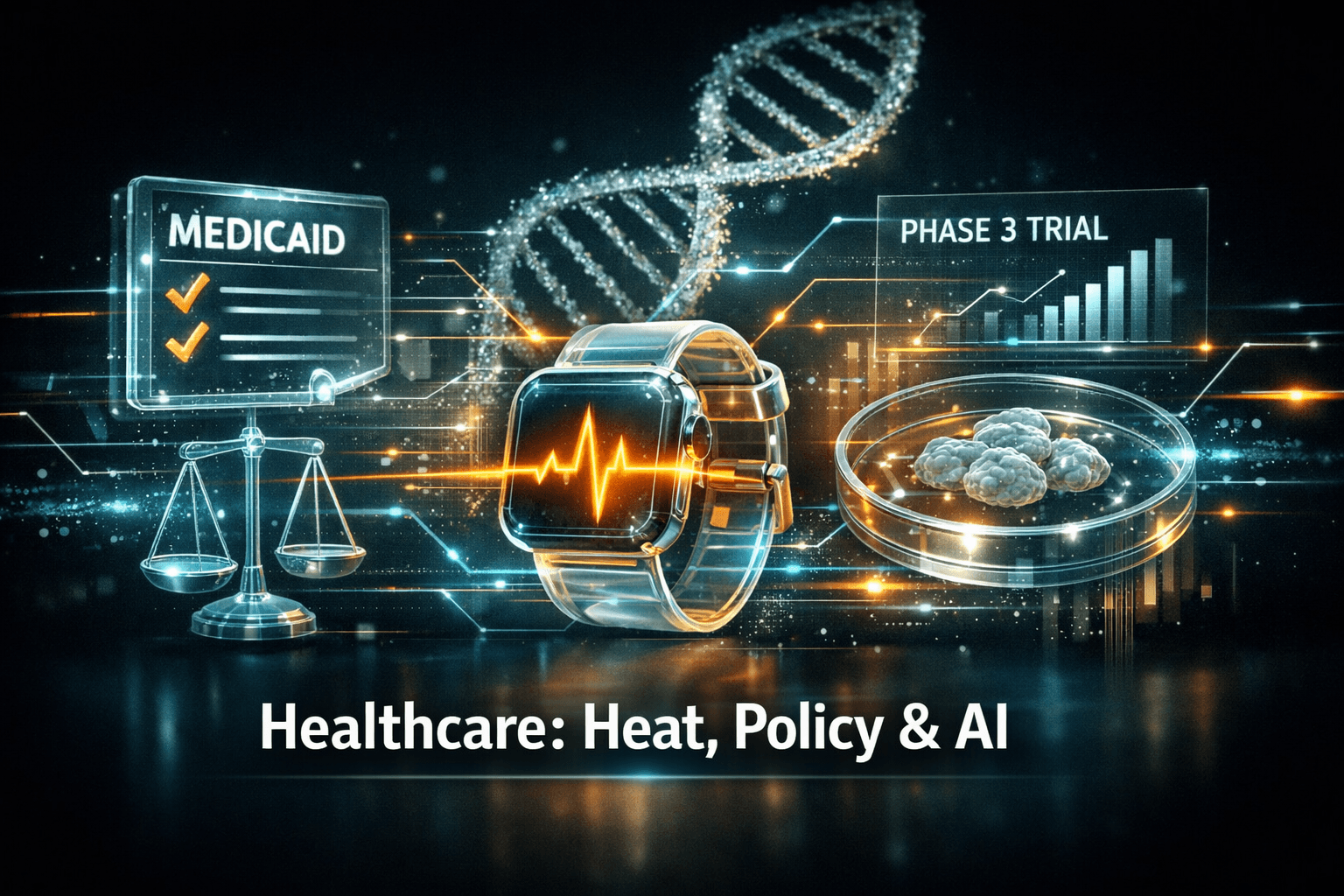
The Big Picture
Policy uncertainty and public-health research are colliding with new technology and clinical trial catalysts, leaving investors with mixed signals this morning. Federal and state-level moves on Medicaid work requirements could reshape payer and provider economics, while independent cardiovascular studies and AI-driven device research point to both growing demand and evolving risks in care delivery.
If you follow healthcare stocks or health policy, today’s headlines matter because they affect volume in hospitals, reimbursement flows for plans, and commercial opportunity for medtech and biopharma. You’ll want to balance near-term policy risk against longer-term product and data-driven growth.
Market Highlights
Key numbers and takeaways to scan quickly.
- Medicaid policy: A federal GOP bill is projected to reduce Medicaid spending by about $900 billion, and state rules are in flux as Georgia’s own work requirements may expire.
- Cardiovascular risks: New research links chronic hypertension before pregnancy to a 30% higher risk of critical congenital heart disease in newborns.
- Climate and admissions: ICU admissions for out-of-hospital cardiac arrest rose when daily temperatures exceeded 90 degrees Fahrenheit, with larger effects in women and older adults.
- AI and wearables: A study found AI analysis of cuff-based and wrist-worn device data could predict hypertensive crises up to three days in advance for people with stage 2 hypertension.
- Biopharma catalyst: Kymera Therapeutics, $KYMR, faces a mid-stage eczema readout that investors see as a potential attempt to rival Dupixent marketed by Regeneron Pharmaceuticals (REGN) and $SNY.
Key Developments
Medicaid work rules and policy uncertainty
Federal momentum for Medicaid work requirements and a high-profile GOP bill with deep spending cuts are creating uncertainty for health plans and providers that rely on stable Medicaid revenue. Georgia, the state that inspired these rules, may let its own requirements lapse, undercutting a model some policymakers have cited.
This is a policy story you should track because state-level variations will affect enrollment, utilization, and payer margins in different markets. How will plans adapt if eligibility rules change? Read between the lines when companies discuss state exposure in upcoming calls.
Cardiovascular studies highlight climate and maternal risks
Two independent presentations at American Heart Association meetings draw attention to systemic drivers of care demand. One study found chronic hypertension before or early in pregnancy raised the risk of critical congenital heart disease by about 30 percent compared with normotensive pregnancies. Another found ICU admissions for out-of-hospital cardiac arrest rose during heat above 90 degrees Fahrenheit, with stronger effects in women and older adults.
Those findings imply higher service needs in obstetrics and critical care during heat events and among specific populations. If you own or follow hospital-facing names, consider how seasonal weather patterns and maternal health trends could influence volumes.
Technology and R&D: AI wearables and a high-stakes eczema readout
Independent research suggests AI applied to cuff-based blood pressure monitors combined with wrist-worn data can flag a hypertensive crisis more than three days in advance in people with stage 2 hypertension. That points to commercial opportunities for remote monitoring providers and for digital therapeutics that link alerts to care pathways.
On the biotech front, Kymera Therapeutics, $KYMR, is preparing for a mid-stage eczema readout that investors and clinicians expect to be a make-or-break moment versus established biologics like Dupixent from $REGN and $SNY. That result will be a short-term catalyst and could shift competitive dynamics in dermatology depending on efficacy and safety data.
What to Watch
Focus on near-term catalysts and risks that could move stocks or alter strategy.
- Kymera mid-stage readout, timing and topline endpoints, and any secondary efficacy or safety detail. How will trial data stack up against Dupixent benchmarks?
- State-level decisions on Medicaid work requirements, and federal rule implementation. Changes in enrollment or eligibility could materially affect revenue for payers and safety-net providers.
- Regulatory path and commercial adoption for AI-enabled blood pressure monitoring. Look for FDA clearances, reimbursement codes, or pilot contracts with health systems.
- Seasonal heat risk, hospital capacity and ICU utilization metrics. Weather-driven admission spikes could raise short-term revenue but strain margins.
- Company commentary on exposure to Medicaid and on digital health strategy in upcoming earnings calls. Listen for discussions of exception volume, return rates, and capacity planning in payment operations.
Bottom Line
- Policy and politics are creating headwinds and regional winners in Medicaid markets, so watch state-level developments closely.
- Independent cardiovascular research signals rising clinical need for maternal and heat-related acute care, which could support demand for hospital services and monitoring tools.
- AI and wearable blood pressure monitoring show promise for early intervention, potentially reducing severe events and creating commercial opportunity for device and software vendors.
- A Kymera mid-stage readout is a clear near-term catalyst for biotech watchers, but outcome uncertainty means you should expect volatility around the result.
- Keep a selective approach and monitor earnings calls and regulatory updates for concrete signs of adoption or reimbursement shifts, because outcomes will vary by company and state.
FAQ Section
Q: What immediate financial impact could Medicaid work rules have on plans? A: Changes to eligibility or work requirements can reduce enrollment and utilization, lowering revenues for Medicaid-focused plans and shifting costs to other payers.
Q: How soon could AI wearables affect clinical outcomes for hypertension? A: Early research shows predictive signals up to three days before crisis events. Wider impact will depend on clinical validation, regulatory clearances, and payer reimbursement.
Q: Should I expect large market moves when Kymera reports results? A: Yes, mid-stage results could trigger substantial volatility, because the trial outcome will be viewed as a signal about competitive potential versus established therapies.