The Big Picture
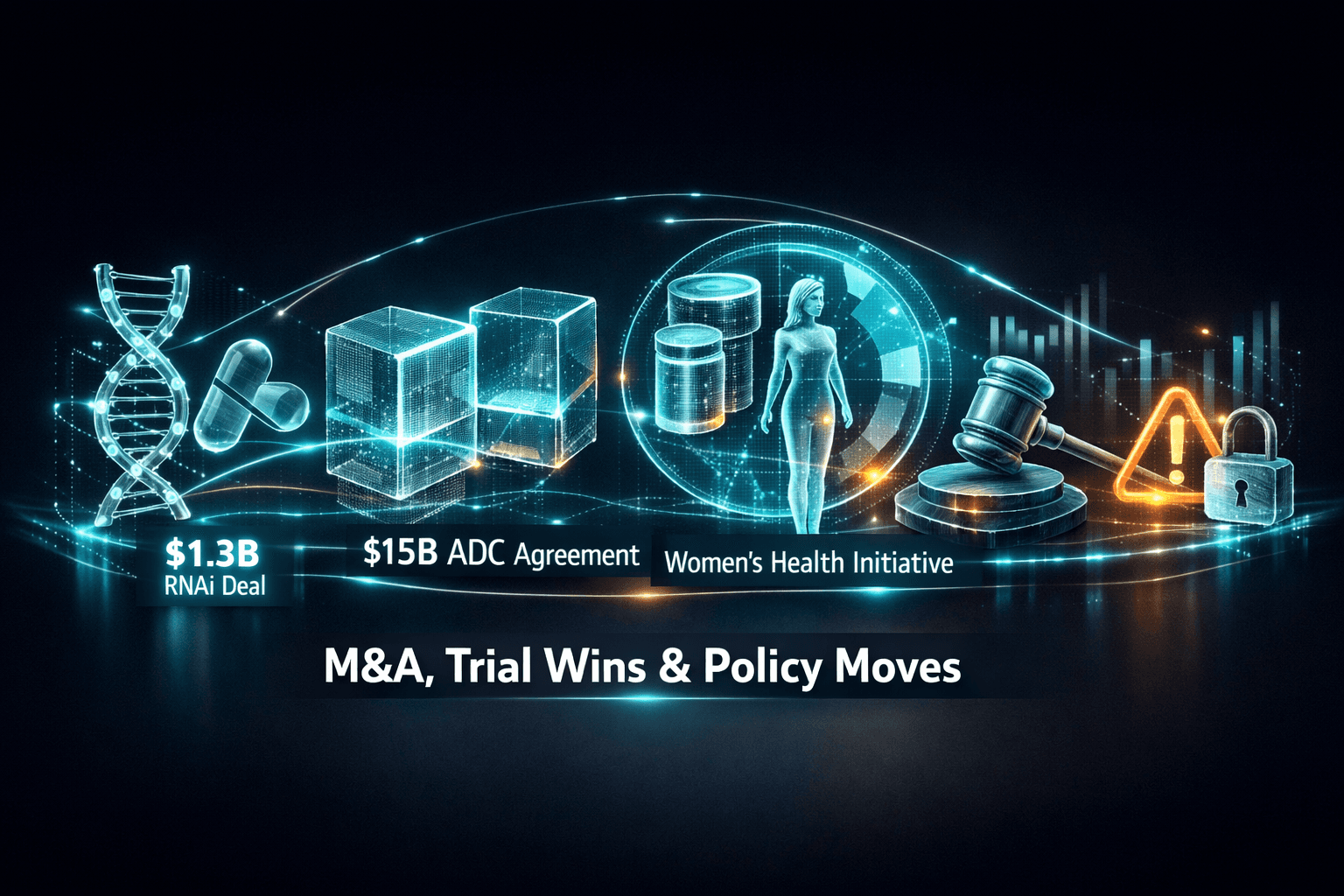
Dealmaking and clinical readouts dominated healthcare headlines today, giving the sector a tangible boost in momentum. Major buyouts and multi-billion dollar partnerships signaled strategic bets on RNA interference and antibody drug conjugates that could reshape mid-term pipelines.
At the same time, policy moves and access research kept the spotlight on regulatory and social drivers of healthcare demand, so you should care both about pipeline upside and evolving policy risk. What does this mean for your watchlist and exposure to biopharma names?
Market Highlights
Here are the quick facts and deal figures investors noted today.
- Merck KGaA agreed to acquire Silence for $1.3 billion, adding an RNAi program aimed at blood disorders that showed positive Phase 2 results.
- Roche struck a broad antibody drug conjugate collaboration with Hansoh in a deal valued at about $15 billion total, with $400 million up front; Roche trades OTC as $RHHBY.
- Disc, whose rare disease candidate was previously turned down by the FDA, reported positive Phase 3 data and plans to re-engage regulators for a second shot at approval.
- Ultragenyx sold a second priority review voucher, and Takeda remains a competitive presence in hematology and rare disease markets, noted in related coverage, $TAK.
- Clinical and real-world research headlines included a Mayo Clinic analysis linking GLP-1 receptor agonists to lower dialysis or transplant risk in bipolar patients with chronic kidney disease, and access research showing one in five pediatric cancer patients live more than 90 minutes from care centers.
- Major GLP-1 makers referenced in the broader story set include $NVO and $LLY, whose portfolio positions keep them central to weight and diabetes market dynamics.
Key Developments
Big Biopharma Deals Signal Strategic Shifts
Merck KGaA's roughly $1.3 billion purchase of Silence puts RNA interference back in the spotlight as a platform with near-term commercial potential in blood disorders. The deal underscores larger players' willingness to pay for modality leadership and late stage promise, and it may pressure peers to pursue complementary or defensive M&A.
Roche's expansive ADC pact with Hansoh, anchored by a $400 million up front payment inside a roughly $15 billion framework, highlights industry appetite for targeted oncology payloads. These moves suggest pipeline concentration around high-value modalities, and you might see continued interest in ADC and RNAi specialists.
Clinical and Regulatory: Second Chances and New Signals
Disc’s Phase 3 turnaround for a rare light-sensitivity condition gives the company a path back to regulators after an earlier FDA rejection. That kind of comeback can re-rate a small-cap biotech if regulators engage constructively, so follow the re-submission timeline closely.
Separately, Mayo Clinic researchers reported an association between GLP-1 receptor agonist use and lower risk of dialysis or transplant among adults with bipolar disorder and chronic kidney disease. The finding is observational, but it adds to the expanding narrative around GLP-1s beyond weight and glucose control, a story that keeps companies like $NVO and $LLY on investor radars.
Policy, Access and Legal Pressure Remain Important
The White House ordered the creation of a new NIH division and task force on women’s health, a policy move expected to channel research attention and possibly funding toward sex-specific conditions. That could open research partnerships and grant opportunities for clinical-stage firms focused on women's health.
At the same time, drugmakers asked to intervene in litigation over a 340B rebate pilot, while reporting showed long travel times can block pediatric cancer patients from out-of-state care. These items keep access and pricing squarely in play, and they’re likely to influence hospital and manufacturer dynamics going forward.
What to Watch
Expect M&A chatter to stay active, especially around RNAi, ADCs, and rare disease assets. Watch for regulator engagement dates after Disc’s Phase 3 announcement and for any FDA feedback on resubmissions. What regulatory signals will matter most to you?
Policy watchers should monitor implementation details for the NIH women’s health division, including potential grant programs and strategic research priorities. Legal updates on the 340B pilot and any court rulings could affect pricing and hospital margins, so keep an eye on filings.
Clinical evidence flow remains crucial, particularly real-world studies that expand GLP-1 use cases. You’ll want to track peer-reviewed publication dates and subsequent label or guideline conversations.
Bottom Line
- Deal activity and positive clinical data drove a constructive tone across healthcare today, pointing to near-term catalysts for biotech and pharma names.
- Policy initiatives, like the new NIH women’s health division, could redirect research dollars and partnership opportunities, while legal fights over 340B keep pricing risk elevated.
- Real-world evidence, including the GLP-1 kidney finding and access studies in pediatric oncology, will shape demand narratives beyond headline trial results.
- Watch regulatory engagement timelines and court filings for the next actionable signals, and expect M&A to remain a key driver of sector re-ratings.
FAQ Section
Q: How do these big deals affect biotech investors? A: Strategic acquisitions and large partnerships can re-price small and mid-cap biotechs, creating sector consolidation opportunities and spurring competing bids.
Q: Are the GLP-1 kidney findings enough to change clinical practice? A: The Mayo Clinic analysis is observational, so it points to a hypothesis that will need prospective trials and guideline consideration before practice changes.
Q: Will the new NIH women’s health division move the needle on funding? A: It has the potential to focus federal research priorities, but the impact will depend on budget allocations and program design over coming months.