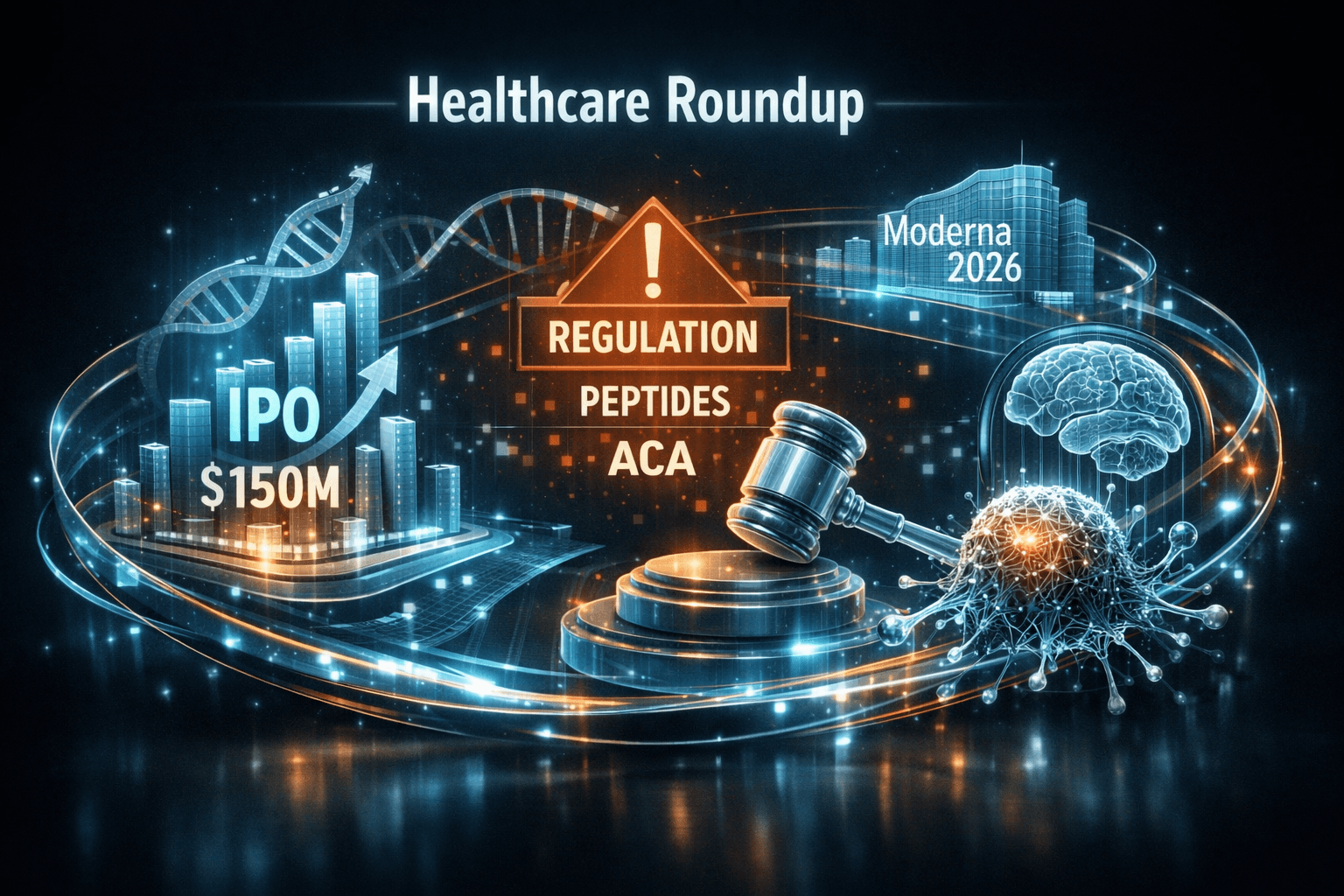
The Big Picture
Today the Healthcare sector saw a blend of commercial momentum, policy friction, and scientific progress that leaves investors parsing near-term winners from longer-term catalysts. You had an AI-driven drug company complete a $150 million IPO while regulators and trade groups squared off over policy changes that could reshape parts of the market.
That mix matters because it underscores how research breakthroughs, commercial activity, and regulatory moves are all driving valuation swings. If you're watching biotech and hospital services, you'll want to separate immediate market sentiment from the pipeline milestones that will matter months from now.
Market Highlights
Quick facts and market-moving items from today's Healthcare coverage.
- Iambic's IPO raised $150 million, highlighting investor interest in AI-enabled drug discovery and development, according to BioPharma Dive.
- Moderna's 2026 share run remained a focus of data coverage, with analysts and chart-watchers pointing to a sharp year-to-date gain as noted in BioPharma Dive's charts, putting $MRNA in the spotlight.
- Policy headlines kept volatility top of mind: the Trump administration's peptide initiative and a lawsuit from the National Association of Benefits and Insurance Professionals over an ACA broker freeze signaled regulatory uncertainty.
- Clinical and science stories showed progress, including molecular imaging work for HER2-positive breast cancer and new tumor metabolism research, both of which could influence biotech pipelines down the road.
- Healthcare cost management remained on the table, with CFO-focused guidance on controlling soaring health costs shared at a conference and summarized by Healthcare Dive.
Key Developments
Iambic IPO underscores AI interest in drug discovery
Iambic completed a $150 million IPO and its CEO discussed the roadshow and the role AI in drug R and D. The offering shows there's still capital available for companies combining machine learning with chemistry, even in a cautious market.
For you, that means AI-enabled biotechs will stay center stage for sentiment and late-stage deal activity. Analysts note the IPO could encourage similar listings, but they'll be watching whether post-IPO performance matches expectations.
Policy moves and legal fights add uncertainty
The administration's plan to allow certain compounding pharmacies to produce peptides drew attention as a potential growth pathway for peptide makers and compounding firms. At the same time, the National Association of Benefits and Insurance Professionals filed suit challenging an HHS decision to pause broker and agent activities related to ACA sign-ups.
These policy items raise questions about supply rules and distribution. What should you watch for next week? Expect commentary from HHS, further legal filings, and possible market reactions among specialty pharmacy and contract manufacturing names.
Scientific advances: imaging and tumor metabolism
A Yale-related study on the strength of food preferences highlights behavioral hurdles in changing eating habits, which is relevant for wellness, nutrition businesses, and providers pursuing prevention programs. More directly market-relevant research showed promise for 68Ga-HER2 PET CT imaging as an early indicator of complete pathologic response in HER2-positive breast cancer patients.
Separately, scientists probed how tumors manipulate amino acid metabolism to grow and blunt immune responses. These mechanistic insights are a double-edged sword for investors, they point to multiple new target classes but also imply longer and more complex clinical development paths for therapies targeting metabolism.
What to Watch
Focus on upcoming catalysts and risks that could move the sector in the near term.
- Earnings and guidance from mid-cap biotech names, which could reset sentiment for AI drug developers and platform companies after the Iambic IPO.
- Regulatory updates on the peptide policy and the NABIP lawsuit, both of which could change market access and distribution economics for specialty products.
- Clinical readouts or enrollment updates for HER2 imaging studies and metabolism-targeting oncology programs, because early surrogate markers could accelerate partnering discussions.
- Healthcare cost trends and payer responses, since employer-driven cost management strategies may alter demand for preventive and longevity services that hospitals are now exploring.
- Market technicals around leaders like $MRNA, which have driven sentiment for the broader biotech complex this year.
Remember, you should separate headlines from durable commercial outcomes. Can hospitals turn longevity clinics into reliable revenue streams? That depends on reimbursement, patient demand, and measurable outcomes over time.
Bottom Line
- Sector momentum is mixed: capital remains available for standout ideas, yet policy and legal risk add short-term uncertainty.
- Scientific advances in imaging and tumor metabolism create meaningful long-term catalysts, but those will play out over multiple quarters.
- Watch regulatory developments on peptides and ACA broker rules, because they can shift market access and distribution economics quickly.
- If you're tracking biotech sentiment, follow post-IPO performance and chart activity around leaders such as $MRNA for market direction cues.
- Be selective and time-sensitive, and keep your focus on upcoming clinical readouts and policy decisions that can change the story.
FAQ Section
Q: How could the peptide policy affect drug suppliers and compounding pharmacies? A: Allowing certain compounding pharmacies to produce peptides could expand supply channels and reduce costs for some therapies, analysts note, but it may also raise quality control and regulatory compliance questions.
Q: Will the imaging study for HER2 change clinical practice soon? A: The 68Ga-HER2 PET CT results are promising as an early marker, but the technique needs broader validation and regulatory clearance before meaningfully altering standard care or commercial opportunity timelines.
Q: What should I watch next week in Healthcare? A: Watch regulatory filings and legal updates on peptides and the ACA broker pause, plus any earnings or clinical updates from mid-cap biotechs, which could shift sentiment across the sector.