The Big Picture
Today’s biggest theme for healthcare investors was mixed signals. A large strategic deal and several promising clinical findings offered upside, but macro and biotech-specific risks kept sentiment in check.
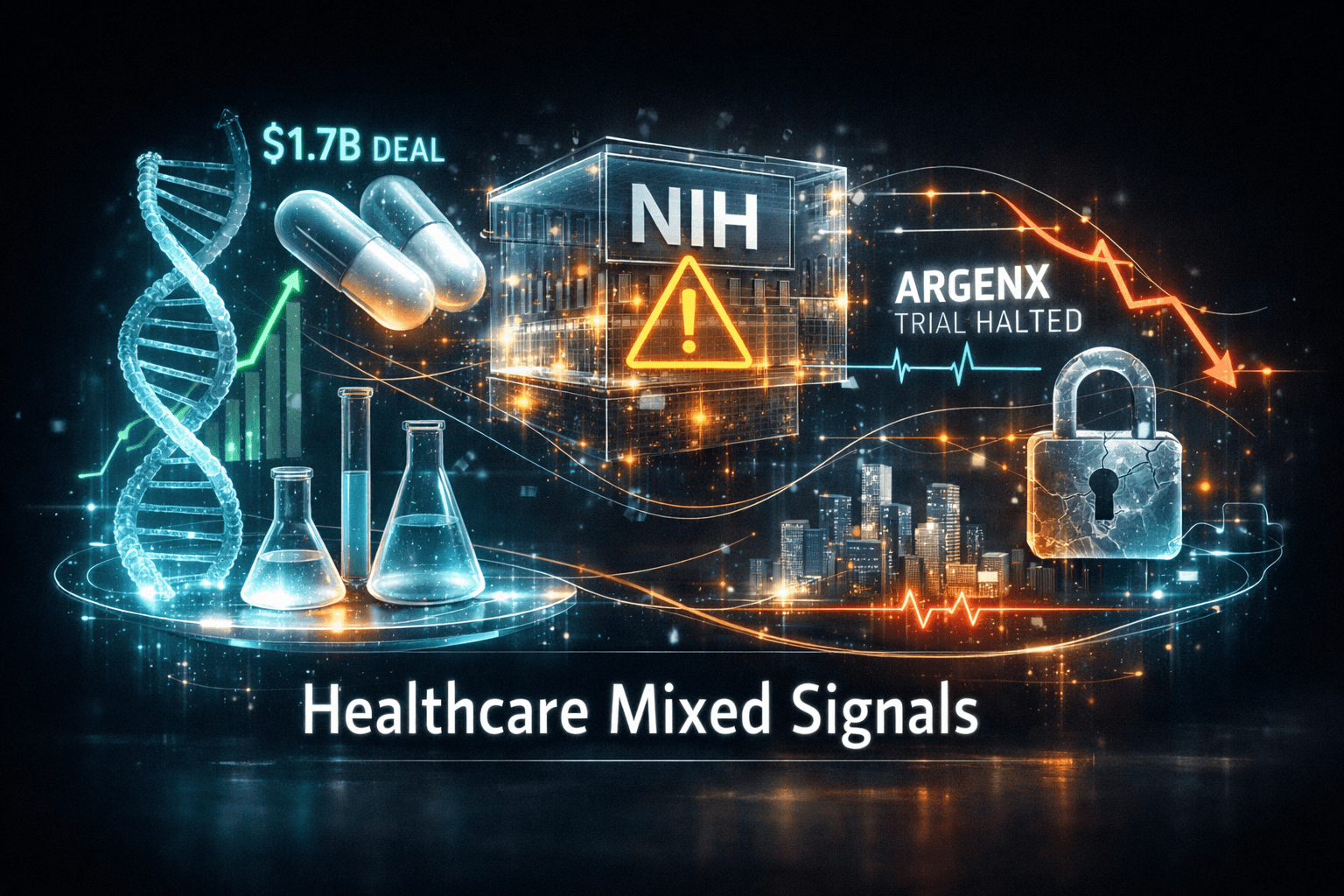
The $1.7 billion takeover of Pacira by Viatris grabbed headlines alongside fresh papers and conference findings. At the same time you had funding uncertainty at the NIH, a surprise clinical futility stop at Argenx, and warnings about quantum-era data risks that could hit provider balance sheets and compliance costs.
Market Highlights
- $VTRS agreed to acquire Pacira in a deal valued at $1.7 billion, adding two non-opioid pain assets that generated nearly $700 million in 2025.
- $ARGX shares dropped after an independent monitoring board recommended stopping a Sjögren’s study for futility, removing a potential label expansion for Vyvgart.
- Researchers showcased promising approaches at ASTRO and in lab studies, including low-dose radiotherapy for early knee osteoarthritis and strategies to reprogram tumor macrophages.
- Public health coverage reminded markets of scale, with obesity affecting about 4 in 10 U.S. adults, a long-term demand driver for chronic-care therapies and devices.
- Policy and security headlines signaled caution: NIH funding uncertainty left biotech investors gloomy and experts warned healthcare organisations are underprepared for quantum computing threats to patient data.
Key Developments
Viatris buys Pacira, strengthens pain portfolio
Viatris closed a $1.7 billion agreement to acquire Pacira, gaining two established non-opioid pain treatments that brought in nearly $700 million last year. For you that means short-term revenue lift for $VTRS, but analysts will be watching how Viatris defends IP as those drugs face looming patent exposure.
Clinical and scientific advances highlight selective upside
Two science-focused items stood out. At the ASTRO meeting researchers reported that low-dose radiotherapy may help early knee osteoarthritis, offering a noninvasive option that could change treatment pathways for some patients. In basic science, studies on reprogramming tumor-associated macrophages identified sugar-coated cell structures as potential targets to shift immune cells back into a cancer-fighting mode. These findings may underpin future drug development, but clinical translation takes time and capital.
Funding, regulatory and security headwinds
Talk of NIH funding uncertainty reverberated through the biotech community and contributed to risk-off sentiment among developers dependent on federal grants. You should note that when government funding is cloudy, early-stage research pipelines and small-cap valuations often feel the pressure. At the same time, experts warned that healthcare organisations are underprepared for quantum computing threats to encryption protecting patient data, which may force IT upgrades and higher compliance costs sooner than many boards expect.
Clinical setbacks and strategic restructuring
$ARGX faced a setback when a monitoring board recommended stopping a Sjögren’s study for futility, a development that removed an anticipated expansion for Vyvgart and pushed the stock lower. Separately, struggling cell therapy developer Caribou emerged as a likely reverse-merger target as it explores strategic alternatives, a sign of consolidation pressure in capital-intensive subsectors.
What to Watch
Keep an eye on NIH budget talks and any short-term funding resolutions because they will shape grant flows and sentiment for early-stage biotech. You should also monitor follow-up commentary from $VTRS about its Pacira integration plan and how it plans to manage patent risk and pricing.
Clinical catalysts matter: watch for additional readouts related to the macrophage-targeting approaches and any confirmatory data on low-dose radiotherapy after the ASTRO presentation. What will regulators say about direct-to-consumer AI health tools? Expect continued scrutiny and possible rulemaking that could affect startups selling predictive algorithms straight to patients.
Finally, cybersecurity budgets and migration plans to quantum-resistant encryption will become an operational focus for health systems and vendors. If you care about downstream costs, this is a risk to factor into vendor and hospital evaluations.
Bottom Line
- Today’s tape was mixed, with M&A and scientific progress offset by funding and trial setbacks; sentiment is neutral, not decisive.
- Big deal activity like $VTRS buying Pacira provides immediate revenue visibility, but patent risk and integration execution matter for long-term value.
- Clinical research at ASTRO and lab breakthroughs keep the innovation pipeline alive, though timelines to commercialization remain long.
- Policy, funding and cyber risks are active negatives to monitor, especially NIH appropriations and quantum-era encryption readiness.
- Be selective and watch near-term catalysts and trial readouts to see whether positive science and deal-making can sustainably outweigh the headwinds.
FAQ Section
Q: How should you interpret the Viatris purchase of Pacira? A: The deal adds near-term revenue and pain assets to $VTRS, but investors and analysts will closely watch how Viatris defends intellectual property and manages off-patent risk.
Q: Does the Argenx trial stop mean the drug is dead across indications? A: A futility stop in one trial removes that particular expansion opportunity, but it does not always negate efficacy in other indications; you should track company statements and any planned subgroup analyses.
Q: Should you worry about quantum threats to healthcare data now? A: Experts say you should start planning now because practical quantum computing could break current encryption later; this is an operational and compliance issue that will affect budgets and vendor selection.