The Big Picture
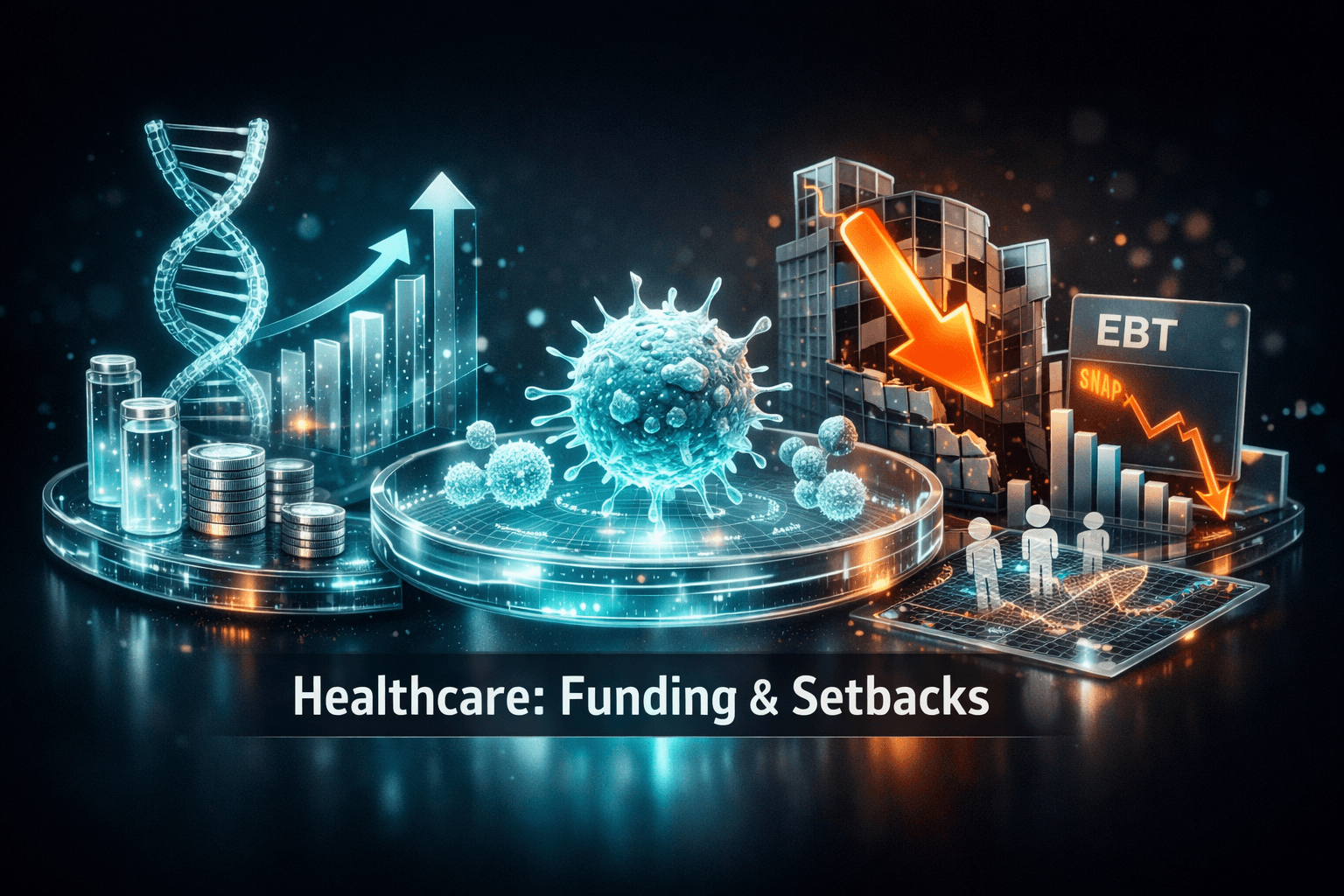
Today’s Healthcare coverage is a story of contrasts, with big capital flows and scientific progress offset by policy-driven pain and company failures. You’ll see positives like a $2.6 billion biotech fundraise and promising lab results, but you’ll also see setbacks including a CAR-T developer shutting down and steep declines in SNAP enrollment.
Why does this matter to you as an investor? Policy shifts and social trends can reshape demand and regulation, while funding cycles and clinical outcomes determine which biotech names get runway and which do not. Which forces will dominate in the near term is still unclear.
Market Highlights
Quick facts and numbers from overnight and early-morning healthcare news.
- Forbion raises $2.6 billion for two venture funds, marking its largest fundraise to date and signaling continued LP appetite for biotech venture capital.
- Caribou Biosciences is shutting down after failing to secure financing for a late-stage off-the-shelf CAR-T trial, illustrating financing risk for capital-intensive cell therapies.
- SNAP enrollment in Louisiana is down more than 20% year-over-year following rule changes under the One Big Beautiful Bill Act, raising food-security and policy concerns.
- Utah approved three new health AI pilots that could expand algorithmic care and drug management, advancing regulatory experimentation with clinical AI.
- Research updates: mtDNA levels link to tumor growth pathways, and a pilot trial suggests structured support may blunt weight regain after GLP-1 cessation.
Key Developments
Policy and Politics: Medicare for All, SNAP and Voter Pressure
Voter anger over rising private insurance costs is boosting support for Medicare for All proposals, according to KFF Health News. Democratic outreach to food security and environmental voters, coupled with sharp SNAP enrollment declines in places like Louisiana, is making access and affordability central themes in the midterms.
For you, that means policy risk is front and center. Which healthcare segments will face pricing pressure and which could see demand growth as coverage expands are critical questions to monitor going forward.
Biotech Funding and Setbacks: Forbion’s Raise and a CAR-T Shutdown
European investor Forbion closed two funds totalling $2.6 billion, a vote of confidence for growth-stage biotech and early-stage innovation funding. That fundraise could boost deal activity and exits in Europe, and it signals continued LP interest despite a tougher macro backdrop.
At the same time, Caribou Biosciences is winding down after failing to raise the capital needed for a late-stage CAR-T program. That failure highlights the capital intensity and fundraising risk for companies developing cell and gene therapies, even when the science is promising.
Innovation and Research: AI Pilots, mtDNA, GLP-1 Support and Rare Disease Access
Utah’s approval of three health AI pilots expands real-world experimentation with care plans and drug management that may operate with less human review. The pilots raise operational questions about oversight, liability and clinical workflow integration that regulators and providers will be watching closely.
On the science front, researchers linked mitochondrial DNA levels to tumor growth and chemo-related gene activity, offering potential biomarker or target leads. A small randomized pilot also suggests structured support may limit early weight regain after stopping GLP-1 therapy. Meanwhile, exon-skipping drugs for Duchenne muscular dystrophy continue to underscore access challenges, where treatment availability reaches only a select few.
What to Watch
Expect the policy calendar and funding flows to drive short-term headlines. Watch midterm outcomes and campaign messaging about coverage, because they could accelerate regulatory and reimbursement debates that affect insurers and large drugmakers.
From a capital markets angle, monitor venture and crossover fundraising, plus venture-backed biotech liquidity. Will firms emulate Forbion’s successful close, or will more cash-starved developers face the same fate as Caribou? You should also track regulatory developments around clinical AI pilots in Utah for potential spillover to other states.
Clinical readouts and trial financing remain key risk factors. Keep an eye on late-stage trial enrollments and sponsor cash positions for capital-intensive programs like CAR-Ts. And when thinking about market exposure, consider how changes to safety-net programs and food assistance could affect healthcare demand and social determinants of health.
Bottom Line
- Sentiment in healthcare is mixed, with strong capital commitments and scientific progress offset by company-level funding failures and policy-driven enrollment drops.
- Policy momentum around Medicare for All and SNAP changes raises regulatory and demand uncertainty that could affect insurers, hospitals and pharmaceutical pricing dynamics.
- Biotech fundraising, exemplified by Forbion’s $2.6 billion close, supports innovation but does not eliminate financing risk for capital-heavy programs like CAR-T.
- Innovation signals are positive, from mtDNA research to GLP-1 support strategies, yet access and cost remain central themes for rare and specialty therapies.
- Watch midterm results, AI pilot outcomes from Utah, and clinical financing updates for signs of which direction the sector will lean next.
FAQ Section
Q: How could Medicare for All momentum affect healthcare companies? A: Increased political support can pressure pricing and reimbursement policy and may shift demand toward public coverage with implications for insurers, hospitals and drugmakers.
Q: What does Caribou’s shutdown tell investors about biotech risk? A: It highlights that late-stage trials for cell therapies are capital intensive, and funding shortfalls can force program or company closures despite prior scientific promise.
Q: Should you expect AI pilots in one state to become nationwide quickly? A: Not necessarily, pilots inform regulators and providers, but broader adoption will depend on demonstrated safety, oversight frameworks and reimbursement clarity.