The Big Picture
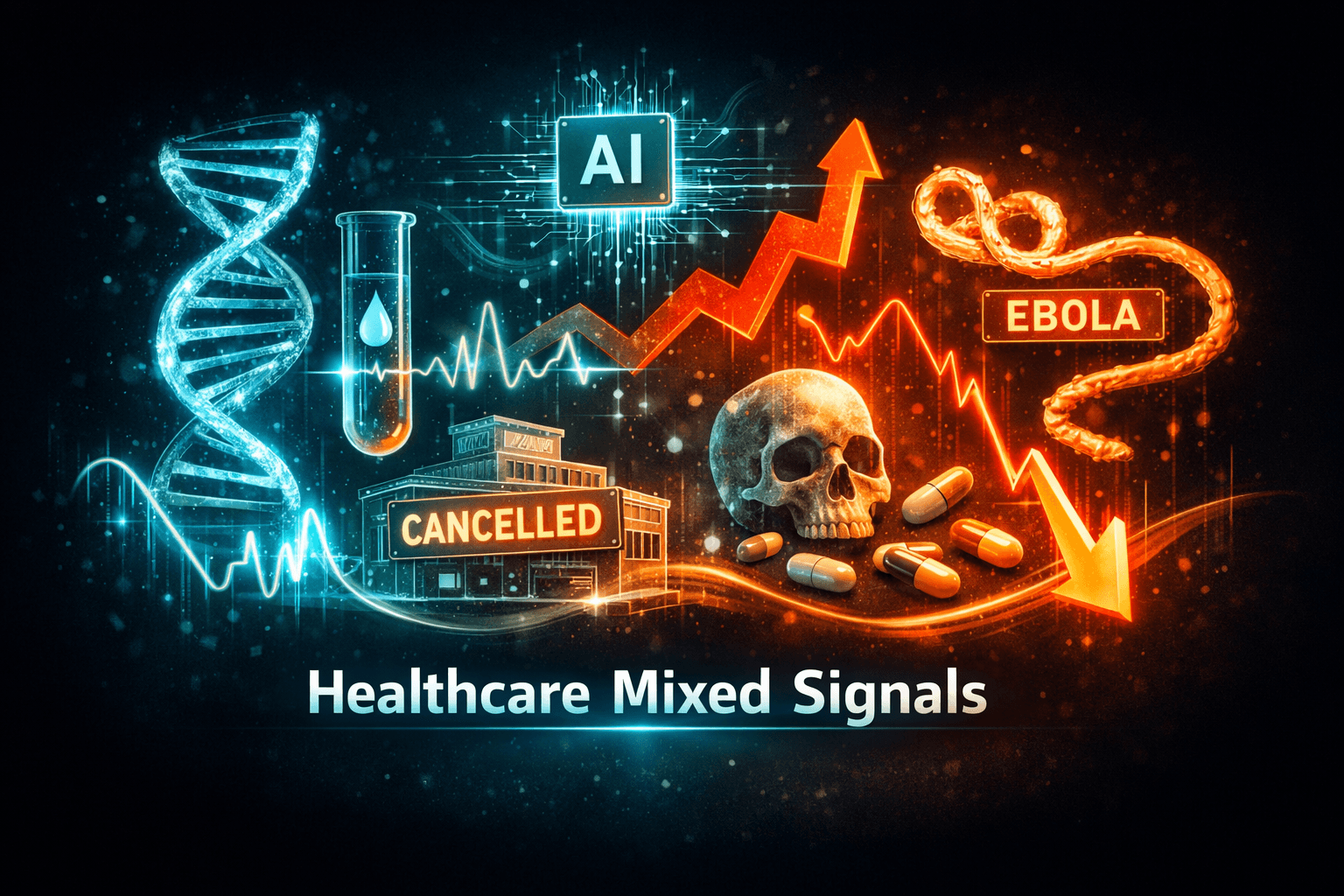
Today the healthcare sector sent mixed signals to markets and to you as an investor. Scientific advances and corporate efficiency moves were offset by mounting public health pressures and a notable biotech program cancellation.
Why does that matter to you? Progress in diagnostics and hospital AI governance can support long term productivity and margins, while outbreaks and worsening drug harms can pressure utilization, costs, and investor sentiment in the near term.
Market Highlights
Key facts and moves from today, presented for quick digestion.
- Diagnostics: Australian reporting highlighted the arrival of new blood tests for Alzheimer’s disease, a development that could reshape early detection and referral flows for dementia care.
- Public health: Ebola has now killed more than 1,700 people in eastern Congo in the fastest growing outbreak reported, elevating global infectious disease risk and humanitarian strain.
- Substances crisis: Australian data from NDARC shows over 2,000 drug‑related deaths in 2024, about 5.5 deaths per day, and nearly 57,000 drug‑related hospitalizations, a 10.5% increase year over year.
- Big pharma and costs: $PFE expanded a multibillion dollar cost cutting plan, announcing $1 billion in new reductions and an additional $1.5 billion expected from drug production streamlining.
- Biotech headlines: Analysts flagged a potential overhang for $VRTX after strong earnings, citing upcoming cystic fibrosis data from rival Sionna Therapeutics. Separately, a small CRISPR startup abruptly scrapped plans to scale custom gene editors amid FDA standards concerns, a reminder of regulatory hurdles.
Key Developments
Diagnostics and basic science advances
Reports from Australia on new blood tests for Alzheimer’s are getting attention because they could enable earlier, less invasive screening. For you, that means diagnostics companies and testing labs may see new referral volumes if clinicians adopt the assays, but reimbursement and clinical workflows will determine the pace.
On the research front, University of Oklahoma scientists described how aggressive breast tumors recruit nerves via immune pathways to fuel growth. Discoveries like this often seed new therapeutic approaches, and they underline the long research runway for oncology innovators.
Public health pressures: overdose surge and Ebola
Data from NDARC points to a sharp rise in harms from amphetamines and cocaine, with a 10.5% jump in hospitalizations and more than 2,000 overdose deaths in 2024. At the same time, Ebola in eastern Congo has claimed over 1,700 lives as the outbreak accelerates. These trends create immediate operational and reputational pressures on health systems, and they can increase demand for acute care services even as payer mixes shift.
Industry structure: cost cuts, competition, and regulatory limits
$PFE's expanded cost cutting plan signals continued focus on margin preservation, with $1 billion in new reductions and $1.5 billion from production streamlining. That kind of announced savings can support earnings, but it also raises questions about where cuts land and how R&D will be prioritized.
Meanwhile, Vertex $VRTX delivered another solid quarter, yet analysts warned that upcoming cystic fibrosis data from much smaller rivals could change the competitive landscape. And a startup aiming to scale custom CRISPR therapies walked back its program after finding FDA expectations difficult to meet, highlighting regulatory risk for personalized gene editing.
What to Watch
Here are the catalysts and risks to track into tomorrow and beyond, so you can stay informed.
- Regulatory signals: Watch for FDA commentary or guidance on personalized gene therapies and on the standards that led the CRISPR startup to scrap plans. How will regulators balance flexibility with safety?
- Data readouts: Keep an eye on cystic fibrosis data from Sionna and other small biotech players, which analysts say could affect $VRTX sentiment and competitive dynamics.
- Public health developments: Monitor Ebola containment measures in Congo and follow NDARC or local health updates on stimulant related harms. Rising caseloads or hospital strain can change utilization patterns quickly.
- Hospital finances and policy: As more patients lose ACA enhanced subsidies, hospitals report worsening payer mixes. You should track quarterly results from hospital systems and any policy moves to restore coverage or provide relief.
- Adoption hurdles for Alzheimer’s blood tests: Look for guidelines from neurology societies, reimbursement decisions by payers, and initial adoption data from clinics. Those will determine commercial potential.
Bottom Line
- News today was a mixed bag, with diagnostics and AI governance progress balanced by serious public health and regulatory setbacks.
- $PFE's expanded cost cuts add near term margin support, but competitive data and R&D decisions remain key long term.
- Public health trends, notably rising stimulant harms and the Ebola surge, are immediate downside risks for hospital operations and system capacity.
- Biotech remains high reward and high risk, as shown by strong earnings at some names and abrupt program changes at others.
- As always, analysts note that you should watch upcoming data readouts, regulatory updates, and payer moves to get clearer direction for the sector.
FAQ Section
Q: What does the arrival of Alzheimer’s blood tests mean for diagnostics companies? A: Earlier, less invasive tests can expand screening and referral, but reimbursement and clinical guideline adoption will determine the revenue opportunity.
Q: How could rising overdose deaths affect hospital finances? A: More overdose cases increase acute care demand and costs, and if payer mixes worsen because more patients lack insurance, hospital margins can come under pressure.
Q: Should regulatory pushback on gene‑editing scale up change my view of biotech risk? A: The episode highlights that regulatory expectations can curtail ambitious programs, so tracking FDA guidance and firm level disclosure is vital to assessing development risk.